Renter holding a leashed medium-size dog at an apartment doorway while a neighbor stands outside, with soft natural light and a blurred interior background.

Your Renter’s Insurance Won’t Cover This Pet Incident (Here’s What Will)

Your furry companion might be your best friend, but one bite, scratch, or knock-down could leave you facing thousands in liability claims—and here’s the problem: most renters insurance policies cap pet-related incident coverage at significantly lower limits than standard liability protection, or exclude certain breeds entirely.
Pet liability insurance bridges this critical gap. When your dog injures a neighbor, damages someone else’s property, or causes an accident that leads to medical bills, this specialized coverage protects your finances from lawsuits and medical expense claims that routinely exceed $30,000. …

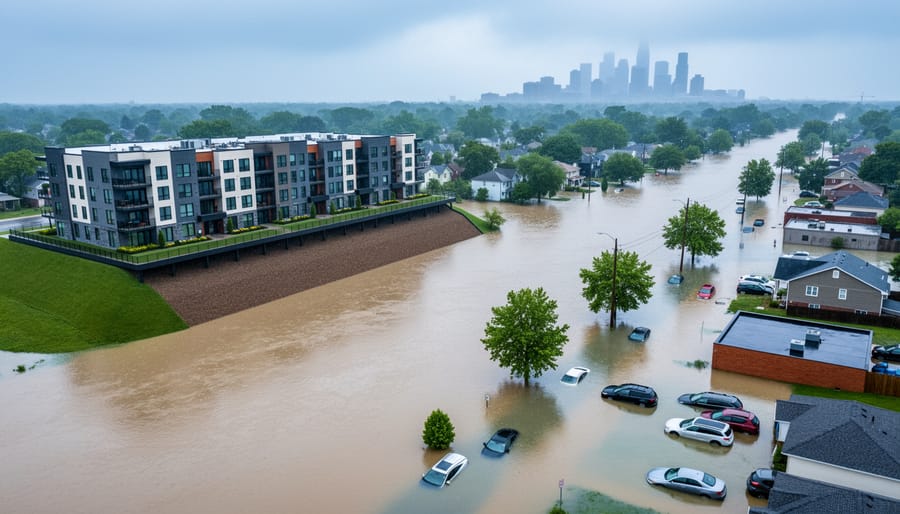
Homeowner in boots placing sandbags at a suburban home’s front step as shallow floodwater reaches the driveway, with a neighbor across the street installing flood barriers on an overcast day.

How Behavioral Science Could Save Your Property from the Next Flood

Recognize that homeowners consistently underestimate their flood risk by 80%, creating a dangerous gap between actual vulnerability and protective action. Research published in leading behavioral science journals reveals three cognitive biases blocking flood mitigation: optimism bias (believing disasters happen to others), present bias (prioritizing immediate costs over future losses), and status quo bias (defaulting to inaction despite known risks).
Frame flood insurance and mitigation as financial protection strategies rather than disaster preparation. Property owners respond more favorably when presented with concrete dollar …

Two investors and a construction manager study blueprints at golden hour in front of a mid-rise apartment building under renovation with scaffolding, workers, lift equipment, and a debris dumpster.

How Distressed Real Estate Funds Turn Your Problem Property Into Profit

Identify distressed properties trading at significant discounts—typically 30-50% below market value—by monitoring foreclosure listings, bank REO portfolios, and properties with delinquent taxes or liens. These opportunities multiply during economic downturns when property owners face financial hardship, creating prime acquisition windows for specialized investment funds.
Target properties with clear value-add potential rather than fundamentally flawed assets. Focus on well-located properties suffering from management issues, deferred maintenance, or temporary market dislocations that can be resolved through capital injection and…

Building inspector and contractor in hard hats examine a storm-damaged suburban house with exposed framing, hurricane straps, and sprinkler piping, under bright overcast light; neighboring homes and scaffolding visible in the background.

Why Building Code Violations Could Leave You Without Insurance After a Disaster

Understand that violating disaster preparedness regulations means your property fails to meet current building codes, fire safety standards, or zoning requirements—a gap that can leave you financially exposed when disaster strikes. Your standard homeowners insurance typically covers only the replacement value of your damaged property as it existed, not the potentially astronomical costs of bringing non-compliant structures up to code during rebuilding.
Review your property immediately for common violations: outdated electrical systems, inadequate fire suppression equipment, substandard roofing materials in hurricane zones, or …

Homeowner’s hands sign a sworn proof of loss form on a wooden table with a notary embosser, calculator, and receipts; soft side daylight; blurred background shows plastic-covered home repairs and an adjuster’s clipboard.

How a Sworn Proof of Loss Form Can Make or Break Your Insurance Claim

A property claim denial or underpayment can cost you thousands of dollars, and the sworn proof of loss form stands as your most powerful legal tool to prevent that outcome. This notarized document serves as your formal, legally binding statement of damages submitted to your insurance carrier, and errors or omissions on this form routinely lead to claim rejections or reduced settlements that leave property owners absorbing losses they’re entitled to recover.
The stakes are particularly high because insurance companies use the sworn proof of loss as the foundation for their investigation and settlement calculations. Once you …

Homeowner, appraiser, and insurance adjuster meet at a kitchen table with roofing materials and a calculator, reviewing repair estimates, with a storm-damaged roof visible outside through the window in soft natural light.

When Your Insurance Company Won’t Pay: How the Appraisal Clause Saves Your Claim

Recognize when your insurance company’s settlement offer falls significantly short of your property damage costs—this gap signals it’s time to invoke your appraisal clause. This contractual provision, embedded in most property insurance policies, offers a powerful alternative to lengthy litigation when you and your insurer disagree on claim values but agree coverage exists.
Document your position by obtaining independent repair estimates from licensed contractors, creating a paper trail that supports your valuation before formally triggering the appraisal process. Send written notice to your insurance company citing …

Over-the-shoulder view of an escrow officer’s hand hovering over a smartphone and keyboard next to house keys and a model home, while a laptop shows a subtly glitched video-call executive in a dim conference room.

How Deepfake Frauds Could Steal Your Home Before Closing Day

A deepfake video shows your company’s CEO authorizing a $2.4 million wire transfer during a property closing. The voice matches perfectly. The mannerisms are identical. Your escrow officer processes the payment without hesitation—and the funds vanish into an untraceable account within minutes. This isn’t a hypothetical scenario from a cybersecurity thriller. It happened to a Hong Kong-based real estate firm in 2024, and similar artificial intelligence-powered fraud attempts have surged by 3,000% in the past eighteen months alone.
Deepfake technology has evolved from a novelty into a sophisticated weapon that criminals …

Homeowner shaking hands with an insurance agent in front of a modern house with rooftop solar panels, a small backyard wind turbine, and a heat pump unit at golden hour.

How Clean Energy Incentives Can Slash Your Home Insurance Costs

Leverage insurance premium reductions of 5-20% by documenting your solar panels, wind turbines, or geothermal systems with your home insurance provider before your policy renewal date. Most carriers offer immediate discounts when you submit proof of renewable energy installation through their online portals or mobile apps, yet fewer than 15% of eligible homeowners actually claim these savings.
Stack multiple incentive layers to maximize returns on your clean energy investment. Beyond federal tax credits, insurance-specific programs provide cash-back rebates, deductible waivers for storm damage to renewable equipment, and enhanced …

Modern coastal house with metal roof, impact-resistant windows, a deployed flood barrier at the front entry, permeable paver driveway, and elevated HVAC and standby generator, photographed after rain with breaking storm clouds in the distance.

How Climate-Resilient Infrastructure Protects Your Property Investment (And Your Wallet)

Fortify your property against extreme weather by upgrading roofing systems to withstand 130+ mph winds, installing flood barriers rated for 500-year events, and elevating critical building systems above projected flood zones—measures that can reduce insurance premiums by 15-45% while protecting your investment from climate-related losses. These improvements aren’t just protective barriers; they’re financial instruments that lower risk profiles and unlock better coverage terms.
Integrate impact-resistant windows, permeable hardscaping, and emergency power systems into your property infrastructure to meet insurance …

Environmental insurance broker wearing a hard hat consults with a real estate investor at a brick apartment building during a site assessment, reviewing a tablet while a soil drilling rig and traffic cones are softly blurred in the background at golden hour.

Why Your Investment Property Needs an Environmental Insurance Broker (Before It’s Too Late)

Environmental liabilities hiding in your investment property can cost hundreds of thousands in cleanup expenses, legal fees, and lost rental income—yet most real estate investors remain dangerously underinsured against these risks. An environmental insurance broker specializes in identifying pollution exposures specific to property investments and securing coverage that standard commercial policies exclude or severely limit.
Unlike traditional insurance agents who handle basic property coverage, environmental insurance brokers possess deep expertise in assessing contamination risks from underground storage tanks, asbestos, lead …