
Property insurance premiums have climbed 33% nationally over the past five years, but a technological revolution happening at the intersection of artificial intelligence and real estate is poised to reverse this trend. Edge insurance—the strategic use of Edge AI systems deployed directly on properties to monitor, predict, and prevent insurable risks—represents the next frontier in property protection and cost reduction.
Unlike cloud-based monitoring systems that process data remotely, Edge AI operates in real-time at your property’s physical location. Smart sensors detect water leaks before they cause catastrophic damage, thermal cameras identify electrical anomalies days before fires start, and predictive algorithms alert you to structural vulnerabilities during their earliest stages. This immediate, on-site intelligence transforms properties from passive assets into proactive risk management systems.
The financial implications are substantial. Early adopters report insurance premium reductions of 15-25% within the first year of implementation, alongside dramatic decreases in claim frequency and severity. More importantly, insurers are beginning to recognize Edge AI-equipped properties as preferred risks, offering dedicated policy discounts and enhanced coverage terms.
For real estate professionals managing portfolios, property owners seeking to protect their investments, and investors evaluating risk profiles, understanding edge insurance isn’t optional—it’s becoming essential. The gap between properties leveraging this technology and those operating without it will only widen as insurers increasingly price policies based on demonstrable risk mitigation capabilities rather than historical data alone.
What Is Edge AI and Why Does It Matter for Real Estate Insurance?
The Technology Behind Edge AI
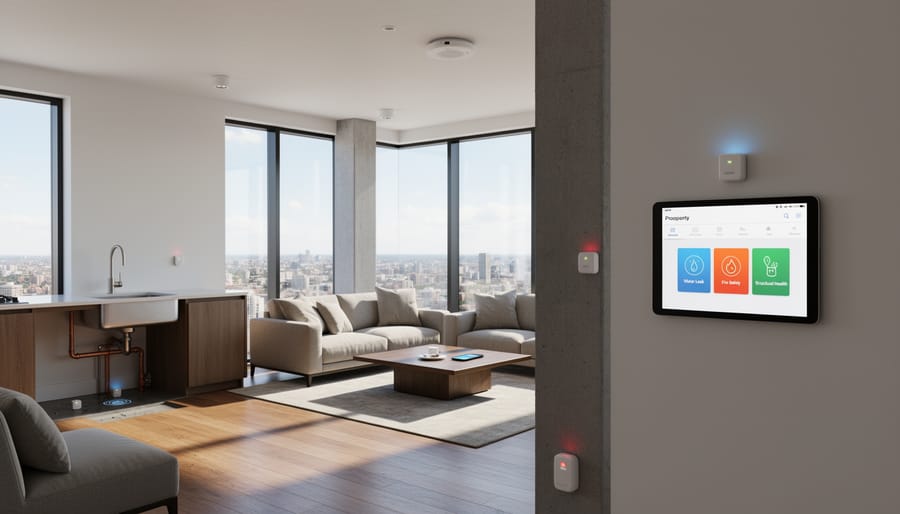
Edge AI represents a fundamental shift in how technology processes information for property protection. Unlike traditional cloud-based systems that send data to remote servers for analysis, Edge AI performs computations directly on local devices—think security cameras, smoke detectors, or water sensors installed in your property. This means when a sensor detects unusual activity or a potential risk, it analyzes that information instantly on-site rather than transmitting it elsewhere first.
The advantages for real estate insurance are significant. Processing data locally dramatically reduces response times from seconds to milliseconds, allowing immediate alerts for threats like water leaks or unauthorized entry. It also enhances security since sensitive property data remains on your premises rather than traveling through internet connections where it could be intercepted. Additionally, Edge AI reduces bandwidth requirements and continues functioning even during internet outages—critical when protecting valuable assets.
For property owners and real estate professionals, this technology works seamlessly with smart sensors revolutionizing insurance to create proactive protection systems. These devices learn your property’s normal patterns and can distinguish between genuine threats and false alarms, providing insurers with reliable risk data that can translate directly into premium reductions.
Why Real Estate Insurance Needs This Innovation Now
The real estate insurance landscape is facing a perfect storm of challenges that traditional methods simply weren’t designed to handle. Over the past five years, property insurance premiums have skyrocketed by an average of 30-40% in many markets, with climate-vulnerable regions seeing even steeper increases. The culprit? Increasingly severe weather events, from hurricanes and floods to wildfires, are forcing insurers to reassess risk at unprecedented scales.
Here’s the problem: conventional insurance assessments rely heavily on historical data, periodic inspections, and broad geographic categorizations. This means two identical homes on the same street might carry the same premium, even if one has a leaky roof and outdated electrical systems while the other is meticulously maintained. This one-size-fits-all approach leaves property owners overpaying for coverage while insurers struggle with unexpected claims.
The inadequacy becomes even more apparent when you consider that most properties are only physically inspected once every few years, if at all. In this gap, critical risks develop unnoticed until they result in costly claims. The industry needs a smarter, more dynamic approach that can monitor property conditions in real-time, catch problems early, and reward proactive maintenance with lower premiums.
Real-Time Risk Detection: The Game-Changer Property Owners Need
Smart Sensors and IoT Integration
Edge AI transforms ordinary property features into intelligent guardians through smart sensors that continuously monitor your real estate investment. These compact devices, strategically placed throughout a property, work around the clock to detect potential hazards before they escalate into costly insurance claims.
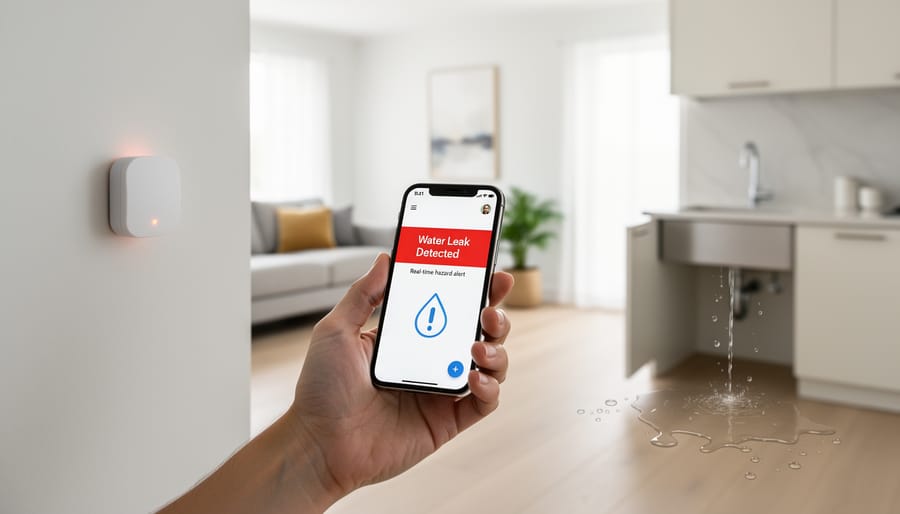
Water leak sensors represent one of the most valuable applications. Placed near water heaters, under sinks, and in basements, these devices use machine learning algorithms to distinguish between normal moisture levels and actual leaks. When anomalies are detected, the system sends instant alerts to property owners and can even trigger automatic water shutoff valves, preventing thousands of dollars in damage. Insurance companies increasingly recognize this proactive approach, often reducing premiums for properties equipped with these systems.
Fire and smoke detection has evolved far beyond traditional alarms. Edge AI-powered sensors analyze air quality patterns, temperature fluctuations, and even recognize unusual heat signatures that might indicate electrical issues before flames appear. This predictive capability aligns perfectly with AI predictive analytics used by modern insurers to assess risk more accurately.
Structural monitoring sensors detect foundation shifts, wall cracks, or roof deterioration by measuring minute changes over time. Meanwhile, security sensors track unauthorized entry, unusual movement patterns, or potential break-in attempts. The key advantage of Edge AI is that all this processing happens locally on the device itself, ensuring rapid response times without relying on cloud connectivity. For property owners, this means comprehensive protection that not only safeguards their investment but also demonstrates to insurers a commitment to risk mitigation.
From Detection to Prevention
The real power of edge insurance lies in its ability to catch problems early, transforming reactive insurance claims into proactive risk management. Think of it as the difference between detecting smoke versus fighting a fully-engulfed fire.
Consider a small water leak under a kitchen sink. Traditional insurance processes mean this might go undetected for weeks or months until significant damage appears. By then, you’re looking at a major claim involving water damage, mold remediation, structural repairs, and possibly even temporary relocation costs. With edge AI sensors monitoring moisture levels, you receive an instant alert the moment unusual moisture appears. A quick call to a plumber costs a few hundred dollars instead of a multi-thousand-dollar insurance claim.
The same principle applies to HVAC systems showing early signs of malfunction. Edge sensors detect irregular temperature patterns or inefficient cycling, prompting maintenance before a complete breakdown occurs during a heatwave. What could have been an emergency repair plus potential property damage from extreme temperatures becomes routine preventive maintenance.
For property investors and landlords, this detection-to-prevention model offers particularly compelling advantages. Vacant properties equipped with edge monitoring systems can alert you to unauthorized entry, heating failures in freezing weather, or burst pipes within minutes rather than days. Each prevented incident not only saves immediate costs but also preserves your claims history, keeping insurance premiums lower over time. This proactive approach fundamentally changes the insurance relationship from damage compensation to risk elimination.
Lower Premiums Through Proactive Risk Management
How Insurers Price Edge AI-Enabled Properties
Insurers calculate edge AI premium discounts by measuring specific risk reduction metrics that demonstrate real-world safety improvements. The most influential factor is claims prevention data—properties with edge AI systems that detect water leaks, fire hazards, or security breaches before damage occurs typically qualify for 5-15% premium reductions, similar to how smart home devices reducing premiums has already transformed the insurance landscape.
Response time metrics also matter significantly. Insurers reward properties where edge AI systems notify owners within seconds of detecting threats, reducing potential claim severity. A leak detected in 30 seconds versus 30 minutes can mean the difference between a minor repair and major structural damage.
Maintenance compliance tracking provides another pricing advantage. Edge AI systems that log HVAC servicing, roof inspections, and electrical system checks demonstrate proactive risk management—exactly what underwriters want to see. Properties with documented maintenance histories may receive additional 3-8% discounts.
Finally, insurers examine the system’s operational uptime and redundancy. Edge AI that functions locally without internet dependency proves more reliable than cloud-dependent systems, translating to more consistent protection and better pricing. The combination of these metrics creates a comprehensive risk profile that justifies substantial premium reductions while giving property owners tangible financial benefits.
Documented Case Studies and Savings
Real-world implementations of Edge AI technology are already delivering measurable insurance savings for property owners. A commercial property management firm in Chicago implemented Edge AI water leak detection systems across 40 buildings and negotiated a 22% reduction in their annual insurance premiums. The system’s ability to detect leaks within seconds and automatically shut off water supply convinced insurers to reclassify their risk profile.
In California, a luxury residential complex reduced fire insurance costs by 18% after installing Edge AI-powered smoke and heat detection systems. The technology’s predictive capabilities identified potential fire hazards before incidents occurred, resulting in zero fire-related claims over three years.
A mixed-use development in Miami saw even more dramatic results. By deploying comprehensive Edge AI monitoring for security, environmental hazards, and structural integrity, they achieved a combined 27% reduction in multiple coverage areas. Their insurer specifically cited the real-time threat detection and immediate response capabilities as justification for the premium adjustment.
These documented cases demonstrate that Edge AI implementation typically pays for itself within 18 to 36 months through insurance savings alone, not counting the additional benefits of reduced damage claims and improved property values. Early adopters are positioning themselves to capture the most significant advantages as insurers increasingly factor smart technology into their underwriting models.
Specific Applications Transforming Property Insurance
Weather and Climate Risk Monitoring
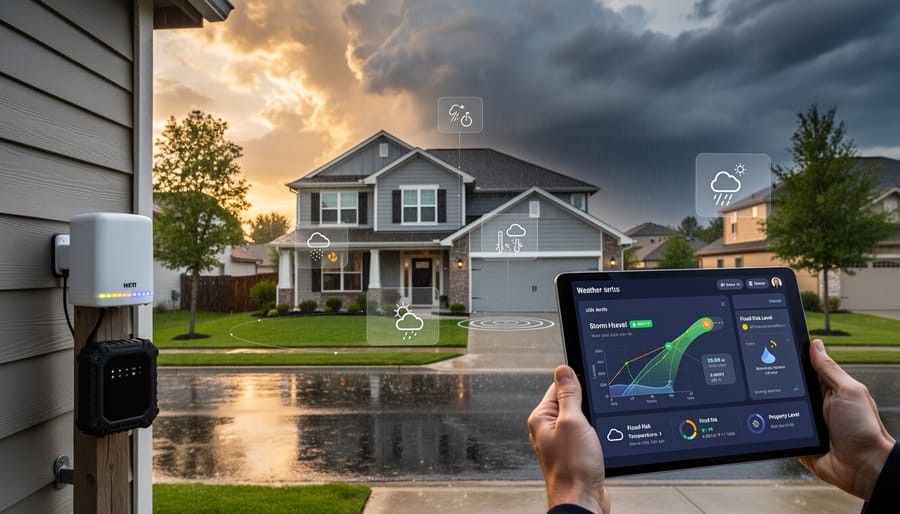
Edge AI is revolutionizing how insurers assess and price property-specific risks by monitoring weather and climate threats in real-time. Unlike traditional models that rely on broad regional data, Edge AI devices installed at properties collect hyperlocal information about wind speeds, rainfall accumulation, temperature fluctuations, and humidity levels. These sensors feed data into sophisticated algorithms that predict potential damage from storms, floods, and wildfires with remarkable accuracy.
For homeowners in wildfire-prone areas, Edge AI can detect rising temperatures and smoke particles, triggering early warnings and even activating sprinkler systems automatically. In flood zones, the technology monitors water levels and soil saturation to forecast inundation risks days before traditional forecasting methods. This predictive capability allows property owners to take preventive action, reducing claim frequency and severity.
The financial benefits are substantial. Properties equipped with Edge AI weather monitoring often qualify for reduced premiums, sometimes up to 20% lower than standard rates. Insurers value the real-time risk mitigation because it directly reduces their exposure to catastrophic losses. This approach complements broader climate resilience insurance strategies, creating a comprehensive protection framework that adapts to our changing environment while keeping coverage affordable.
Maintenance and Structural Integrity
Edge AI transforms property maintenance from reactive crisis management to proactive protection. Smart sensors embedded throughout a property continuously monitor critical systems, analyzing data in real-time to detect subtle changes that signal developing problems. For foundation integrity, these systems track microscopic shifts, moisture levels, and soil conditions that precede major structural issues. Roof monitoring uses thermal imaging and moisture sensors to identify leaks or deterioration long before they’re visible to the naked eye.
HVAC systems benefit enormously from this technology. Edge AI algorithms learn your equipment’s normal performance patterns and flag anomalies like unusual energy consumption, pressure variations, or component stress that indicate impending failure. This allows you to schedule repairs during off-peak seasons at lower costs, rather than facing emergency replacements during summer heatwaves or winter freezes.
For insurers, this predictive maintenance data translates directly into reduced risk and lower premiums. Properties with documented AI monitoring systems demonstrate responsible ownership and significantly lower claim likelihood. Some insurance providers now offer premium discounts up to 15% for homes equipped with comprehensive edge AI monitoring, recognizing that prevention costs far less than catastrophic repairs.
Security and Liability Protection
Edge AI’s smart surveillance capabilities go beyond basic security monitoring—they actively identify liability risks before they become costly claims. These systems can detect hazards like water pooling near entryways, damaged handrails, or unauthorized individuals in restricted areas, alerting property managers in real-time to address issues immediately.
What makes this particularly valuable for insurance purposes is the documentation aspect. When incidents do occur, Edge AI provides timestamped, objective evidence that can protect property owners from fraudulent claims or help demonstrate due diligence in maintaining safe conditions. Insurance carriers increasingly recognize properties with advanced monitoring systems as lower-risk, often rewarding owners with reduced premiums.
The technology also tracks patterns that traditional security cameras miss. For example, it might notice that a particular stairwell experiences frequent near-slips during rainy weather, prompting preventative measures like improved drainage or additional signage. This proactive approach to risk management doesn’t just reduce insurance exposure—it creates safer environments for tenants and visitors while protecting property owners from the financial and reputational damage of preventable accidents. For real estate professionals managing multiple properties, this level of automated risk detection becomes an invaluable asset in maintaining portfolio-wide safety standards.
What Property Owners Should Know Before Investing in Edge AI
Initial Investment vs. Long-Term Savings
While Edge AI technology requires an upfront investment in hardware, sensors, and installation, the long-term savings can be substantial for property owners. Initial costs typically range from $2,000 to $10,000 per property depending on size and system complexity. However, the return on investment often materializes within 18-36 months through reduced insurance premiums, fewer claims, and prevented losses.
Insurance carriers increasingly offer premium discounts of 15-25% for properties equipped with Edge AI monitoring systems because they demonstrably reduce risk. Beyond premium savings, the real financial advantage comes from preventing costly incidents altogether. A single prevented water leak can save $10,000 in damages, while early fire detection can preserve hundreds of thousands in property value.
For real estate investors managing multiple properties, Edge AI scales efficiently. The per-unit cost decreases with portfolio size, while the cumulative savings multiply. Additionally, properties with advanced monitoring systems command higher market values and attract quality tenants willing to pay premium rents for enhanced security and safety features.
Combining Edge AI with comprehensive property risk management strategies creates a robust framework that protects both immediate cash flow and long-term asset appreciation.
Choosing Compatible Insurance Providers
Not all insurance providers currently offer discounts or specialized policies for Edge AI-equipped properties, so selecting the right insurer is crucial. Start by asking potential insurers directly whether they recognize smart home technology and Edge AI systems in their underwriting process. Progressive carriers often have dedicated programs for tech-enhanced properties, viewing them as lower-risk investments.
Look for insurers that conduct thorough assessments of your Edge AI capabilities rather than offering generic smart home discounts. The best providers will send trained evaluators who understand the difference between basic connected devices and sophisticated edge computing systems that process data locally for real-time risk prevention.
Request documentation on how specific Edge AI features translate to premium reductions. Quality insurers should provide clear breakdowns showing how leak detection systems, fire prevention sensors, or security monitoring affect your rates. Some forward-thinking companies even offer tiered discount structures that increase as you add more Edge AI capabilities.
Consider working with insurance brokers who specialize in technology-integrated properties. These professionals maintain relationships with carriers actively developing Edge AI recognition programs and can match you with providers offering the most competitive rates for your specific setup. Don’t settle for standard policies when your property’s advanced systems deserve specialized coverage and appropriate premium credits.
Edge AI represents a genuine paradigm shift in how we approach property insurance, moving from reactive claims processing to proactive risk prevention. The technology’s ability to analyze data locally, identify hazards in real-time, and reduce premiums makes it increasingly essential for property owners who want to stay competitive and protected in today’s market.
For homeowners and real estate professionals, the path forward is clear: start exploring Edge AI solutions now. Begin with a property risk assessment, research compatible smart devices for your specific needs, and engage with insurance providers who offer premium discounts for these technologies. Even small steps like installing smart water leak detectors or security cameras with edge processing capabilities can yield immediate benefits.
Looking ahead, expect rapid evolution in this space. Integration with IoT ecosystems will deepen, AI algorithms will become more sophisticated at predicting property-specific risks, and insurance pricing models will increasingly reward tech-savvy property owners. The question isn’t whether Edge AI will transform real estate insurance—it already is. The question is whether you’ll be among the early adopters who reap maximum benefits, or play catch-up later. The choice, and the potential savings, are yours to claim.