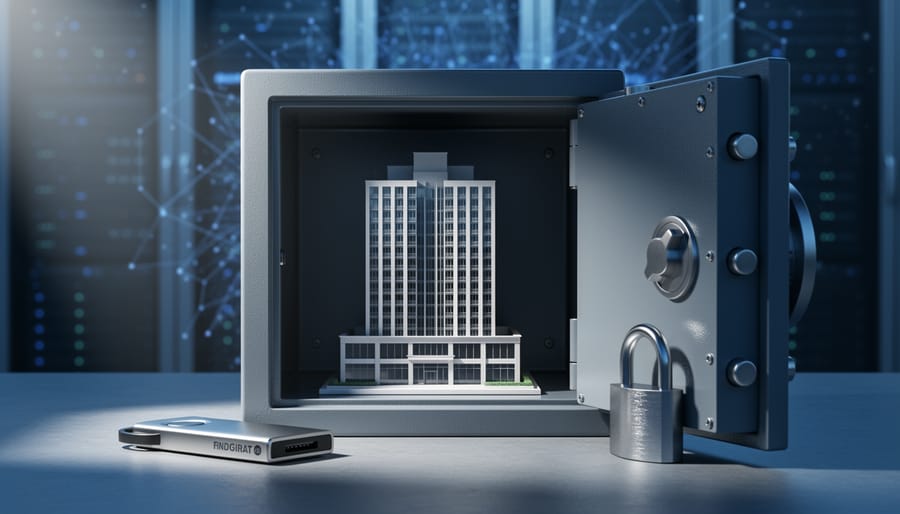
Eye-level close-up of a modern building scale model inside an open steel safe with an unbranded hardware crypto wallet and solid padlock, lit with cool blue-gray tones; blurred server racks and faint blockchain-like lights in the background.

Your Tokenized Real Estate Could Vanish Without Proper Crypto Custody

Understand that crypto custody is simply the secure storage and management of the digital keys that prove ownership of your blockchain-based property assets—think of it as the difference between keeping physical deeds in a safe versus trusting a title company. Tokenized real estate transforms property shares into digital tokens on a blockchain, but without proper custody solutions, you risk losing access to assets worth hundreds of thousands or even millions of dollars through …

Close-up of a businessperson holding a frosted acrylic block encasing a metal house key, with a contemporary home softly blurred in the background under warm golden light, symbolizing privacy-preserving verification in property transactions.

Your Property Transactions Are About to Get a Privacy Makeover

Imagine selling your $2 million property without revealing your identity, income history, or personal financial details to every party involved in the transaction—while still proving you’re the legitimate owner and have clear title. Zero-knowledge proofs make this possible in blockchain-based property transactions, offering a revolutionary solution to one of real estate’s most pressing concerns: protecting sensitive information while maintaining transparency and trust.
This …

Low-angle photo of a modern glass building facade with a faint luminous chain pattern reflecting on its windows, symbolizing blockchain-based property title registries, with a blurred city skyline and suburban rooftops in the background at golden hour.

Why Property Titles Are Moving to Blockchain (And What It Means for Your Real Estate)

Property ownership is about to experience its most significant transformation since the introduction of computerized land records. Blockchain registry technology promises to eliminate centuries-old inefficiencies in how we record, verify, and transfer property titles—potentially saving buyers thousands of dollars while reducing transaction times from weeks to mere hours.
At its core, a blockchain registry is a distributed, tamper-proof digital ledger that records property ownership and transactions across multiple computers simultaneously. Unlike traditional county recorder offices where a single entity maintains paper records or …

Eye-level photo of a suburban house with a glowing spherical node and light-trail connections to a floating blockchain-like grid, warm side lighting, trees and distant skyline softly blurred behind.

How Blockchain Oracles Are Solving Real Estate’s Biggest Data Problem

Real estate transactions are drowning in inefficiency. Property sales that should take days stretch into weeks because multiple parties manually verify the same information repeatedly—title searches, property inspections, mortgage approvals, and insurance underwriting all operate in disconnected silos. Blockchain technology promises to streamline these processes through smart contracts that automatically execute when conditions are met, but there’s a critical problem: blockchains can’t access real-world data on their own.
This is where blockchain oracles enter the picture. Think of oracles as trusted information …

Frustrated THCa vape business owner at a desk with a laptop, payment terminal, and unbranded vape product boxes, with a blurred city skyline and bank-like building in the background.

Why Your THCa Vape Business Keeps Getting Rejected by Banks (And How to Fix It)

Securing payment processing for your THCa vape business requires partnering with high-risk merchant account providers who understand cannabis-adjacent industries. Traditional banks and mainstream processors like Square or PayPal will reject your applications due to federal cannabis regulations, even though THCa products occupy a legal gray area under the 2018 Farm Bill.
The THCa disposables here present unique payment processing challenges that differ significantly from standard e-commerce businesses. Getting paid for them demands specialized financial infrastructure. Payment …

Three modern skyscraper platforms over water connected by sleek bridges with glowing house-shaped light particles flowing between them at golden hour, with a softly hazed distant city skyline.

Why Your Real Estate Tokens Are Trapped (And How Cross-Chain Technology Sets Them Free)

Diversify your property portfolio across multiple blockchain networks by leveraging cross-chain protocols that enable seamless token transfers between platforms like Ethereum, Polygon, and Binance Smart Chain. This approach allows you to access a broader range of international property opportunities without being locked into a single ecosystem, reducing geographic and technological risk while maximizing liquidity options.
Evaluate cross-chain bridge security before moving tokenized assets between networks by examining the bridge’s audit history, total value locked, and incident response track record. Focus on established …

Twilight city skyline with modern residential high-rises connected by glowing holographic bridges of light, symbolizing cross-chain interoperability in tokenized real estate

How Cross-Chain Technology Is Breaking Down Barriers in Real Estate Investment

The real estate industry stands at a technological crossroads where blockchain networks are reshaping property ownership, yet these systems remain frustratingly isolated from one another. Cross-chain interoperability—the ability for different blockchain networks to communicate and transfer value seamlessly—represents the missing infrastructure that could unlock trillions in tokenized real estate assets currently trapped in siloed ecosystems.
Consider the current reality: a property tokenized on Ethereum cannot easily interact with digital assets on Polygon, Solana, or other blockchain platforms without complex workarounds that …

Real estate closing table with a miniature house, brass scales of justice, and a tablet showing a generic digital coin icon, lit by soft daylight with blurred law-office shelves, paperwork, and keys in the background.

Why Stablecoin Regulations Could Make or Break Your Next Real Estate Deal

# Stablecoins Regulation: What Real Estate Professionals Need to Know Before Accepting Digital Payments
Verify your state’s money transmission laws before accepting stablecoins for property transactions—most jurisdictions haven’t explicitly addressed digital asset payments in real estate, creating a regulatory gray zone that could expose you to compliance violations. Contact your state’s Department of Financial Institutions to determine if handling stablecoin payments requires special licensing.
Implement enhanced due diligence protocols that exceed traditional anti-money laundering standards, as federal …

A split-screen illustration showing a modern house on one side and cryptocurrency symbols on the other, linked by digital lines to represent the convergence of cryptocurrency and real estate markets.

Crypto and Real Estate: Smart Investment or Dangerous Gamble?

Cryptocurrency investing presents a compelling yet complex opportunity in today’s investment landscape, demanding careful consideration from real estate professionals looking to diversify their portfolios. While Bitcoin’s 2021 surge to $69,000 and subsequent volatility has captured headlines, the fundamental question remains: does crypto merit a place alongside traditional real estate investments?
The answer lies not in speculative fervor but in understanding how digital assets can complement existing investment strategies. For real estate professionals, cryptocurrency offers unique advantages: 24/7 market access, …

Conceptual representation of real estate and NFT integration, showing a city skyline combined with digital blockchain symbols and NFT tokens.

NFTs Meet Real Estate: A Smart Investment Strategy for Property Tokenization

Mastering NFT investment in real estate demands a strategic blend of digital innovation and traditional property expertise. Smart investors are leveraging blockchain-verified digital assets to tokenize real estate properties, creating unprecedented opportunities for fractional ownership and automated revenue streams. The marriage of NFTs with physical real estate assets has opened new frontiers for portfolio diversification, offering enhanced liquidity and reduced entry barriers compared to conventional property investments. Whether you’re a seasoned real estate professional or a forward-thinking investor, understanding the …