Community insurance counselor sits with a family at a kitchen table, reviewing a tablet and forms, with house keys and a piggy bank on the table; soft morning light with a blurred kitchen interior and neighborhood visible through the window.

How Micro-Insurance is Finally Reaching the Communities Banks Forgot

Nearly 1.8 billion adults worldwide lack access to traditional insurance products, leaving low-income communities vulnerable to financial shocks that can derail homeownership dreams and housing stability. A single unexpected medical bill, property damage, or job loss can force families into impossible choices between keeping their homes and meeting basic needs.
Micro-insurance has emerged as a groundbreaking solution tailored specifically for households earning below median income levels. These specialized products offer affordable premiums, simplified enrollment processes, and coverage designed around the unique risks facing lower-…

Hands pressing a laptop fingerprint reader beside a smartphone with a verification screen and a model house on the desk, with a blurred modern office and glass-walled server racks in the background.

Why Your Insurance Company’s Security Hangs on Identity Management (And What It Means for Your Coverage)

Your insurance company holds the keys to your most sensitive information—property valuations, mortgage details, financial records, and personal identification. Every time you file a claim, update your policy, or simply log into your account, access and identity management (IAM) systems work behind the scenes to determine who can view, modify, or share that data. These digital gatekeepers don’t just protect your insurer’s databases; they directly impact how quickly your claims get processed, whether fraudulent policies can be opened in your name, and ultimately, the security costs that get passed along in your premiums.

Older landlord wearing glasses reviewing documents at a kitchen table with an eyeglasses case, calculator, and house keys, with a weathered rental property and toolbox softly blurred in the background.

Why Your Aging Investment Property Needs Vision Insurance (And How Retirees Can Protect Their Eyes)

Review your current Medicare plan during the annual enrollment period (October 15-December 7) to determine whether Original Medicare Part B or a Medicare Advantage plan better serves your vision needs. Part B covers only diagnostic eye exams for conditions like glaucoma and diabetic retinopathy, not routine vision care or eyewear—a gap that costs the average retiree $500-$800 annually out-of-pocket.
Purchase standalone vision insurance through private carriers like VSP or EyeMed if you have Original Medicare, with monthly premiums ranging from $15-$30 for coverage that includes annual eye exams, lens upgrades, and frames …

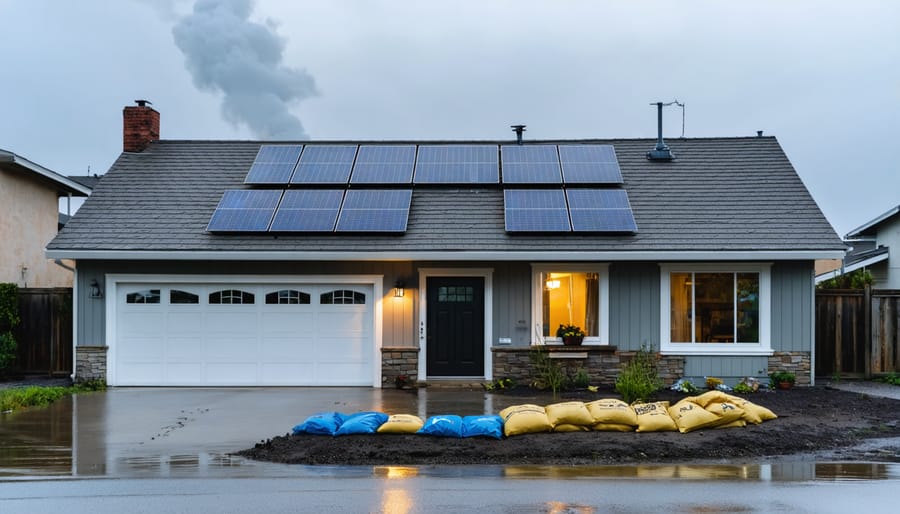
Suburban house with solar panels and metal roof, drought-tolerant landscaping, and sandbags by the front door as floodwater rises on the driveway; distant orange wildfire smoke and storm clouds over nearby rooftops.

Why Your Disaster Insurance Policy Won’t Cover Climate Damage (And What Will)

**Audit your current homeowner’s policy for climate-related exclusions immediately.** Most standard policies contain surprising gaps—flood damage typically requires separate coverage, earthquake protection isn’t automatic, and “acts of God” clauses may deny claims for wind-driven rain or wildfire smoke damage. Request a complete list of excluded perils from your insurer, then cross-reference against climate risks specific to your property’s location.
**Prioritize carriers offering green rebuilding endorsements and climate resilience incentives.** These eco-friendly policies go beyond traditional …

Modern mixed-use building with glass-fronted ground-floor retail and multiple stories of apartments above, seen from street level at a slight angle during golden hour, with a softly blurred city street and pedestrians in the background.

Why Your Mixed-Use Property Needs Different Insurance (And What Happens If You Get It Wrong)

**Recognize that your mixed-use property—combining residential units above street-level retail or office space—falls into an insurance gray area that standard policies won’t adequately cover.** Most property owners discover this gap only after filing a claim, when insurers deny coverage because the policy was written for purely residential or commercial use. Mixed-use properties require hybrid policies that address the unique liability exposures of having tenants living above customer-facing businesses, plus the increased fire risk from commercial cooking equipment or manufacturing activities beneath residential spaces.
**…

Farmer kneeling to examine healthy cover crop and rich topsoil beside a contour-planted field at golden hour, with a solar-paneled barn, retention pond, hedgerows, and a distant tractor in the background, illustrating sustainable practices that protect farm investments.

How Crop Sustainability Insurance Protects Your Farm Investment (And Your Bottom Line)

# Crop Sustainability: The Foundation of Agricultural Real Estate Value
Sustainable farming practices directly increase property values by 15-25% compared to conventional operations, making crop sustainability a critical consideration for agricultural real estate investors and property owners. When farmland demonstrates long-term soil health, water conservation measures, and biodiversity management, it commands premium prices and attracts quality tenants willing to pay higher lease rates.
**Align insurance coverage with sustainability certifications.** Properties enrolled in organic, regenerative, or certified sustainable …

Contractor in a hard hat reviewing renovation plans with a homeowner in front of a suburban house under construction, with scaffolding, exposed framing, a roll-off dumpster, and tools visible in soft late-afternoon light.

Your Home Renovation Could Void Your Insurance (Here’s How to Protect Yourself)

**Notify your insurance carrier at least 30 days before starting any major renovation project—failing to do so can leave you with denied claims or coverage gaps worth tens of thousands of dollars.** Most homeowners don’t realize that even seemingly minor upgrades like bathroom remodels or kitchen expansions can trigger significant policy implications, from premium adjustments to temporary coverage suspensions.
Your standard homeowners policy wasn’t written with construction zones in mind. When contractors enter your property, your liability exposure increases dramatically, material theft becomes a real concern, and …

Homeowner couple meeting with an insurance agent at a kitchen table with documents, laptop, ring box, and calculator, soft daylight and blurred background showing a living room and a house with scaffolding outside

Policy Riders Could Save You Thousands on Your Next Property Claim

Understand that insurance policy riders—also called endorsements—are optional add-ons that customize your base policy to fill specific coverage gaps your standard homeowner’s insurance won’t address. A rider for jewelry coverage, for example, protects your $15,000 engagement ring beyond the typical $1,500 limit for valuables, while a water backup endorsement covers the $8,000 in damage when your sewer line fails—an exclusion in most standard policies.
Review your existing policy’s declarations page to identify current coverage limits and exclusions …

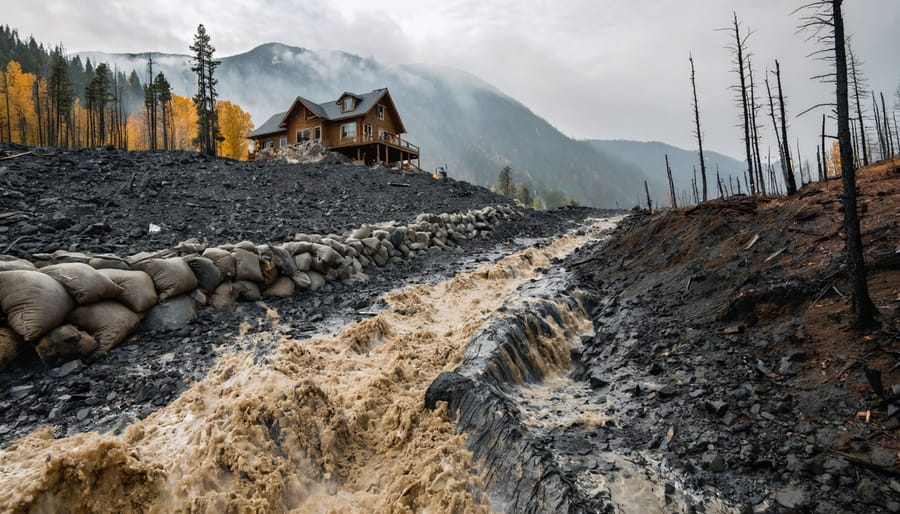
Mud, ash, and rocks rush down a charred hillside toward a house with sandbags during a rainstorm, with burned trees and dark storm clouds in the background.

Post-Fire Debris Flows Could Destroy Your Property Before Insurance Kicks In

**When Wildfire’s Aftermath Becomes Your Property’s Next Threat**
A wildfire may have passed, but your property faces a secondary danger that catches most homeowners off-guard: post-fire debris flows. These fast-moving slurries of mud, ash, boulders, and charred vegetation can race down burned hillsides at speeds exceeding 35 mph, destroying everything in their path—often with as little as 15 minutes warning after rainfall begins.
Unlike typical mudslides, post-fire debris flows occur because wildfire strips away vegetation and creates a water-repellent soil layer, transforming hillsides into slick chutes that …

An illustration showing a house with overlays of mortgage documents and insurance policies, highlighting the essential relationship between home financing and insurance requirements.

Here’s the Truth About Mortgages and Homeowners Insurance Requirements

Contrary to common belief, homeowners insurance isn’t automatically built into your mortgage—but they’re inextricably linked in the home-buying process. Every mortgage lender requires homeowners insurance coverage before closing, making it a non-negotiable component of homeownership. While the insurance isn’t technically “built in,” most lenders establish an escrow account that combines your monthly mortgage payment, property taxes, and insurance premiums into a single payment for convenience and risk management.
Understanding this relationship is crucial for first-time homebuyers and seasoned …