Standby generator running beside a modern California hillside home during a power outage, with smoky golden-hour sky, cleared defensible space, dry grasses, and distant power lines.

When the Lights Go Out During Fire Season: Your Property Protection Plan

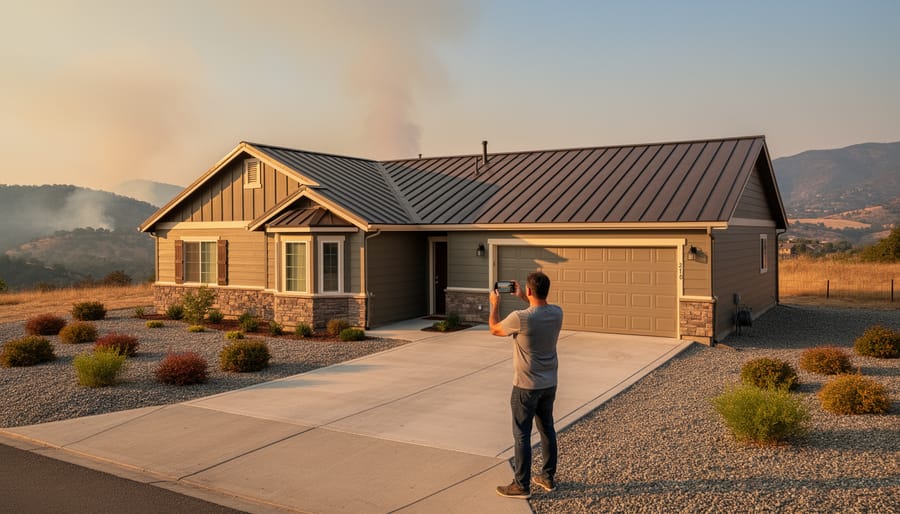
Download a comprehensive power outage emergency response plan template immediately and customize it within 24 hours—not next week when Public Safety Power Shutoffs (PSPS) are announced with minimal warning. Property owners in California’s fire-prone regions face average PSPS events lasting 24-48 hours, with some extending beyond five days, making documented emergency protocols essential for protecting both physical assets and property values.
Create your plan by identifying critical systems requiring backup power: security systems, sump pumps, refrigeration units, and medical equipment. Document specific generator capacities…

Renter holding a leashed medium-size dog at an apartment doorway while a neighbor stands outside, with soft natural light and a blurred interior background.

Your Renter’s Insurance Won’t Cover This Pet Incident (Here’s What Will)

Your furry companion might be your best friend, but one bite, scratch, or knock-down could leave you facing thousands in liability claims—and here’s the problem: most renters insurance policies cap pet-related incident coverage at significantly lower limits than standard liability protection, or exclude certain breeds entirely.
Pet liability insurance bridges this critical gap. When your dog injures a neighbor, damages someone else’s property, or causes an accident that leads to medical bills, this specialized coverage protects your finances from lawsuits and medical expense claims that routinely exceed $30,000. …

Homeowner in boots placing sandbags at a suburban home’s front step as shallow floodwater reaches the driveway, with a neighbor across the street installing flood barriers on an overcast day.

How Behavioral Science Could Save Your Property from the Next Flood

Recognize that homeowners consistently underestimate their flood risk by 80%, creating a dangerous gap between actual vulnerability and protective action. Research published in leading behavioral science journals reveals three cognitive biases blocking flood mitigation: optimism bias (believing disasters happen to others), present bias (prioritizing immediate costs over future losses), and status quo bias (defaulting to inaction despite known risks).
Frame flood insurance and mitigation as financial protection strategies rather than disaster preparation. Property owners respond more favorably when presented with concrete dollar …

Building inspector and contractor in hard hats examine a storm-damaged suburban house with exposed framing, hurricane straps, and sprinkler piping, under bright overcast light; neighboring homes and scaffolding visible in the background.

Why Building Code Violations Could Leave You Without Insurance After a Disaster

Understand that violating disaster preparedness regulations means your property fails to meet current building codes, fire safety standards, or zoning requirements—a gap that can leave you financially exposed when disaster strikes. Your standard homeowners insurance typically covers only the replacement value of your damaged property as it existed, not the potentially astronomical costs of bringing non-compliant structures up to code during rebuilding.
Review your property immediately for common violations: outdated electrical systems, inadequate fire suppression equipment, substandard roofing materials in hurricane zones, or …

Low drone view of a modern home with rooftop and perimeter sprinklers soaking the roof, eaves, and yard, with a galvanized water tank and pump near the driveway and distant smoky ridge under golden-hour light.

Home Wildfire Defense Systems That Could Save Your Property Investment

Wildfires destroyed over 18,000 structures in the United States last year alone, yet most homeowners in fire-prone areas remain dangerously unprepared. Home wildfire defense systems represent a critical evolution in property protection—automated networks of sprinklers, foam applicators, and water delivery mechanisms designed to create defensive barriers when evacuation becomes your only option.
These systems operate on a simple premise: maintain moisture saturation around your property’s perimeter and vulnerable surfaces during the critical hours when flames approach. Unlike traditional landscaping or firebreaks, modern …

Remote worker photographing a cracked flat-screen TV in a modern home office; tipped coffee mug, keyboard, and surge protector nearby; soft natural daylight; blurred sofa and shelves in background.

Your TV Broke While Working From Home—Will Insurance Pay for It?

Check your homeowners insurance policy declarations page right now—most standard policies cover TV damage under personal property protection, but only when caused by named perils like fire, lightning, windstorms, or theft. Your flat-screen isn’t automatically protected from accidental drops, power surges, or that coffee spill during your morning Zoom call.
Review your policy’s personal property coverage limit, typically set at 50-70% of your dwelling coverage. A $300,000 home policy generally provides $150,000-$210,000 for belongings, including electronics. However, sub-limits often apply to electronics, capping …

Homeowner in a rain jacket securing sandbags and checking a portable sump pump at a suburban home’s front door during flooding, with pooled street water and an elevated HVAC platform in the background under overcast light.

How Emergency Response Planning Can Save Your Property When Floods Strike

Understand that emergency management operates in four distinct phases—mitigation, preparedness, response, and recovery—each directly impacting your property’s value, insurability, and long-term investment security. Property owners who master this framework reduce flood insurance premiums by up to 45%, protect equity during disasters, and maintain market competitiveness when selling in flood-prone areas.
The mitigation phase involves identifying vulnerabilities before disaster strikes—elevating HVAC systems, installing backflow valves, and securing flood insurance policies that reflect actual risk exposure. Real estate …

Close-up of a residential alarm keypad with a red indicator light in a dim hallway; blurred background shows blue and red police light reflections through a window and a concerned homeowner silhouette near a console with scattered mail.

Why Your Home Security System Might Be Costing You More Than It Protects

That blinking red light on your security system might be costing you more than you think—not in protection, but in false confidence that could inflate your insurance premiums and drain your wallet through avoidable fees.
False alarms plague 94-98% of all security system alerts, triggering a cascade of financial consequences that most homeowners never anticipate. Each false dispatch can cost between $50-$500 in municipal fines, and after just three incidents in many jurisdictions, you’ll face escalating penalties. More concerning is what happens behind the scenes: insurance carriers track false alarm patterns and may adjust …

Contractors and an excavator demolish the undamaged wing of a storm-damaged older house, with debris piles and neighboring homes in the background under overcast light.

Why Your Home Insurance Won’t Pay to Rebuild After a Natural Disaster

Understand that standard homeowners insurance won’t cover the full cost of rebuilding if local building codes have changed since your home was constructed. When disaster strikes an older property, you’ll face a harsh reality: your insurer pays to restore what existed before, but your municipality requires upgrades to current code—leaving you potentially tens of thousands of dollars short.
Ordinance or law coverage bridges this critical gap by covering three distinct expenses most homeowners don’t anticipate. First, it pays for demolition and debris removal of undamaged portions of your home that must come down …

Elevated coastal single-family home on concrete piers with metal hurricane shutters and flood vents at golden hour, with marshland and distant water softly blurred in the background.

How FEMA’s Hazard Mitigation Assistance Could Save Your Property (and Your Money)

Understand that federal hazard mitigation assistance programs offer property owners substantial financial incentives—including grants up to 75% of project costs—to protect homes from flooding, hurricanes, earthquakes, and wildfires before disaster strikes. The Federal Emergency Management Agency’s Hazard Mitigation Assistance (HMA) portfolio encompasses three distinct grant programs that can fund everything from elevating flood-prone structures to installing hurricane shutters, with direct implications for your property’s insurance premiums, resale value, and long-term financial security.
Property owners who invest …