Utility technician consulting with two homeowners in a bright California living room, smart thermostat on the wall and stainless kitchen softly blurred in the background.

How PG&E’s Energy Efficiency Program Can Slash Your New Home’s Utility Bills

Reduce your new home’s energy bills by 20-40% immediately by enrolling in PG&E’s Energy Efficiency Program, which offers California homeowners rebates up to $7,500 for qualifying upgrades like HVAC systems, insulation improvements, and smart thermostats. Navigate to pge.com/rebates within 24 hours of moving in to claim instant rebates on appliances you’re already planning to purchase—timing matters because some incentives apply only to installations completed within your first year of ownership, helping you avoid …

Fire inspector’s gloved hand attaching a red safety violation tag to a commercial building sprinkler control valve, with pipes and an emergency light softly blurred in the background.

K Tags Could Save Lives in Your Property (Here’s What Landlords Must Know)

A K tag on your property is more than a compliance violation—it’s a financial liability that can derail real estate transactions, spike insurance premiums, and expose you to significant legal risk. These red placards, issued by fire marshals when buildings fail to meet life safety code requirements, signal critical deficiencies in fire protection systems, emergency exits, or building infrastructure that must be corrected immediately.
Property owners who ignore K tags face compounding consequences. Insurance carriers routinely increase premiums by 15-40% or deny coverage entirely for properties with unresolved life safety …

Facilities manager with tablet beside solar panels and high-efficiency HVAC units on a commercial rooftop at golden hour, with a softly blurred city skyline in the background.

How KPMG’s ESG Framework Is Reshaping Property Technology and Energy Costs

Align your property portfolio with KPMG’s environmental, social, and governance framework by first conducting a comprehensive energy audit across all buildings to establish baseline metrics for carbon emissions, water usage, and waste generation. Download KPMG’s sector-specific ESG assessment tools and map your current operational data against their materiality matrix, identifying which sustainability factors most significantly impact your property values and operating costs.
Integrate PropTech energy management platforms that automatically track and report ESG metrics in formats compatible with …

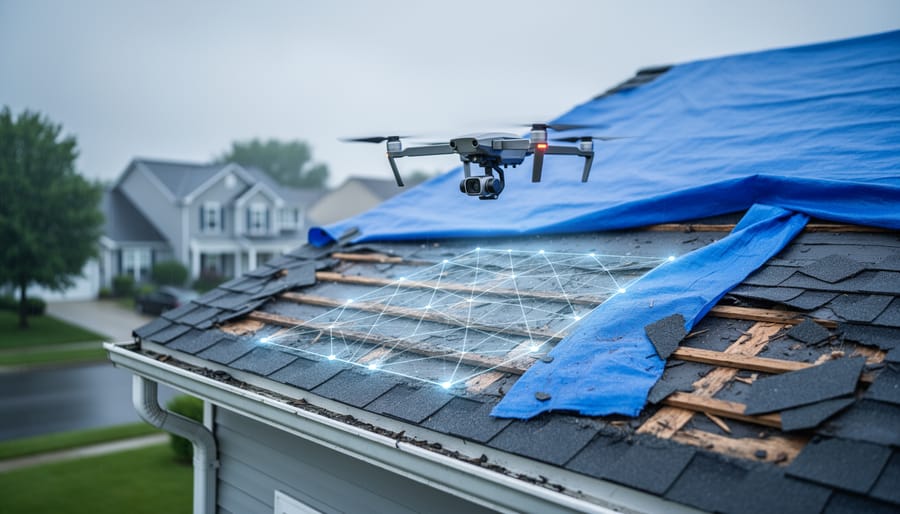
Drone inspecting a storm-damaged suburban house roof with missing shingles and a blue tarp, shown from a slightly elevated 45-degree angle, with a subtle translucent scan grid indicating AI analysis; soft overcast daylight and blurred neighborhood in the background.

How AI Is Catching Fraudulent Property Claims Before They Cost You Thousands

Every insurance claim you file generates dozens of data points—from photos of water damage to repair cost estimates—and artificial intelligence now analyzes this information in seconds rather than weeks. Insurance claims analytics uses machine learning algorithms to evaluate property damage, detect fraudulent patterns, and calculate fair settlements automatically, fundamentally changing how your homeowners or property insurance claims get processed.
For property owners and real estate professionals, this technology means receiving claim decisions in hours instead of days, with AI systems instantly comparing your roof damage …

Diverse adult hands place small coin stacks around a scale model of a modern apartment building on a table, with a blurred city skyline and houseplants in soft natural light.

How Non-Accredited Investors Can Finally Access Real Estate Crowdfunding Deals

Verify your income doesn’t meet the $200,000 annual threshold or $1 million net worth requirement—you can still access real estate crowdfunding opportunities thanks to Regulation Crowdfunding rules that opened the door for everyday investors in 2016. Focus on platforms like Fundrise, Groundfloor, and Arrived Homes that specifically welcome non-accredited investors with minimums as low as $10 to $100, allowing you to build diversified real estate portfolios without the traditional …

Older adult seated on a modern curved stairlift with padded seat and armrests on a light-wood staircase in a bright home, softly lit by natural daylight, with a blurred hallway and living room in the background.

A stairlift in your home for when you become less mobile

Do you notice that climbing stairs has suddenly become much more difficult than a few years ago? This can have quite an impact, because it makes some areas of your home much less accessible. Many people choose at first to walk a bit more slowly or hold on to the railing more firmly. Eventually, however, climbing stairs can start to require more and more energy. You may even notice that you prefer to avoid certain floors in your home and postpone some household tasks such as doing the laundry. Once climbing stairs truly becomes an obstacle, it can be wise to take measures. A stairlift can ensure that you can move effortlessly from one floor…

Investor’s hands reviewing real estate deal folders with coin stacks, a small building model, and a laptop showing property photos on a wooden desk, city skyline softly blurred in the background.

Crowdfunding Investments: The Real Returns Behind the Hype

Crowdfunding investments can deliver returns between 8-12% annually for real estate projects, but your success hinges on understanding three critical factors before committing a single dollar.
Evaluate platform track records by examining default rates, completed project percentages, and investor recovery amounts from failed deals. Top-tier real estate crowdfunding platforms maintain default rates below 2%, while struggling platforms see failures exceeding 10%. Request specific performance data spanning at least three years, not just cherry-picked success stories.
Assess your liquidity requirements honestly. Most crowdfunding …

Real estate professional using a calculator at a modern desk beside a laptop, house keys, and a small house model, with a city skyline softly blurred in the background; no legible text visible.

Maximizing Deductions: How Real Estate Professionals Can Reduce Their Tax Burden

The real estate industry, whether you’re an agent, investor, or developer, offers tremendous opportunities, but it also comes with a complex web of tax obligations. As a real estate professional, understanding how to navigate the nuances of tax deductions and efficient tax planning is crucial to maximizing profits and minimizing liabilities. Often, real estate professionals are unaware of the full range of tax-saving opportunities available to them, leaving money on the table each year.
In this post, we’ll explore how real estate professionals can take advantage of available deductions, implement tax …

Black umbrella covering a house model, paperwork, keys, and calculator on a wooden desk, with blurred single-family home, small apartment building, vacation cottage, and construction scaffolding in the background

The Insurance Gaps That Could Cost Real Estate Investors Everything

Secure landlord liability insurance immediately—even before purchasing your first rental property—because standard homeowners policies won’t cover tenant injuries, property damage claims, or legal defense costs that regularly exceed $50,000 per incident. Many new investors discover this gap only after facing their first lawsuit, when it’s already too late.
Structure your coverage based on property type and usage, not one-size-fits-all recommendations. Single-family rentals require different protection than multi-unit buildings or short-term vacation rentals, with vacation properties demanding specialized policies …

Slightly elevated wide shot of a UK construction site beside a restored wetland, wildflower meadow, and young trees in protective tubes, with cranes, partially built structures, and a distant skyline under golden-hour side light.

How Biodiversity Net Gain is Reshaping Property Values and Development Costs

Biodiversity net-gain regulations are reshaping real estate development costs and timelines across the UK, requiring projects to deliver a measurable 10% improvement in habitat value for 30 years—a mandate that translates directly into your project budget, site selection criteria, and financing terms.
For developers and real estate professionals, this isn’t simply an environmental checkbox. BNG compliance typically adds £20,000 to £100,000 per hectare in habitat creation costs, extends planning approval timelines by 3-6 months, and introduces long-term land management obligations that affect asset valuations and exit …