Close-up of a notary-sealed property deed next to a silver house key on a wooden table, with realtor hands and a sunlit suburban home softly blurred in the background.

Home Title vs. Deed: Why Confusing These Two Could Cost You Everything

Understand that home title and deed are not the same thing, though they work together to establish property ownership. The deed is the physical document that transfers property from seller to buyer, containing signatures, legal descriptions, and notarization. The title, however, represents your legal right to own, use, and sell the property—it’s a concept, not a document you can hold.
Recognize why this distinction matters for first-time homebuyers and current homeowners: a deed proves the …

Utility technician consulting with two homeowners in a bright California living room, smart thermostat on the wall and stainless kitchen softly blurred in the background.

How PG&E’s Energy Efficiency Program Can Slash Your New Home’s Utility Bills

Reduce your new home’s energy bills by 20-40% immediately by enrolling in PG&E’s Energy Efficiency Program, which offers California homeowners rebates up to $7,500 for qualifying upgrades like HVAC systems, insulation improvements, and smart thermostats. Navigate to pge.com/rebates within 24 hours of moving in to claim instant rebates on appliances you’re already planning to purchase—timing matters because some incentives apply only to installations completed within your first year of ownership, helping you avoid …

Fire inspector’s gloved hand attaching a red safety violation tag to a commercial building sprinkler control valve, with pipes and an emergency light softly blurred in the background.

K Tags Could Save Lives in Your Property (Here’s What Landlords Must Know)

A K tag on your property is more than a compliance violation—it’s a financial liability that can derail real estate transactions, spike insurance premiums, and expose you to significant legal risk. These red placards, issued by fire marshals when buildings fail to meet life safety code requirements, signal critical deficiencies in fire protection systems, emergency exits, or building infrastructure that must be corrected immediately.
Property owners who ignore K tags face compounding consequences. Insurance carriers routinely increase premiums by 15-40% or deny coverage entirely for properties with unresolved life safety …

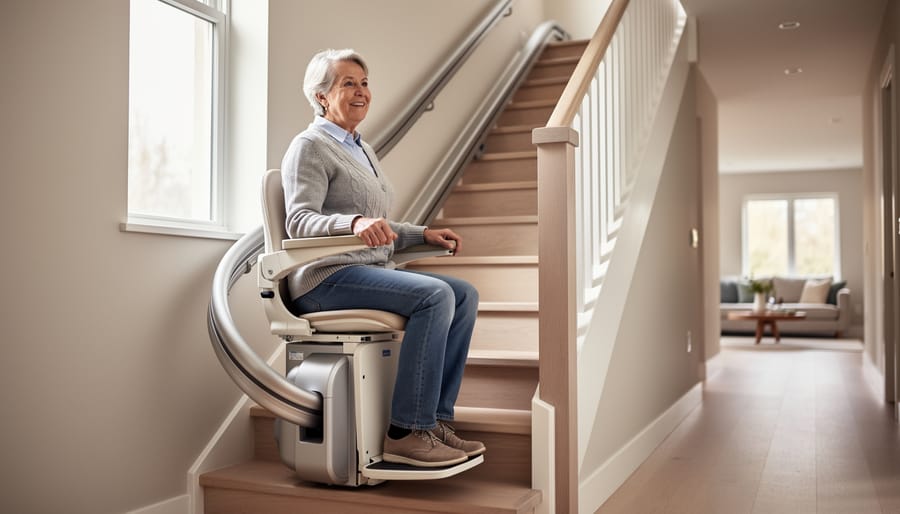
Older adult seated on a modern curved stairlift with padded seat and armrests on a light-wood staircase in a bright home, softly lit by natural daylight, with a blurred hallway and living room in the background.

A stairlift in your home for when you become less mobile

Do you notice that climbing stairs has suddenly become much more difficult than a few years ago? This can have quite an impact, because it makes some areas of your home much less accessible. Many people choose at first to walk a bit more slowly or hold on to the railing more firmly. Eventually, however, climbing stairs can start to require more and more energy. You may even notice that you prefer to avoid certain floors in your home and postpone some household tasks such as doing the laundry. Once climbing stairs truly becomes an obstacle, it can be wise to take measures. A stairlift can ensure that you can move effortlessly from one floor…

Real estate professional using a calculator at a modern desk beside a laptop, house keys, and a small house model, with a city skyline softly blurred in the background; no legible text visible.

Maximizing Deductions: How Real Estate Professionals Can Reduce Their Tax Burden

The real estate industry, whether you’re an agent, investor, or developer, offers tremendous opportunities, but it also comes with a complex web of tax obligations. As a real estate professional, understanding how to navigate the nuances of tax deductions and efficient tax planning is crucial to maximizing profits and minimizing liabilities. Often, real estate professionals are unaware of the full range of tax-saving opportunities available to them, leaving money on the table each year.
In this post, we’ll explore how real estate professionals can take advantage of available deductions, implement tax …

House key on a keyring next to an embossed notary seal and small metal shield on a wooden real estate closing table, with two people shaking hands softly blurred in the background.

The Four Types of Deeds That Protect (Or Expose) Your Property Rights

Understanding which deed type protects your property rights can save you from costly legal battles and ownership disputes down the road. When transferring real estate, the deed you receive determines your level of protection against title defects, liens, and competing ownership claims—yet most buyers don’t realize these documents vary dramatically in the guarantees they provide.
The four main deed types—general warranty, special warranty, quitclaim, and bargain and sale—exist on a spectrum from maximum protection to virtually none. A general warranty deed offers the strongest safeguards, with the seller guaranteeing …

Homeowner’s hands reviewing property tax documents with a calculator and a small house model on a kitchen table, soft daylight and a blurred kitchen with a laptop in the background.

Property Tax Questions That Could Be Costing You Thousands

Review your property tax assessment notice within 30 days of receipt to identify calculation errors, incorrect property characteristics, or outdated square footage that could inflate your bill by thousands of dollars annually. Contact your local assessor’s office immediately if you spot discrepancies—most jurisdictions allow informal reviews before formal appeals become necessary.
Compare your assessed value against recently sold comparable properties in your neighborhood using public records or real estate databases. If your assessment exceeds market value by 10% or more, you have strong grounds for an appeal. Document …

Close-up of two people exchanging a house key over an unsigned legal document with a notary seal stamp and folder on a wooden table; blurred law office shelves and a small house model in the background.

Quick Claim Deeds Could Cost You Your Home: What Every Property Owner Must Know

You’ve likely typed “quick deed” into a search engine when what you really need is a quitclaim deed—one of the most misunderstood yet frequently used documents in real estate transfers. This common misspelling points to a critical knowledge gap that costs homeowners thousands in lost protections and creates legal headaches that last for years.
A quitclaim deed transfers whatever ownership interest you have in a property to someone else, with zero guarantees about what that interest actually is. Unlike a warranty deed that promises clean title, a quitclaim essentially says “I’m giving you whatever …

Four HOA board members review documents and a tablet at a clubhouse conference table, with a small model house in view and suburban homes softly blurred outside the windows.

Why Your HOA Board Needs D&O Insurance (Before It’s Too Late)

Serving on a homeowners association board means making consequential decisions about other people’s property and money—a responsibility that exposes you to personal liability even when you’re acting in good faith. Directors and Officers (D&O) insurance for HOAs protects board members from lawsuits alleging mismanagement, breach of fiduciary duty, or wrongful decisions that harm homeowners or the association itself.
Without this coverage, your personal assets become vulnerable. A disgruntled homeowner who disagrees with a special assessment, a vendor claiming breach of contract, or a resident injured due to …

Hand installing an LED bulb in a porch fixture with a modern home behind it, rooftop solar panels and an outdoor heat pump unit softly blurred in the background at golden hour.

Your New Home Could Be Saving Money While Saving the Planet

Calculate your home’s baseline energy consumption before investing a single dollar in green upgrades. Request 12 months of utility bills from the previous owner or your provider, then use free online calculators to identify which systems—heating, cooling, or appliances—drain the most power. This data-driven approach prevents wasting money on trendy solar panels when your real issue is a 20-year-old furnace hemorrhaging cash monthly.
Prioritize improvements by return on investment rather than environmental appeal. Air sealing and insulation upgrades typically cost $1,500-$3,500 and reduce energy bills by 15-30% within the …