
Understand that violating disaster preparedness regulations means your property fails to meet current building codes, fire safety standards, or zoning requirements—a gap that can leave you financially exposed when disaster strikes. Your standard homeowners insurance typically covers only the replacement value of your damaged property as it existed, not the potentially astronomical costs of bringing non-compliant structures up to code during rebuilding.
Review your property immediately for common violations: outdated electrical systems, inadequate fire suppression equipment, substandard roofing materials in hurricane zones, or seismic retrofitting deficiencies in earthquake-prone areas. Municipal inspectors often grandfather existing structures until significant damage occurs, at which point enforcement becomes unavoidable.
Secure Ordinance or Law coverage as a critical endorsement to your existing policy. This specialized insurance addresses three distinct exposures: the undamaged portion of your building that must be demolished to comply with current codes, the increased construction costs to meet updated standards, and the loss of use during extended rebuilding periods. Without this protection, you’re personally liable for compliance costs that frequently exceed the original property value.
Document your property’s compliance status through professional inspections and maintain records of all upgrades. Understanding disaster preparedness essentials positions you to make informed decisions about coverage limits, as most standard policies cap ordinance protection at 10% of dwelling coverage—often insufficient for major code violations.
Calculate your potential exposure by consulting local building departments about specific regulatory requirements applicable to your property type and location.
What Violating Disaster Preparedness Regulations Actually Means
Common Building Code Violations That Trigger Coverage Issues
When insurance adjusters review claims after a disaster, certain building code violations immediately raise red flags that can significantly impact your coverage. Understanding these common culprits helps you address potential issues before disaster strikes.
Outdated electrical systems top the list of problematic violations. Many older homes still operate with knob-and-tube wiring or aluminum wiring systems that no longer meet current electrical codes. After a fire or storm damage, insurers may deny coverage for bringing the electrical system up to code, leaving you facing tens of thousands in unexpected upgrade costs. This is particularly relevant when considering home renovation requirements that often trigger mandatory electrical updates.
Non-compliant roofing materials present another frequent issue. Insurance companies scrutinize whether your roof meets wind resistance ratings and fire classifications required by current building codes. If your original roof was perfectly legal when installed but doesn’t meet today’s standards, replacement costs after storm damage may not include the price difference between your old materials and code-compliant ones.
Inadequate fire suppression systems particularly affect commercial properties and multi-unit residential buildings. Missing or outdated sprinkler systems, fire-rated walls, and emergency exits can void portions of your claim related to code compliance upgrades.
Foundation and structural deficiencies round out the critical violations. Homes built before modern seismic codes or flood elevation requirements face substantial coverage gaps. Foundation repairs, structural reinforcements, and elevation requirements can easily exceed the original repair estimate by 50% or more.
The financial impact becomes painfully clear: without proper Ordinance or Law coverage, you’re personally responsible for bridging the gap between what your standard policy covers and what building codes actually require for reconstruction.
The Difference Between Pre-Existing Violations and New Requirements
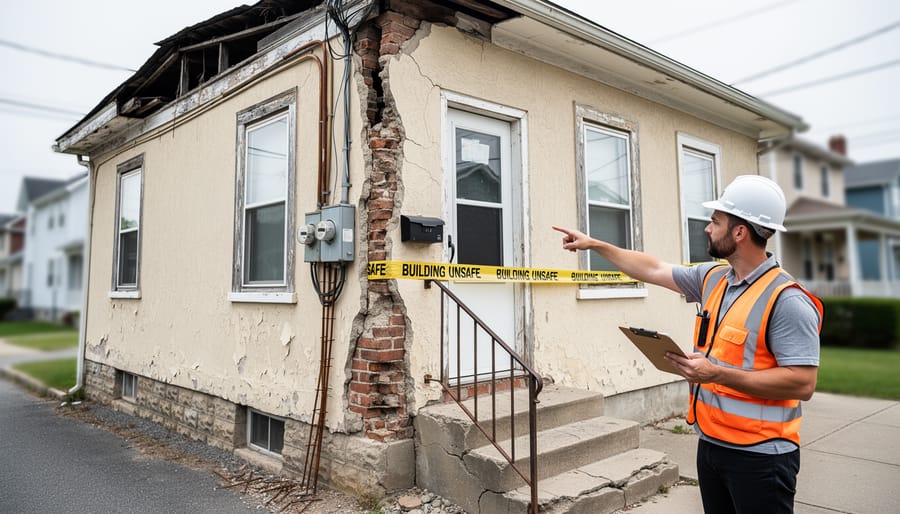
Understanding the difference between pre-existing violations and new requirements is crucial for property owners navigating disaster preparedness regulations. Many jurisdictions operate under grandfathering provisions, which allow buildings constructed under older codes to maintain their original specifications even after regulations change. This means your property might technically not meet current disaster preparedness standards but still be legally compliant because it met the requirements at the time of construction.
However, grandfathering protection has limits. Once you undertake substantial improvements or renovations beyond a certain threshold, typically 50% of the building’s value, your property must be brought up to current code standards. This trigger point can create significant unexpected costs, especially in disaster-prone areas where new regulations might require expensive retrofitting like seismic reinforcements, hurricane-resistant windows, or elevated foundations.
The situation becomes particularly complex when considering renovations and insurance coverage. After a major disaster, if your property requires repairs exceeding that 50% threshold, you’ll face a double challenge: rebuilding costs plus the expense of meeting current codes. This is precisely where Ordinance or Law insurance becomes invaluable, covering both the demolition of non-compliant structures and the additional construction costs required to meet updated standards.
For real estate investors and homeowners, documenting your property’s compliance status and understanding local grandfathering provisions should be part of your due diligence process. This knowledge directly impacts your insurance needs and potential financial exposure in disaster scenarios.
How Ordinance or Law Endorsements Bridge the Coverage Gap
The Three Coverage Components Explained
Ordinance or Law coverage typically breaks down into three distinct components, each addressing a specific financial exposure when disaster strikes a non-compliant property.
Coverage A protects the undamaged portion of your building that must be demolished to comply with current codes. Here’s how it works: imagine a fire destroys 40% of your commercial building, but local regulations require buildings with damage exceeding 30% to be completely torn down and rebuilt to modern standards. Your standard property insurance covers the damaged 40%, but Coverage A picks up the cost of demolishing the remaining 60% that wasn’t touched by the fire. Without this protection, you’re paying out-of-pocket to tear down perfectly intact sections of your building—a financial gut-punch when you’re already dealing with disaster recovery.
Coverage B handles the actual demolition and debris removal costs associated with ordinance compliance. While your base policy includes some debris removal, it rarely covers the extensive work required when codes mandate complete teardown. A real estate investor recently learned this lesson when her 1960s apartment building suffered flood damage. The city required full demolition due to outdated electrical systems throughout the structure. Her Coverage B paid the $85,000 demolition bill; without it, those costs would have consumed her entire profit margin on the property.
Coverage C addresses increased construction costs to meet current building codes. This is often the most expensive component. Consider a homeowner whose 1,200-square-foot beach cottage was partially damaged by a hurricane. Building codes now require elevated foundations, impact-resistant windows, and upgraded structural reinforcements. While her property insurance covered replacement at pre-loss value, Coverage C paid the additional $120,000 needed to meet new coastal construction standards—the difference between rebuilding and walking away from the property entirely.
These three coverages work together, creating a comprehensive safety net when outdated buildings meet modern code requirements after a covered loss.
What Standard Policies Don’t Cover
Most property owners discover too late that their standard insurance policies contain significant blind spots when it comes to code compliance and disaster recovery. Here’s what typically isn’t covered under basic homeowners or commercial property insurance.
Your standard policy generally covers the cost to repair or rebuild your property to its pre-disaster condition. Sounds reasonable, right? The problem emerges when local building codes have changed since your property was originally built. If your 30-year-old home gets damaged by fire or flooding, you might be required to rebuild according to current codes, which could involve upgraded electrical systems, modern plumbing, reinforced foundations, or entirely different construction materials.
These code-mandated upgrades can add 20-50% to your reconstruction costs, and standard policies won’t pay the difference. You’re only covered for what existed before the disaster, not what the law now requires you to build.
Similarly, demolition costs often fall outside standard coverage. When a building is damaged beyond repair or violates current safety regulations, authorities may mandate its complete removal before reconstruction can begin. This demolition expense, along with debris removal exceeding basic policy limits, becomes your financial burden.
The replacement value coverage many homeowners rely on also has limitations. While it covers rebuilding your damaged structure, it stops at matching the previous building’s specifications. Any enhanced features required by updated building codes, energy efficiency mandates, or environmental regulations represent out-of-pocket expenses unless you’ve secured additional protection.
Commercial property owners face even steeper exposure, as business-related code upgrades often involve complex systems like fire suppression, accessibility features, and commercial-grade utilities that can cost hundreds of thousands of dollars to bring into compliance.
Real-World Scenarios: When Code Violations Cost Property Owners
The financial consequences of disaster preparedness violations become painfully clear when examining what property owners actually paid out-of-pocket. These real-world scenarios demonstrate why understanding code compliance matters long before disaster strikes.
Consider the Miami beachfront condo damaged during Hurricane Irma in 2017. The building’s storm shutters hadn’t been updated to current wind-resistance standards, a violation the owners discovered only after filing their insurance claim. The carrier covered the direct hurricane damage but refused to pay the $180,000 cost to bring the shutters up to code during repairs. Without Ordinance or Law coverage, the condo association had to levy a special assessment of $4,200 per unit.
In California’s Wine Country, a homeowner learned an expensive lesson after the 2017 wildfires destroyed her property. Building inspectors discovered her home had been built with non-compliant electrical wiring that didn’t meet the fire-resistant standards required in her high-risk zone. Her standard policy paid to replace the structure, but she personally funded $95,000 in code upgrades before receiving an occupancy permit. The rebuild dragged on for an additional seven months while she continued paying both temporary housing costs and her mortgage.
Following the 2011 Joplin tornado, a warehouse owner faced a similar predicament. Post-disaster inspections revealed the building lacked required seismic anchoring, even though earthquakes weren’t the cause of damage. The city mandated compliance during reconstruction, adding $220,000 to rebuild costs. The owner’s insurance policy covered tornado damage but treated code upgrades as a separate, uncovered expense.
Perhaps most frustrating was a New Jersey homeowner after Superstorm Sandy. Flood damage revealed unpermitted additions built by a previous owner decades earlier. The municipality required complete demolition and reconstruction to current floodplain standards, transforming a $150,000 flood claim into a $380,000 ordeal. The homeowner’s lack of Ordinance or Law endorsement meant absorbing that $230,000 difference personally.
These scenarios share a common thread: property owners who assumed their standard coverage would handle everything.
Assessing Your Property’s Vulnerability
Red Flags That Signal Potential Violations
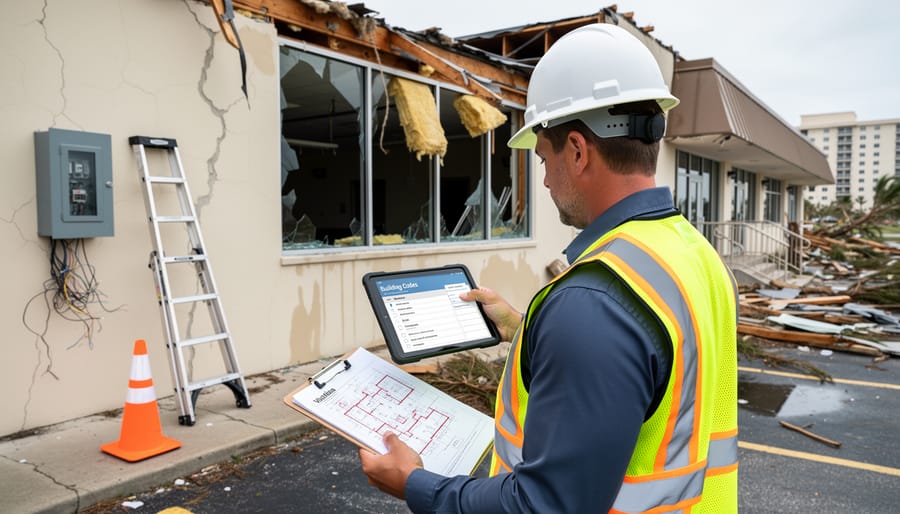
Identifying potential violations before they become insurance nightmares requires knowing what to look for. Properties built before 1980 often face the greatest risk, as building codes have evolved significantly since then. If your structure predates major code updates in your jurisdiction, it’s likely operating under outdated safety standards that could trigger coverage issues during a claim.
Recent renovations without proper permits are major red flags. That finished basement or kitchen remodel might look great, but unpermitted work often means code violations lurking beneath the surface. Insurance adjusters specifically investigate renovation history after disasters.
Location matters tremendously. If your property sits in newly designated flood zones, wildfire interfaces, or earthquake-prone areas that weren’t previously mapped as high-risk, you may unknowingly be out of compliance with current disaster preparedness requirements. These updated hazard maps often come with new building standards that existing structures must meet.
Commercial properties face additional scrutiny around fire suppression systems, emergency exits, and accessibility features. Deferred maintenance on these critical systems compounds aging property insurance challenges.
Watch for outdated electrical systems, particularly knob-and-tube wiring or aluminum wiring, and roofs exceeding their expected lifespan. These conditions frequently trigger ordinance enforcement during post-disaster inspections.
Getting a Professional Code Compliance Assessment
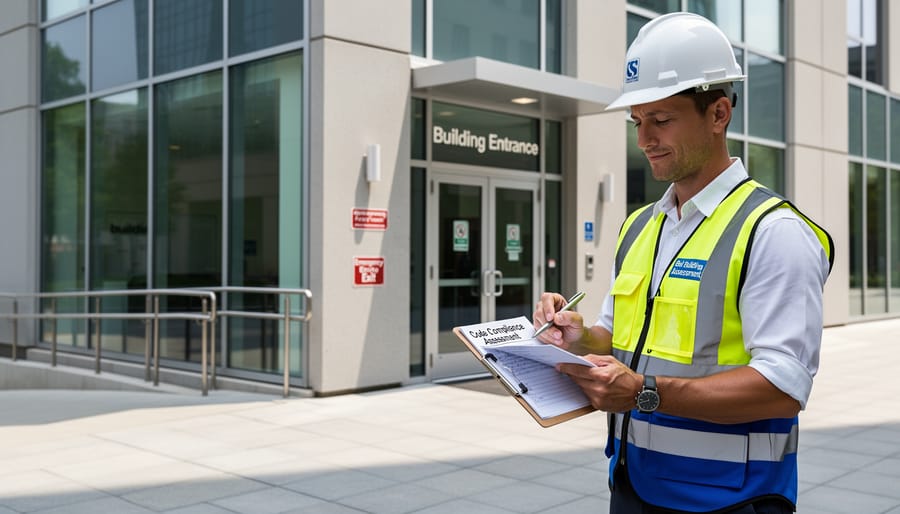
Before disaster strikes, a professional code compliance assessment can save you thousands in insurance claim denials and reconstruction costs. Working with qualified building inspectors, structural engineers, or specialized insurance assessors provides an objective evaluation of your property’s adherence to current disaster preparedness codes.
Start by contacting your local building department to schedule an official inspection. Many municipalities offer voluntary compliance reviews at minimal cost. These inspectors understand regional hazards, whether it’s seismic requirements in California or hurricane standards in Florida, and can identify specific vulnerabilities before they become claim-killing issues.
For commercial properties or complex residential structures, hiring a licensed structural engineer adds another layer of protection. Engineers can assess whether your building meets elevated foundation requirements, wind-resistance standards, or fire-rated construction specifications that often determine Ordinance or Law coverage eligibility.
Insurance assessors specializing in property risk evaluation offer a unique perspective. They review your property through the lens of claim viability, identifying exactly what insurers will scrutinize after a disaster. This proactive approach helps you prioritize upgrades that maximize both safety and coverage.
Document everything. Request written reports detailing current code compliance status, recommended improvements, and estimated upgrade costs. This documentation becomes invaluable when negotiating insurance premiums, applying for building permits, or demonstrating due diligence to potential buyers.
Making the Financial Case for Ordinance or Law Coverage
Let’s talk numbers, because when it comes to protecting your property investment, the math tells a compelling story.
Ordinance or Law coverage typically adds between $50 to $300 annually to your homeowner’s policy, depending on your property’s value and location. Compare that to the potential out-of-pocket costs you could face without it, and the decision becomes remarkably clear.
Consider a typical scenario: You own a $400,000 home built in 1985. A kitchen fire causes $75,000 in damage, but during repairs, the inspector discovers your electrical system doesn’t meet current code. Full code compliance during reconstruction could add $40,000 to $60,000 in mandatory upgrades. Without Ordinance or Law coverage, that’s entirely your responsibility, even though your standard policy covers the fire damage itself.
For commercial properties, the stakes escalate quickly. A $2 million retail building from the 1970s might require $500,000 or more in code-related upgrades after a covered loss. The annual endorsement cost of $800 to $1,500 looks like a bargain when weighed against this exposure.
Here’s the real-world breakdown by property type:
Single-family homes valued at $300,000 to $500,000 typically pay $75 to $150 annually for 25% coverage (covering up to 25% of the dwelling value for code upgrades). Investment properties and multi-unit buildings in the $750,000 to $1.5 million range might pay $200 to $400 annually for similar coverage ratios.
The return on investment becomes obvious during a claim. Spending $150 yearly for a decade equals $1,500—potentially saving you tens of thousands when building codes demand expensive modernization. For property owners serious about protecting their equity, this coverage isn’t optional; it’s foundational risk management that pays dividends precisely when you need it most.
How to Add This Protection to Your Policy
Adding Ordinance or Law coverage to your property insurance policy is a straightforward process, but it requires active communication with your insurance agent or broker. Start by scheduling a dedicated conversation about this specific endorsement rather than treating it as an afterthought during policy renewal. When reviewing your insurance policy, clearly explain that you want protection against losses stemming from building code violations or disaster preparedness regulation non-compliance.
Ask your agent these critical questions: What percentage of my building’s value does the coverage provide for demolition, increased construction costs, and undamaged portions? Many policies offer tiered options like 10%, 25%, or 50% of your dwelling coverage. Does the endorsement cover loss of rental income during extended reconstruction periods? Are there exclusions specific to my property’s age or location? Understanding these details helps you avoid nasty surprises during claims.
Coverage limits deserve careful consideration. Real estate investors with older properties should consider higher limits, as bringing a pre-1980s building to current code can easily double reconstruction costs. The sweet spot for most homeowners falls between 25-50% of dwelling coverage, though properties in high-risk zones may warrant maximizing this protection.
This endorsement typically works alongside your standard dwelling coverage, not as a replacement. It activates only when a covered peril triggers the loss and authorities mandate code compliance upgrades. Request written confirmation of how it coordinates with your replacement cost coverage and any flood or earthquake endorsements you carry.
Understanding the financial risks associated with building code violations isn’t meant to create panic—it’s about making informed decisions that protect your investment. Ordinance or Law endorsements represent more than just another line item on your insurance policy. They’re a strategic safeguard against costs that could otherwise derail your financial recovery after a covered loss. The gap between standard property insurance and the actual cost of code-compliant rebuilding can stretch into hundreds of thousands of dollars, turning what should be a full recovery into a devastating financial burden.
Now is the time to take action. Pull out your current property insurance policy and review your coverage limits. Look specifically for Ordinance or Law endorsements and assess whether the coverage amounts align with your property’s actual exposure. Don’t leave this crucial protection to chance or assumptions. Schedule a conversation with your insurance professional to discuss your specific situation, including your property’s age, location, and potential code upgrade requirements. This proactive approach transforms potential financial catastrophe into manageable, predictable risk—an investment in your peace of mind and financial security.