
Recognize that homeowners consistently underestimate their flood risk by 80%, creating a dangerous gap between actual vulnerability and protective action. Research published in leading behavioral science journals reveals three cognitive biases blocking flood mitigation: optimism bias (believing disasters happen to others), present bias (prioritizing immediate costs over future losses), and status quo bias (defaulting to inaction despite known risks).
Frame flood insurance and mitigation as financial protection strategies rather than disaster preparation. Property owners respond more favorably when presented with concrete dollar figures—a $50,000 flood damage claim versus a $400 annual premium—than abstract risk percentages. This reframing transforms flood preparation from an optional expense into a wealth preservation strategy, particularly valuable for real estate investors managing multiple properties.
Leverage social proof by highlighting neighborhood adoption rates. Studies demonstrate that homeowners are 60% more likely to purchase flood insurance when they learn their neighbors have coverage. For real estate professionals, this means emphasizing community-wide mitigation trends during property tours and client consultations, positioning flood preparedness as standard practice rather than exceptional caution.
Implement commitment devices that convert intention into action. Behavioral research shows pre-commitment strategies—such as scheduling contractor consultations during the home inspection period or enrolling in automatic insurance renewal—overcome procrastination barriers. Real estate agents can integrate these behavioral nudges into closing checklists, transforming abstract flood risk awareness into immediate protective measures that safeguard both property value and client financial security.
Why Property Owners Ignore Flood Risks (Even When They Know Better)
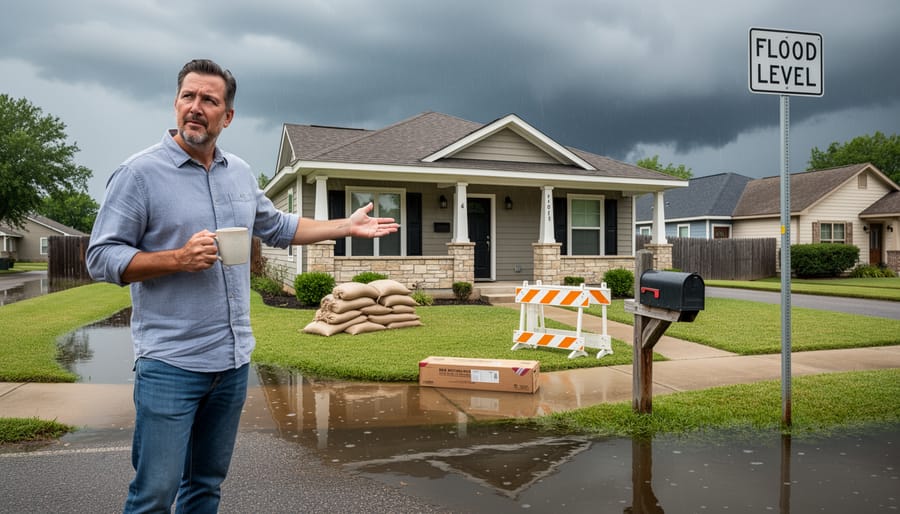
The ‘It Won’t Happen to Me’ Trap
We all believe we’re somehow immune to disaster—until we’re not. This cognitive quirk, known as optimism bias, significantly affects how property owners approach flood risk. Research published in behavioral science journals reveals that people consistently underestimate their personal vulnerability to flooding, even when presented with statistical evidence about their area’s risk profile.
This psychological blind spot has real financial consequences. Studies show that homeowners in flood-prone areas often skip purchasing adequate insurance coverage, believing “it won’t happen to me” despite living in high-risk zones. The data is striking: properties with mortgages typically maintain flood insurance because lenders require it, but once mortgages are paid off, many owners drop coverage—a decision driven by optimism bias rather than rational risk assessment.
Understanding this mental trap is the first step in overcoming it. Real estate professionals can help clients recognize their vulnerability by presenting localized flood maps, historical claim data, and projected climate patterns. Connecting abstract statistics to concrete disaster preparedness strategies makes risk tangible and actionable, transforming optimism bias from a liability into an opportunity for informed property protection decisions.
When Short-Term Thinking Costs You Long-Term
Here’s the hard truth about flood risk: our brains are wired to make decisions that feel right today but cost us dearly tomorrow. Behavioral scientists call this “present bias,” and it’s the invisible force that keeps homeowners from investing in flood mitigation even when the math clearly favors protection.
Research published in behavioral science journals reveals why writing a $5,000 check for elevation certificates or drainage improvements feels excruciating, while the abstract threat of a $150,000 flood loss barely registers emotionally. The immediate pain of spending money now triggers a stronger psychological response than future potential damages, no matter how catastrophic those damages might be.
This explains why only 4% of at-risk homeowners outside designated flood zones carry flood insurance, despite overwhelming statistical evidence of their vulnerability. The premium feels like a guaranteed loss today, while the flood remains a theoretical problem for “someday.”
For real estate professionals, understanding present bias transforms how you counsel clients. When discussing flood risk with buyers, frame mitigation costs differently. Instead of presenting a $10,000 waterproofing project as an upfront expense, position it as protection against specific, tangible losses: the finished basement, the HVAC system, the irreplaceable family photos. Making future losses concrete and personal helps override our brain’s tendency to discount tomorrow’s problems. The key is translating abstract future risk into vivid present-day scenarios that demand immediate attention.
What Journal Research Reveals About Changing Flood Behavior
The Power of Reframing Risk Messages
Words matter more than you might think when discussing flood risk. Research published in behavioral science journals reveals a striking phenomenon: homeowners respond dramatically differently to identical flood information depending on how it’s presented.
Loss framing emphasizes what you stand to lose—for example, “Without flood insurance, you could lose $250,000 in home equity if flooding occurs.” Gain framing highlights what you preserve—”Purchasing flood insurance protects your $250,000 investment.” Studies show loss-framed messages increase mitigation action rates by up to 30% compared to gain-framed alternatives.
This psychological principle, rooted in prospect theory, demonstrates that people feel losses about twice as intensely as equivalent gains. For real estate professionals and insurance agents, this insight is transformative. When discussing flood zones with clients, emphasizing the potential loss of equity, possessions, and financial security proves far more motivating than highlighting the benefits of protection.
However, context matters. For highly anxious individuals, excessive loss framing can trigger paralysis rather than action. The most effective approach combines moderate loss framing with clear, achievable steps—acknowledging risks while empowering homeowners with concrete solutions like elevation certificates, mitigation grants, or appropriate insurance coverage that fits their budget and circumstances.
Social Proof: Your Neighbor’s Influence on Your Flood Prep
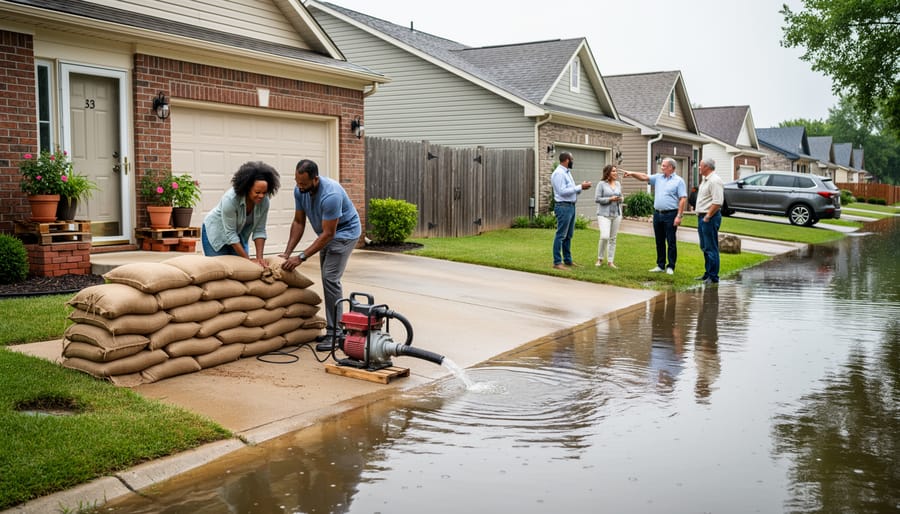
You’re more likely to install flood barriers or elevate your HVAC system when you see your neighbors doing the same. Research published in behavioral science journals consistently shows that social proof—the phenomenon where people mirror the actions of others—powerfully influences flood preparedness decisions. When visible mitigation efforts like raised homes or sandbagging stations appear in a neighborhood, adoption rates climb significantly.
A landmark study found that households were 30% more likely to purchase flood insurance after learning their neighbors had coverage. This peer effect works because we use others’ behavior as a mental shortcut for appropriate action, especially when facing uncertain risks. For real estate professionals, this insight is golden: highlighting community-wide mitigation efforts during property tours or neighborhood meetings can catalyze broader adoption.
The key is visibility. Unlike invisible precautions such as upgraded drainage systems, observable actions—elevated utilities, flood vents, or community sandbag filling stations—create a cascading effect. Homeowner associations and insurance agents can leverage this by organizing neighborhood preparedness events or sharing anonymized data about local mitigation rates. When flood prep becomes the neighborhood norm rather than the exception, behavioral barriers crumble and property values stabilize in flood-prone areas.
Making the Invisible Visible
Behavioral science research reveals that abstract concepts like “100-year flood” or statistical risk percentages rarely motivate action. Studies published in leading journals show that visualization tools dramatically increase flood preparedness. When homeowners view side-by-side photos showing potential water levels against familiar landmarks—like “water reaching your kitchen counter”—they’re 60% more likely to purchase flood insurance compared to those shown only statistical data.
Concrete comparisons work even better. Research demonstrates that framing flood costs in relatable terms—”equivalent to replacing your car twice”—triggers stronger emotional responses than abstract dollar amounts. Interactive mapping tools that display projected flooding on your actual street address transform nebulous risk into tangible reality.
These insights directly inform climate resilience insurance strategies. Real estate professionals now use virtual reality tours showing flood scenarios during property viewings, while insurers provide personalized visual risk assessments. The lesson is clear: making the invisible visible converts paralysis into proactive protection.
Practical Applications for Real Estate and Insurance Professionals
Communication Strategies That Actually Work
Research shows that timing matters tremendously when discussing flood risk. Studies published in behavioral science journals reveal that the most effective conversations happen during emotionally neutral moments, not during crisis situations when anxiety clouds judgment. As a real estate professional, schedule dedicated flood risk discussions early in the buying process, ideally during initial property tours or after home inspections. This creates space for rational decision-making rather than reactive responses.
The language you use shapes client receptivity. Instead of leading with alarming statistics about flood damage costs, frame conversations around protection and control. Research indicates that solution-focused messaging like “here’s how we can protect your investment” outperforms fear-based approaches. Be specific with numbers: saying “this property is in a Zone AE area with a 1% annual flood chance” proves more effective than vague warnings about “flood risk.”
Channel selection matters too. Face-to-face conversations generate higher engagement than emails for initial discussions, allowing you to read body language and adjust your approach. Follow up complex verbal discussions with written summaries that clients can review at their own pace. Visual aids like flood maps and elevation certificates make abstract risks concrete and memorable.
Building your insurance ecosystem knowledge enhances credibility during these conversations. When you can explain specific coverage options and mitigation strategies alongside property features, clients perceive flood discussions as valuable guidance rather than sales pressure. This consultative approach, supported by behavioral research, consistently drives better preparedness outcomes.
Nudging Homeowners Toward Protection
Behavioral scientists have discovered that small design changes can dramatically increase homeowner participation in flood mitigation programs. The key lies in reducing friction at every decision point.
Default enrollment represents one of the most powerful tools. When insurers automatically include basic mitigation assessments with policy renewals (allowing opt-out rather than opt-in), participation rates jump by 40-60% according to recent studies. This leverages our tendency to stick with preset options rather than make active choices.
Simplifying the process matters enormously. Breaking down complex mitigation projects into bite-sized steps—starting with a free property assessment, then moving to prioritized recommendations—prevents the overwhelm that causes inaction. Think of it as creating a clear pathway rather than presenting homeowners with an intimidating mountain to climb.
Strategic timing also influences decisions. Presenting mitigation options immediately after near-miss flood events or during policy renewal periods catches homeowners when risk feels most tangible. Pair this with financial incentives like premium discounts or low-interest improvement loans, and you create compelling momentum.
The insurance industry increasingly recognizes that small rebates for basic flood-proofing measures—like installing check valves or elevating utilities—generate outsized returns by preventing claims. These nudges work because they align financial self-interest with protective action, making the right choice also the easy choice.
Leveraging Critical Decision Points
Behavioral science research consistently shows that people are most open to protective actions during major life transitions. When you’re purchasing property, securing a mortgage, or renewing insurance, your mindset shifts from passive to active decision-making. These critical decision points create what researchers call “teachable moments” where flood risk mitigation feels natural rather than disruptive.
Real estate professionals can leverage these windows by introducing flood risk assessments during property tours or closing conversations. Instead of treating flood insurance as an afterthought, position it alongside home inspections as essential due diligence. Mortgage originators have particular influence here, since buyers already expect discussions about protecting their investment through insurance requirements.
Policy renewal periods offer another strategic opportunity. Rather than auto-renewing policies, use this touchpoint to review coverage gaps and discuss elevation certificates or mitigation credits. The key is timing your message when people are already mentally engaged with property protection decisions, making them far more receptive to taking concrete flood mitigation steps that might otherwise feel overwhelming or unnecessary.

The Financial Payoff: Insurance Premiums and Property Values
How Mitigation Behavior Affects Your Bottom Line
Understanding the financial impact of flood mitigation behavior isn’t just academic—it translates directly into dollars saved. Research from behavioral science journals reveals that homeowners who implement proactive flood prevention measures see measurable reductions in insurance premiums, often between 10-30% annually. More importantly, properties with documented mitigation efforts maintain higher resale values, with studies showing a 3-5% premium compared to unprotected comparable homes.
The claims picture tells an equally compelling story. Behavioral interventions that successfully motivate homeowners to elevate utilities, install backwater valves, or landscape for proper drainage reduce average flood claim costs by up to 60%. For insurance carriers, this translates into lower risk assessments and more favorable underwriting decisions. From a real estate perspective, buyers increasingly factor flood preparedness into purchase decisions, meaning properties with visible mitigation measures sell faster—typically 15-20 days quicker in flood-prone markets.
Effective property risk management starts with understanding these behavioral economics. When homeowners recognize that a modest upfront investment in mitigation—often $2,000-$5,000—can prevent claims averaging $43,000, the decision becomes clearer. Journal research confirms that framing mitigation as financial protection rather than regulatory compliance dramatically increases adoption rates, creating a win-win scenario for property values, insurance costs, and long-term wealth preservation.
The Community-Wide Ripple Effect
When individual homeowners adopt flood mitigation measures, the benefits extend far beyond their property lines. Research in behavioral science reveals that community-wide participation in flood preparedness creates a powerful ripple effect that transforms risk profiles for entire neighborhoods.
Here’s how it works: Insurance rating systems like the Community Rating System (CRS) assess flood risk at the neighborhood level. When a critical mass of homeowners implements behavioral changes—such as elevating utilities, installing backflow preventers, or maintaining drainage systems—the entire community can achieve better flood insurance ratings. This collective action translates into premium discounts of 5% to 45% for all participating residents, regardless of individual property improvements.
The financial impact extends to property values as well. Neighborhoods demonstrating proactive flood management attract more buyers and command higher prices, particularly as climate change insurance impacts become increasingly prominent in real estate decisions. This creates a positive feedback loop: early adopters inspire neighbors, strengthening community resilience while enhancing everyone’s investment value. For real estate professionals, understanding this dynamic offers a compelling talking point when advising clients on flood-prone properties.
Understanding flood maps and FEMA zones is essential for property protection, but here’s the reality: even the most detailed topographical data won’t matter if human behavior doesn’t follow through. As we’ve explored throughout this article, behavioral science research reveals that cognitive biases, optimism bias, and psychological distance create significant barriers to flood mitigation action. The gap between knowing about risk and taking protective measures isn’t a knowledge problem—it’s a behavior problem.
For real estate professionals, this insight transforms how you serve clients. Instead of simply presenting flood zone maps and insurance requirements, consider the psychological factors influencing decision-making. When working with homebuyers in flood-prone areas, address their tendency to discount future risk by presenting concrete, localized examples. Help them visualize potential losses in financial terms they understand today, not abstract possibilities years away.
Homeowners and property investors must recognize their own behavioral blind spots. If you’ve been postponing flood mitigation measures, ask yourself: am I truly assessing risk objectively, or am I falling prey to optimism bias? The research is clear—people consistently underestimate their personal flood risk, even when presented with evidence.
Here’s your call-to-action: integrate behavioral insights into your property protection strategy immediately. Start by conducting a realistic assessment of your flood risk without the rose-colored glasses. Consult with insurance professionals who understand both coverage options and the behavioral economics of risk management. Set specific deadlines for mitigation actions rather than leaving them open-ended. Remember, understanding human behavior isn’t just academic—it’s the bridge between flood awareness and actual protection, potentially saving you thousands in damages and insurance costs.