
Understanding property value requires mastering three fundamental approaches that form the bedrock of real estate appraisal: the sales comparison approach, which analyzes recent comparable property transactions in your market; the cost approach, which calculates value based on land worth plus construction expenses minus depreciation; and the income approach, which determines value through projected rental income and capitalization rates. Each method serves distinct property types and transaction purposes, yet traditional applications increasingly fall short when evaluating modern sustainable buildings equipped with solar panels, high-performance insulation, and water reclamation systems.
The gap between conventional valuation practices and green property assessment creates significant financial risk. Standard appraisal models often overlook energy savings, reduced operating costs, and enhanced tenant retention that sustainable features deliver. Properties with LEED certification or Energy Star ratings command premium prices and generate higher returns, yet many appraisers lack frameworks to quantify these benefits accurately. This disconnect leaves investors unable to justify higher acquisition costs despite long-term value creation, while sellers struggle to capture full market value for their sustainable investments.
Bridging this valuation gap requires integrating new metrics into traditional approaches: energy performance certificates, operational cost comparisons, and tenant willingness-to-pay studies. Forward-thinking professionals now incorporate carbon footprint analysis, climate risk assessments, and utility bill comparisons into their valuation toolkits. These enhanced methodologies protect investments, ensure accurate pricing, and position stakeholders to capitalize on the accelerating shift toward environmentally responsible real estate.
Why Traditional Valuation Methods Miss the Sustainability Picture

The Green Value Gap
When appraisers rely on the comparable sales approach to value sustainable properties, they often hit a frustrating roadblock: the green value gap. This phenomenon occurs because traditional valuation methods struggle to accurately price eco-friendly features, leaving money on the table for sellers and creating uncertainty for buyers.
The core issue is a lack of comparable data. Most real estate markets simply don’t have enough green properties trading hands to establish reliable pricing benchmarks. When an appraiser tries to value a home with solar panels, geothermal heating, or advanced insulation systems, finding truly comparable sales becomes nearly impossible. Standard property databases don’t systematically track sustainability features, and when they do, the data is often incomplete or inconsistent.
Even when comparable green properties exist, quantifying their environmental features in dollar terms presents a significant challenge. How much value should be assigned to a LEED certification versus Energy Star appliances? What premium should a net-zero energy home command compared to a standard new build? Without clear market signals, appraisers often default to conservative estimates or ignore green features altogether.
This conservative approach creates a vicious cycle. When appraisals undervalue sustainable features, lenders may not approve financing that reflects the true worth of these improvements. Homeowners then hesitate to invest in green upgrades, perpetuating the scarcity of comparable sales data. Breaking this cycle requires new valuation frameworks that can capture the financial benefits of sustainability, from reduced utility costs to enhanced property resilience.
What Appraisers Are Missing
Traditional appraisers often undervalue properties with sustainable features, missing crucial value drivers that resonate with today’s buyers. Solar panel installations top the list of overlooked assets. While appraisers may acknowledge their presence, they frequently fail to account for the long-term energy cost savings and potential income from net metering programs. This oversight can shortchange sellers by thousands of dollars.
Water efficiency systems present another blind spot. High-efficiency irrigation, greywater recycling systems, and rainwater harvesting infrastructure rarely receive proper valuation credit, despite their measurable impact on utility costs. Similarly, advanced HVAC systems with smart thermostats and zoning capabilities often get lumped into standard mechanical assessments without recognizing their superior performance metrics.
Green building certifications like LEED or ENERGY STAR also fall victim to inconsistent valuation practices. Many appraisers lack training to quantify certification benefits, treating them as subjective rather than data-driven value indicators. Insulation upgrades, high-performance windows, and advanced air sealing measures frequently go unnoticed in appraisal reports, even though these eco-friendly features boost value through reduced operating costs and enhanced comfort. The gap between actual sustainable value and appraised value represents a significant market inefficiency that savvy investors can leverage.
The Cost Approach for Green Buildings
Calculating Sustainable Upgrades
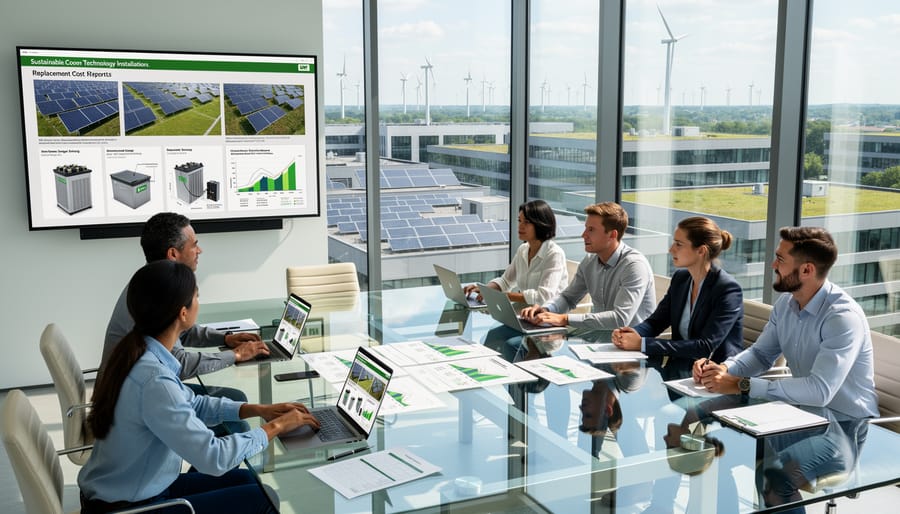
Valuing green improvements requires a methodical approach that recognizes both immediate costs and long-term financial benefits. Start by documenting the actual installation costs of sustainable features, then calculate their impact on operating expenses and market appeal.
For solar installations, appraisers typically examine the system’s purchase price, expected energy savings, and applicable tax incentives. A $25,000 solar array generating $200 monthly savings creates quantifiable value through reduced utility costs. However, the premium you can add to property value depends on local market acceptance and comparable sales data showing buyer willingness to pay for such features.
Premium materials like reclaimed hardwood or low-VOC finishes warrant careful analysis. While these upgrades cost 15-30 percent more than standard options, they may only contribute 10-15 percent additional value in markets where green certification isn’t prioritized. The key is identifying which improvements resonate with your specific buyer demographic.
Advanced HVAC systems present unique valuation challenges. A high-efficiency geothermal system costing $30,000 might replace a conventional $12,000 unit. The $18,000 difference doesn’t automatically translate to equivalent property value. Instead, calculate annual energy savings, maintenance cost reductions, and remaining useful life. If the system saves $150 monthly and has 20 years remaining versus 10 years for conventional equipment, these factors justify a value premium.
Documentation proves critical. Maintain detailed records showing energy audit results, utility bill comparisons, equipment warranties, and professional certifications to support your valuation claims during appraisals or negotiations.
Depreciation and Green Features
Green features present a unique depreciation challenge in real estate valuation. While conventional systems like HVAC units typically depreciate on a predictable 15-20 year curve, sustainable technologies often follow different patterns that appraisers must understand to assign accurate values.
Solar panels, for instance, may maintain functionality for 25-30 years, but their economic value can diminish faster due to rapid technological improvements. This creates a gap between physical lifespan and functional obsolescence. A ten-year-old solar system still generating power might be worth significantly less than installation cost because newer panels operate at higher efficiency rates.
Conversely, some green features depreciate more slowly than traditional alternatives. High-performance windows, advanced insulation, and geothermal systems often outlast conventional counterparts while maintaining their energy-saving benefits. The key is distinguishing between features that truly extend useful life versus those that merely delay replacement.
When valuing properties with sustainable systems, appraisers should consider the remaining economic life rather than just physical condition. This means accounting for potential technological obsolescence while recognizing that energy cost savings may offset depreciation. Insurance valuations must also reflect replacement costs for specialized green systems, which can differ substantially from standard equipment. Understanding these nuances ensures more accurate property assessments that reflect both current market conditions and long-term value propositions.
The Income Approach: Capturing Energy Savings and Rental Premiums
Quantifying Operating Cost Reductions
Understanding how operating cost reductions translate to property value is essential for accurately appraising sustainable buildings. The income capitalization approach provides the clearest framework for this conversion. Here’s how it works in practice.
Start with the basic formula: Property Value Increase = Annual Operating Cost Savings / Capitalization Rate. The capitalization rate, or cap rate, represents the expected rate of return on a real estate investment and typically ranges from 4% to 10% depending on property type and market conditions.
Let’s examine a real-world example. Consider a commercial property that implements LED lighting, high-efficiency HVAC systems, and smart building controls. These upgrades generate the following annual savings: $8,000 in electricity costs, $3,500 in HVAC maintenance, and $2,000 in water expenses, totaling $13,500 annually.
Using a conservative 7% cap rate common in stable commercial markets, the calculation becomes: $13,500 / 0.07 = $192,857. This means the operating cost reductions alone justify nearly $193,000 in additional property value.
For residential properties, the math works similarly but often uses different benchmarks. A home with solar panels saving $150 monthly in electricity costs ($1,800 annually) translates to approximately $22,500 in added value at an 8% cap rate typical for single-family residences.
The key is documenting these savings with utility bills, maintenance records, and service contracts covering at least 12 months. Appraisers and lenders increasingly accept this data when properly presented, particularly for ENERGY STAR certified buildings or LEED-certified properties.
Remember that cap rates vary by location, property class, and market cycle. Conservative appraisers might apply higher cap rates to green features due to perceived technology risk, potentially reducing the capitalized value. Always verify local market cap rates through comparable sales and investor surveys to ensure accurate valuations.
The Green Rental Premium
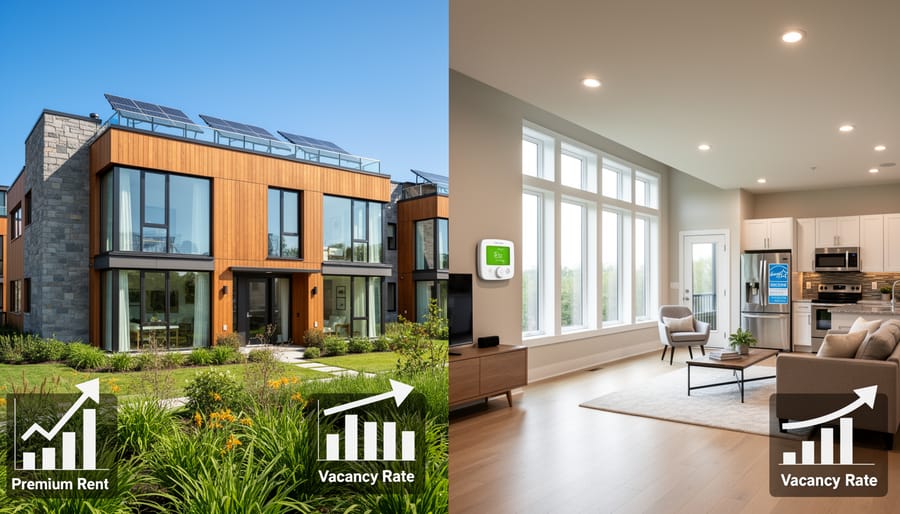
Research consistently shows that sustainable buildings command premium rents while experiencing lower vacancy rates—a phenomenon known as the green rental premium. Studies across multiple markets indicate that LEED-certified and ENERGY STAR buildings achieve rental premiums ranging from 3% to 7% compared to conventional properties. Equally important, these properties often maintain occupancy rates 2-4 percentage points higher than their traditional counterparts.
When applying income capitalization approaches, these benefits directly impact Net Operating Income (NOI). Higher rental income and reduced vacancy losses translate to measurably increased property values. For example, a building generating $100,000 in annual NOI with a 7% capitalization rate yields a value of approximately $1.43 million. A 5% rent premium and 3% lower vacancy could boost NOI to $108,000, increasing the property value to roughly $1.54 million—an 8% uplift attributable solely to sustainability features.
Smart appraisers now incorporate sustainability metrics when projecting income streams, recognizing that tenant demand for efficient, healthy spaces creates tangible financial advantages that warrant explicit consideration in valuation models.
The Sales Comparison Approach Goes Green
Finding True Sustainable Comparables
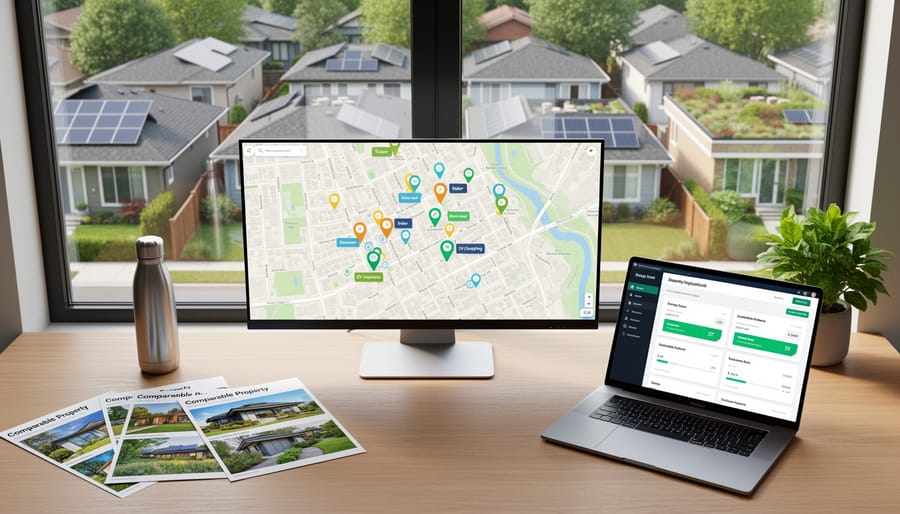
Finding truly comparable sustainable properties requires moving beyond basic square footage and location matches. The key is identifying properties with similar green credentials—think LEED certification levels, Energy Star ratings, or specific sustainable features like solar panels, geothermal systems, or high-performance insulation.
Start by building a database that tracks sustainability certifications in your market area. Properties with LEED Gold certification, for example, shouldn’t be compared to standard construction or even LEED Silver properties, as the value differential can be substantial. Documentation matters here: verified third-party certifications carry more weight than self-reported green claims.
Pay attention to the age and functionality of green features when selecting comparables. A ten-year-old solar installation won’t deliver the same value as a brand-new system, just as a basic low-flow toilet package differs significantly from a comprehensive water reclamation system. Consider the actual energy performance data when available—utility bills can provide objective evidence of operating cost savings that justify premium pricing.
Geographic considerations also shift for sustainable properties. Buyers willing to pay premiums for green features often search across broader areas, meaning your comparable search radius may need to expand beyond traditional boundaries. This wider net helps compensate for the still-limited inventory of certified sustainable properties in many markets.
Making Green Adjustments That Hold Up
Quantifying the value premium of sustainable features requires a disciplined approach grounded in actual market data rather than assumptions. Start by building a database of comparable sales that include green features similar to your subject property. For LEED-certified buildings, research shows value premiums typically range from 3% to 8%, but this varies significantly by market and certification level.
When adjusting for Energy Star ratings, examine utility cost savings as a percentage of operating expenses. Properties with Energy Star certification often command rental premiums of $0.50 to $1.50 per square foot in commercial markets. For residential properties, look at recent sales within your market that highlight energy efficiency in marketing materials, then calculate the price differential against comparable non-certified homes.
Solar panel adjustments present unique challenges since they involve both immediate value and long-term savings. Calculate the present value of energy savings over the remaining system life, typically 20-25 years, but don’t simply add the installation cost to property value. Market acceptance varies widely, so paired sales analysis works best here—comparing identical properties where one has solar and one doesn’t.
Documentation is critical. Maintain records of energy audits, certification documents, and utility bills that substantiate performance claims. Many appraisers undervalue green features simply because they lack hard data. The Appraisal Institute’s Residential Green and Energy Efficient Addendum provides a standardized framework for reporting these adjustments, helping ensure your valuation withstands scrutiny from lenders and investors who increasingly recognize sustainability’s financial impact.
Emerging Valuation Tools for Sustainable Properties
Energy Performance Certificates and Valuation
Energy Performance Certificates (EPCs) are increasingly becoming critical components in property valuation, transforming from mere compliance documents into valuable market indicators. These certificates, which rate a building’s energy efficiency on a standardized scale, provide appraisers with quantifiable data that directly correlates with operating costs and environmental impact.
Across Europe, where EPCs have been mandatory since 2008, data shows properties with higher energy ratings consistently command price premiums of 3-10% compared to similar properties with lower ratings. In the United Kingdom, research indicates that homes rated A or B can sell for up to 14% more than their G-rated counterparts. This trend is accelerating as buyers become more conscious of long-term utility expenses and carbon footprints.
Progressive appraisers are now integrating energy audit data into their comparable sales analyses, adjusting values based on insulation quality, HVAC efficiency, and renewable energy installations. Some markets have developed “green adjustment” matrices that systematically account for energy performance differences between properties. Insurance companies are also taking notice, with some offering reduced premiums for high-performing properties that demonstrate lower risk profiles through superior energy efficiency and climate resilience features.
Green Certification Premium Analysis
Green-certified properties command measurable premiums in today’s market, though the numbers vary significantly by certification type and location. LEED-certified commercial properties typically see a 3-7% value increase compared to conventional buildings, with Platinum certifications at the higher end of that range. BREEAM-certified properties in European markets show similar trends, averaging 5-6% premiums in the UK and Northern Europe. The WELL Building Standard, focusing on occupant health, is emerging as a premium driver, particularly in Class A office spaces where tenant quality matters most.
Market-specific data reveals interesting patterns. In sustainability-forward cities like San Francisco, Portland, and Copenhagen, green premiums can reach 10-15% for residential properties. Meanwhile, markets with less environmental awareness might only see 2-3% increases, if any. Energy Star certification, while less comprehensive than LEED, provides the most consistent returns across residential markets at 2-4% premiums nationwide.
The challenge for appraisers lies in isolating certification value from other premium features these buildings typically include. Advanced construction quality, superior locations, and newer vintage often accompany green certifications, making pure certification premiums difficult to extract. Recent paired-sales analysis suggests that certification itself accounts for roughly 40-60% of the observed premium, with remaining value tied to associated quality improvements.
Climate Risk and Future-Proofing Adjustments
Forward-thinking appraisers are revolutionizing property valuation by incorporating environmental risk factors that were once overlooked. As extreme weather events become more frequent and costly, climate resilience features now directly impact long-term property values. Coastal properties face scrutiny for flood zone designations, while inland homes are assessed for wildfire risk and drought vulnerability. Smart appraisers now consider whether a property has protective features like elevated foundations, impact-resistant windows, or backup power systems. They’re also factoring in emerging regulatory requirements, such as mandatory energy efficiency standards and carbon disclosure rules that could affect future marketability. Insurance availability has become a critical valuation component too, as some high-risk areas see carriers withdraw coverage entirely. Properties with documented climate adaptation measures increasingly command premium prices, while those vulnerable to environmental hazards face valuation discounts that reflect potential future losses and reduced buyer appeal.
What This Means for Your Next Real Estate Transaction
For Buyers and Investors
When purchasing property with green features, protecting your investment starts with requesting a comprehensive appraisal that specifically accounts for sustainable elements. Don’t assume your appraiser will automatically recognize the value of solar panels, energy-efficient HVAC systems, or green building certifications. Instead, explicitly request that these features be evaluated and documented in the appraisal report.
Ask potential appraisers about their experience with green valuations and whether they use specialized tools or databases that track energy-efficient comparable sales. An appraiser unfamiliar with sustainability metrics might undervalue features that significantly reduce operating costs and increase long-term property value.
When reviewing offers, scrutinize how green features are factored into the price. A seller claiming premium value for solar panels should provide documentation of energy savings and system warranties. Calculate the actual return on investment by examining utility bills and maintenance records rather than relying solely on promotional materials.
Consider obtaining an independent energy audit to verify claimed efficiency ratings. This protects you from overpaying for underperforming green features while ensuring you’re not leaving money on the table by undervaluing legitimate sustainable improvements. Remember, accurate valuation of green properties requires both traditional appraisal knowledge and specialized understanding of how environmental features translate into measurable financial benefits.
For Sellers and Appraisers
If you’re selling or appraising a property with sustainable features, proper documentation is your best friend. Start by creating a comprehensive green features inventory that includes energy-efficient appliances, solar panels, smart home systems, water-saving fixtures, and sustainable building materials. Don’t just list them—gather the receipts, warranties, and utility bills that prove their value. Energy audit reports and utility cost comparisons showing month-over-month savings provide concrete evidence that resonates with appraisers and buyers alike.
When preparing your listing or appraisal report, quantify everything possible. Instead of simply noting “solar panels,” specify the system capacity, installation date, estimated annual savings, and remaining warranty period. For LEED or ENERGY STAR certifications, include the certification level and date. This specificity helps appraisers justify higher valuations and gives buyers confidence in their investment.
Work proactively with appraisers by providing comparable sales data from properties with similar green features. Many appraisers aren’t yet trained in sustainable property valuation, so making their job easier increases the likelihood that eco-friendly upgrades receive proper consideration. Consider obtaining a green appraisal addendum, which specifically addresses sustainable features and their impact on value. Remember, the insurance benefits of disaster-resistant features and energy-efficient systems can also strengthen your property’s market position, so highlight these elements prominently in your documentation.
The real estate landscape is shifting dramatically, and sustainable valuation approaches are no longer a niche consideration—they’re rapidly becoming standard practice. For property owners, investors, and industry professionals, understanding how green features impact property values isn’t just about environmental responsibility; it’s about protecting and maximizing financial returns. Properties with verified sustainable features consistently demonstrate lower operating costs, higher tenant retention, and increased market appeal, all of which translate directly to your bottom line.
As green building standards evolve and energy efficiency regulations tighten, traditional valuation methods alone won’t capture the full financial picture. This creates both risk and opportunity. Working with specialized appraisers who understand sustainable valuation methodologies ensures you’re making informed decisions based on comprehensive data rather than outdated assumptions.
Whether you’re buying, selling, refinancing, or insuring property, staying current with evolving valuation standards is essential. The financial implications are real—from securing better financing terms to commanding premium sales prices. Make it a priority to seek professionals who integrate sustainability metrics into their analyses, and keep yourself informed about emerging certification programs and assessment tools. Your financial future in real estate depends on it.