
Responsible online casino play in Canada starts with treating your gambling budget as discretionary entertainment spending, never as income or investment capital, and establishing hard financial guardrails that protect your down payment savings, mortgage payments, and credit score before you place a single bet. For Canadian homeowners and property investors, this means separating gambling funds entirely from real estate reserves and setting up automated account barriers that prevent dipping into equity lines of credit or emergency funds. The stakes are particularly high in 2026, as the rise of crypto gambling platforms has made it easier than ever to bypass traditional banking safeguards and quickly move substantial sums without the friction that once gave players natural pause points.
The connection between gambling habits and financial health isn’t abstract. Mortgage underwriters scrutinize bank statements for patterns of risky behavior, and excessive casino transactions can raise red flags during refinancing or new property acquisitions. Even moderate online play can spiral when it’s funded through home equity or when losses prompt desperate attempts to recover money earmarked for property taxes or insurance premiums.
This guide approaches responsible gambling through a real estate and finance lens, recognizing that your primary wealth-building tool is property ownership, not casino winnings. The frameworks outlined here aren’t generic harm-reduction tips. They’re specific financial firewalls designed to preserve your borrowing capacity, maintain clean credit, and ensure that a night of online blackjack never jeopardizes your closing date or forces you to postpone essential home repairs. The goal is simple: if you choose to play, do it in a way that leaves your property investment strategy completely intact.
The Hidden Connection Between Online Casino Play and Your Real Estate Goals

Most Canadian homeowners would never think twice about the connection between placing a few casual bets online and their ability to refinance a mortgage or secure that investment property. Yet online casino play creates a documented financial trail that lenders, insurers, and credit bureaus scrutinize closely, and the patterns they spot can derail real estate plans years in the making.
When you place bets through online casinos, those transactions appear on bank statements as recurring debits. Mortgage underwriters reviewing your application don’t just verify income; they analyze spending patterns to assess financial discipline and stability. Frequent casino transactions, even small ones, signal potential risk management issues. If your statements show regular gambling activity totaling hundreds of dollars monthly, underwriters may question your ability to prioritize mortgage payments during financial stress or calculate higher debt-to-income ratios that push you outside qualification thresholds.
The credit score impact runs deeper than most realize. While responsible gambling won’t directly damage your credit, the behaviors it can trigger absolutely will. Players chasing losses often tap credit cards, exceeding recommended utilization rates. Research on gambling problems in Canada shows that individuals experiencing moderate to severe gambling issues face significantly higher rates of bankruptcy and debt accumulation. Each maxed-out card drops your score by 20 to 50 points, and missed payments, often occurring when gambling spending crowds out bill payments, can slash scores by 100 points or more.
The wealth-building consequences compound over time. Consider a buyer who spends $200 weekly on online casinos, roughly $10,400 annually. Redirected into a high-interest savings account at 4.5%, that same amount would generate over $58,000 in ten years, enough for a substantial down payment in many Canadian markets. Instead, it vanishes with zero return, delaying homeownership and costing years of equity accumulation.
For current homeowners, gambling habits threaten equity protection strategies. Property investors juggling multiple mortgages face razor-thin cash flow margins. A few losing months can mean skipped maintenance, delayed renovations, or tapping home equity lines for non-investment purposes, decisions that erode property value and long-term returns. The opportunity cost isn’t just the money lost; it’s the compound growth, equity building, and financial flexibility that responsible real estate investing creates.
Understanding Canada’s Online Casino Landscape in 2026
Provincial Regulations and What They Mean for You
Canada’s online casino landscape is a patchwork of provincial oversight, not federal regulation. Each province operates its own gambling authority, creating distinct rules that directly affect your access, protections, and recourse if problems arise.
Ontario leads with its regulated iGaming market launched in 2022, overseen by the Alcohol and Gaming Commission of Ontario (AGCO). Licensed operators must implement mandatory deposit limits, self-exclusion tools, and reality checks. Quebec runs its own platform, Espacejeux, maintaining monopoly control with no private operators allowed. British Columbia operates exclusively through the BC Lottery Corporation.
For Atlantic provinces, the Atlantic Lottery Corporation provides the sanctioned platform. Prairie provinces like Manitoba and Saskatchewan similarly restrict play to government-run sites. Alberta permits both AGLC’s and offers some private operator licensing.
Here’s what matters for your financial protection: provincially-regulated sites must verify your identity, enforce responsible gambling tools, and provide complaint mechanisms. They cannot extend credit or allow you to gamble on margin, critical safeguards for protecting your down payment fund.
Offshore sites operating outside provincial frameworks offer zero consumer protections. If you dispute a transaction or experience technical issues costing you money, you have no regulatory body backing your claim. They also lack mandatory spending limits, making budget overruns more likely. Stick with your province’s regulated options to ensure your real estate savings stay protected.
The Rise of Mobile Casino Access
Smartphones have fundamentally changed when and where Canadians can access online casinos. Unlike desktop gambling that required sitting at a computer, mobile apps now let players place bets during lunch breaks, commutes, or even while reviewing mortgage documents at home. This constant availability has removed the natural friction that once limited gambling frequency.
The convenience creates specific risks for budget management. Research shows mobile casino users gamble more frequently in shorter sessions, often without the mindful decision-making that comes with deliberately opening a laptop. You might allocate $200 monthly for entertainment, but mobile access makes it dangerously easy to make “just one more” deposit when that budget runs dry.
For homeowners and aspiring buyers, this accessibility means your down payment savings account is always just a few taps away from compromise. Many mobile banking apps let you transfer funds instantly to casino accounts, eliminating the cooling-off period that previously existed between impulse and action. Setting up device-level restrictions, removing casino apps during vulnerable moments, and establishing separate “untouchable” savings accounts become essential protective measures in this mobile-first gambling environment.
Financial Red Flags: When Casino Play Threatens Your Property Investment
Your online casino play crosses into dangerous territory when it starts competing with your property investments for financial resources. The transition from recreational gambling to a threat against your real estate wealth often happens gradually, which is why recognizing the warning signs early can mean the difference between a minor course correction and a derailed home-buying timeline.
The most immediate red flags appear in your monthly cash flow. When you find yourself juggling which bills to pay first, or consistently running short between paydays despite a steady income, gambling expenditures may be the culprit. Many Canadian homeowners and aspiring buyers don’t realize how quickly $50 or $100 sessions add up until they’re staring at an overdrawn account on the first of the month.
Watch for these specific warning signs that casino play is compromising your real estate goals:
- Missed or late mortgage payments that you previously managed without difficulty
- Emergency fund balances dropping below three months of expenses or being completely depleted
- Using credit cards or lines of credit to fund gambling sessions
- Postponing necessary property maintenance or repairs due to lack of funds
- Failing to contribute to your down payment savings account for two or more consecutive months
- Borrowing from family members or taking payday loans to cover basic living expenses
Your credit utilization ratio provides another critical indicator. If your credit card balances have climbed above 30 percent of your available limits, particularly on cards you previously kept at low balances, gambling-related spending may be responsible. This elevated utilization damages your credit score, which directly affects mortgage qualification and the interest rates lenders will offer you.
The down payment fund test offers perhaps the clearest measure. Ask yourself honestly whether your intended property purchase timeline has shifted backward. If you planned to buy within 18 months but now realize you’re no closer to your savings goal than you were six months ago, your gambling budget may be consuming funds that should be building equity. Similarly, if you’ve dipped into your down payment savings to cover current expenses or gambling losses, you’ve crossed a critical line that requires immediate intervention.
Property owners face an additional red flag when they start viewing their home equity as a gambling bankroll. Considering a home equity line of credit to fund casino play, or already having tapped one for this purpose, represents a severe threat to your financial foundation that demands professional help.
Building Your Responsible Play Framework
The Real Estate-First Budget Method
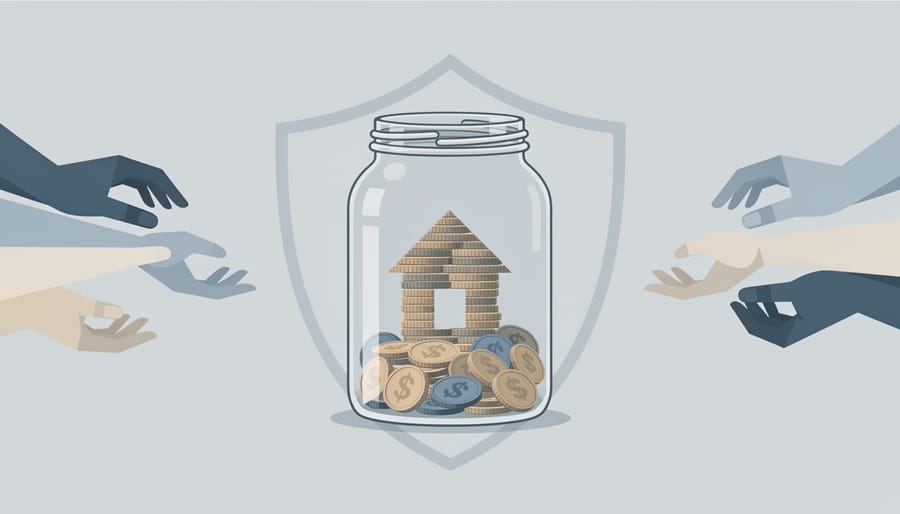
The Real Estate-First Budget Method flips traditional budgeting on its head by treating your property goals as non-negotiable fixed expenses rather than aspirational targets. This approach ensures your gambling entertainment never competes with your mortgage payment or down payment savings.
Here’s how to implement this framework:
- Calculate your total monthly housing costs, including mortgage (or rent), property taxes, insurance, utilities, and maintenance reserves. This becomes your first-priority allocation.
- Set aside your down payment contribution immediately after payday, treat it like a bill you cannot skip. Automate transfers to a separate high-interest savings account that requires extra steps to access.
- Cover essential living expenses: groceries, transportation, insurance premiums, and minimum debt payments. Include smart debt management strategies to reduce interest costs that eat into your housing fund.
- Build or maintain an emergency fund equal to three months of housing costs. Property ownership comes with surprise expenses, a failed furnace or roof leak shouldn’t force you to tap gambling funds or credit.
- Only after these four categories are fully funded can you allocate discretionary income to entertainment, including online casino play. Calculate this as a specific dollar amount, not a percentage, so it never scales up with winnings.
The key difference from standard budgeting is sequencing. Most people budget for necessities, then split what remains between savings and fun. The Real Estate-First method locks in your property goals before anything discretionary enters the equation. If a particular month leaves nothing for casino play after covering priorities one through four, that’s your financial reality speaking, and protecting your home ownership dreams.
Track every category separately using banking apps or spreadsheets. When your gambling allocation runs out, you’re done for the month, regardless of winning streaks or promotional offers.
Setting Hard Limits That Protect Your Down Payment
Your down payment fund represents your ticket to homeownership, and protecting it requires concrete barriers, not just good intentions. Start by opening a completely separate savings account at a different financial institution from your primary bank. This physical separation creates friction that prevents impulsive transfers during a gambling session.
Set up automatic transfers to this dedicated account immediately after each payday, treating it like a non-negotiable bill. Many Canadian banks allow you to remove online access to specific accounts. Take advantage of this feature for your down payment fund. If you can’t transfer money online at 11 PM during a casino session, you’ve created a crucial protective barrier.
Most legitimate Canadian online casinos offer deposit limit tools. Set a monthly limit that equals no more than 2-3% of your after-tax income, and never your down payment amount. These limits typically require a 24-48 hour cooling-off period before increasing them, which stops heat-of-the-moment decisions.
Consider using casino self-exclusion programs offered through provincial gaming authorities. These range from short-term breaks (weeks or months) to permanent exclusions. If you’re within 12 months of your home purchase target date, a temporary self-exclusion removes temptation entirely during this critical savings period.
For maximum protection, designate your down payment account as a joint account with a trusted family member who must co-sign any withdrawals. This accountability layer makes it impossible to raid the fund without having an uncomfortable conversation first. Some aspiring homebuyers even have their accountant or financial advisor hold their down payment in trust until they’re ready to make an offer, eliminating access completely.
The key is making it genuinely difficult to access these funds on impulse, not just mentally promising yourself you won’t touch them.
Tools and Resources for Canadian Players
Canada offers a robust network of responsible gambling resources designed to help online casino players maintain control and protect their financial well-being. Whether you’re looking to assess your habits, set protective boundaries, or access immediate support, understanding these tools can make the difference between recreational play and financial jeopardy that threatens your real estate goals.
Start with self-assessment tools available through the Canadian Centre on Substance Use and Addiction (CCSA) and provincial problem gambling organizations. These confidential questionnaires take just five to ten minutes and help you identify whether your gambling patterns are crossing into risky territory. The Problem Gambling Severity Index, widely used across Canada, provides clear scoring that indicates whether you’re engaging in low-risk, moderate-risk, or problem gambling behavior. Taking this assessment quarterly gives you an objective measure of whether your habits are trending toward financial danger.
Most licensed online casinos operating in Canada now include mandatory responsible gambling features. Deposit limits let you cap daily, weekly, or monthly spending at levels that won’t compromise your mortgage payment or property tax obligations. Reality checks interrupt your play at intervals you choose, displaying how long you’ve been gambling and how much you’ve spent. These simple interruptions create crucial decision points where you can choose to stop rather than continue on autopilot. Self-exclusion programs allow you to ban yourself from gambling sites for periods ranging from six months to permanent exclusion, with breaches taken seriously by regulators.
| Province | Support Service | Contact | Key Features |
|---|---|---|---|
| Ontario | ConnexOntario | 1-866-531-2600 | 24/7 helpline, counseling referrals, self-exclusion registry |
| British Columbia | BC Problem Gambling Help | 1-888-795-6111 | Free counseling, family support, financial planning assistance |
| Alberta | Alberta Health Services | 1-866-332-2322 | In-person and virtual counseling, self-exclusion coordination |
| Quebec | Gambling: Help and Referral | 1-800-461-0140 | Bilingual support, rapid access to addiction specialists |
Provincial helplines connect you with trained counselors who understand the financial implications of problem gambling, including impacts on credit scores and mortgage qualification. Many services now offer specialized support for homeowners and buyers concerned about protecting their property investments. Financial counseling linked to these programs can help you establish gambling budgets that safeguard your down payment savings and monthly housing costs. Don’t wait until gambling threatens an imminent mortgage payment to reach out. These resources work best when you use them proactively, before small concerns become major financial crises.
Insurance and Credit Implications of Problem Gambling
Gambling-related financial troubles ripple far beyond your bank account, they directly impact your ability to secure insurance coverage and favorable rates. When online casino play damages your credit score through late payments, maxed-out cards, or debt defaults, insurers take notice. Most homeowner’s insurance companies in Canada use credit-based insurance scores as a key underwriting factor, and a drop of 50-100 points can translate to premium increases of 20-30% or policy denial entirely.
Mortgage insurance requirements become harder to meet when gambling habits create red flags. CMHC, Sagen, and Canada Guaranty scrutinize debt-service ratios and credit histories closely. If gambling debts push your total debt service ratio above 44%, you’ll struggle to qualify for high-ratio mortgages requiring default insurance. Lenders see gambling-related financial instability as elevated risk, potentially disqualifying you even with sufficient income.
The credit implications extend to policy renewals too. Insurers can reassess your risk profile at renewal time, and a credit score that’s plummeted due to casino-related debt might trigger non-renewal notices or substantially higher premiums. This creates a dangerous cycle: the financial stress from gambling makes it harder to protect your home affordably, potentially leaving you underinsured or uninsured.
Protecting your insurability means treating your credit score as valuable as the equity in your property. Before gambling habits cause damage, set up automatic payments for all insurance premiums and mortgage obligations. Monitor your credit report quarterly through Equifax or TransUnion to catch issues early. If you’ve already experienced credit damage, work with an independent insurance broker who can shop multiple carriers, some weigh credit scores less heavily than others, giving you options even with impaired credit.
Recovery and Rebuilding: Getting Your Real Estate Plans Back on Track
Credit Repair Strategies for Aspiring Homebuyers

Rebuilding credit after gambling-related debt requires a systematic approach that mortgage lenders recognize and respect. Start by obtaining your credit reports from both Equifax and TransUnion Canada, you’re entitled to free copies annually. Review them meticulously for errors, and dispute any inaccuracies immediately, as even small corrections can boost your score.
Focus on paying all bills on time moving forward; payment history accounts for 35% of your credit score. Set up automatic payments for utilities, phone bills, and any remaining debt obligations to prevent missed deadlines. If you’re carrying balances, prioritize paying down high-interest credit cards first while maintaining minimum payments on other accounts.
Keep credit utilization below 30% of your available limits, ideally under 10% for optimal scoring. Resist the temptation to close old credit cards, even if paid off, as this reduces your available credit and shortens your credit history. Instead, use them occasionally for small purchases you pay off immediately.
Consider a secured credit card if your score has dropped significantly. These require a cash deposit that becomes your credit limit, allowing you to demonstrate responsible usage. After six to twelve months of consistent, on-time payments, you’ll see measurable improvement.
Crush your debt using the avalanche or snowball method, both work, but consistency matters more than the approach. Most lenders want to see at least 12 months of clean payment history before considering mortgage applications, so patience and discipline are essential for regaining your homebuying potential.
Working With Mortgage Lenders After Financial Setbacks
Approaching mortgage lenders after gambling-related financial setbacks requires transparency and preparation. Most Canadian lenders will review your application if you can demonstrate 12-24 months of stable financial behavior since your last credit issue. Bring documentation that tells your recovery story: consecutive bank statements showing consistent savings deposits, proof of gambling self-exclusion enrollment, letters explaining the circumstances and your corrective actions, and evidence of on-time payments for all current obligations.
Your lender needs to see that the problem is resolved, not ongoing. If your credit score dropped below 650, expect to work with B-lenders initially or require a co-signer. Budget for higher interest rates, typically 0.5-2% above prime rates, until you rebuild credit sufficiently to refinance with A-lenders. Some applicants benefit from reviewing first-time homeownership steps to understand exactly what lenders scrutinize and how to strengthen each qualification area.
Realistic timeline: minor setbacks (one missed payment, small collection) may clear within 12 months of correction; significant issues (multiple delinquencies, consumer proposal) typically require 24-36 months of demonstrated financial responsibility before approval.
Your path to property ownership in Canada hinges on consistent financial discipline, and that includes how you approach online casino entertainment. While recreational gambling can be an enjoyable pastime, the moment it starts pulling funds away from your mortgage payments, eroding your down payment savings, or damaging your credit score, it becomes a direct threat to your real estate goals.
The good news is that responsible online casino play is entirely achievable with the right framework in place. By implementing the real estate-first budgeting method, setting hard limits that protect your property fund, and leveraging Canada’s provincial support tools, you can enjoy occasional gaming without sacrificing your financial future.
Take a moment this week to honestly assess your current gambling habits. Review your bank statements from the past three months. Calculate what percentage of your income goes toward online casinos. If that number exceeds your predetermined entertainment budget, or if you’ve ever delayed a mortgage payment or dipped into savings to fund casino play, it’s time to recalibrate.
Your home is likely the largest investment you’ll ever make. Protecting that investment starts with protecting the financial foundation it rests on. Set your limits, stick to your budget, and never let a night of gaming derail years of careful planning. Your future self, standing in the home you’ve worked so hard to secure, will thank you for the discipline you maintain today.