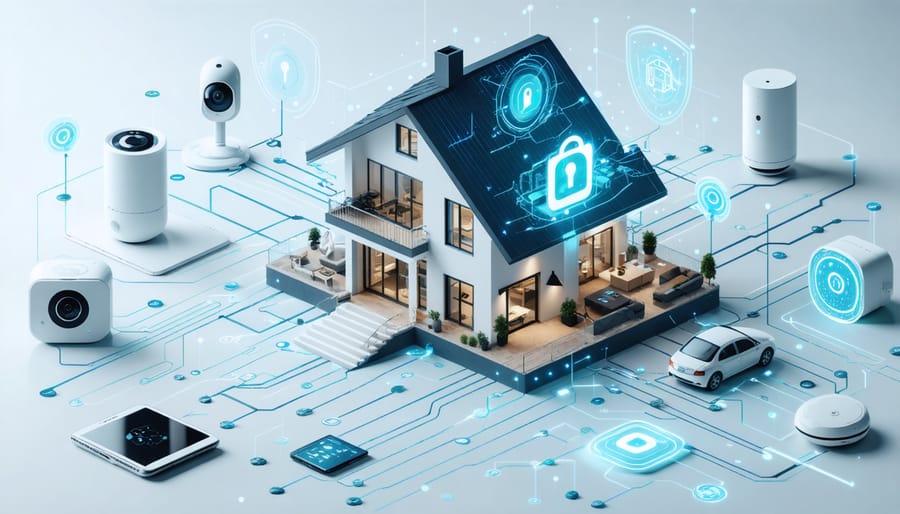
Conceptual illustration of a smart home integrated with interconnected IoT devices, including smart thermostats, cameras, and sensors, surrounded by digital security symbols indicating protection against cyber threats.

Smart Home Insurance Security Gaps That Put Your Property at Risk

The rapid expansion of IoT devices in smart homes and insurance monitoring systems has created a pressing security challenge that threatens both property owners and insurers. As connected devices proliferate – from smart thermostats to water leak detectors – they create an expanding attack surface that cybercriminals are increasingly targeting. Industry data shows that IoT-related security breaches have surged 48% in the past year alone, with smart home devices being particularly vulnerable.
For property owners and insurance professionals, these vulnerabilities present a dual risk: potential compromise of sensitive household …

Conceptual illustration of blockchain nodes and smart contracts integrating with property insurance documents, highlighting enhanced security and transparency in real estate insurance.

Blockchain Security Transforms Insurance: What Real Estate Pros Need to Know

Blockchain technology is revolutionizing the insurance industry, transforming centuries-old practices into streamlined, secure, and transparent processes. By leveraging smart contracts and distributed ledger technology, insurance companies are now automating claims processing, reducing fraud, and offering personalized coverage options that were previously impossible to implement.
For property owners and real estate professionals, this technological shift represents a fundamental change in how insurance policies are created, managed, and executed. Automated claims processing through blockchain can reduce settlement times from weeks …

A digital globe with glowing circuits illustrating AI protecting a real estate network from cyber threats with dynamic data lines.

AI-Powered Insurance Security: How Smart Detection Stops Cyber Threats Before They Strike

In an era where cyber threats evolve at lightning speed, AI-driven threat detection stands as the cornerstone of modern security infrastructure. Real estate and insurance professionals now leverage artificial intelligence to identify potential security breaches before they materialize, protecting billions in assets and sensitive client data. This revolutionary technology doesn’t just react to threats – it anticipates them, analyzing patterns across vast networks to spot anomalies that human observers might miss.
By combining machine learning algorithms with real-time monitoring, these systems provide an unprecedented level of …

Conceptual illustration of a secure digital vault within a cloud, encased by layers of protection featuring data streams and healthcare symbols, symbolizing robust cloud security for healthcare data.

How Cloud Security Shields Healthcare Data in Modern Insurance Platforms

In today’s digital healthcare landscape, securing sensitive patient data in the cloud isn’t just a compliance requirement—it’s a critical business imperative. As healthcare organizations increasingly migrate their operations to cloud platforms, the intersection of HIPAA compliance, cybersecurity, and operational efficiency creates unique challenges that demand sophisticated solutions.
Recent statistics reveal that 83% of healthcare organizations now utilize cloud services, yet 45% report experiencing a data breach in the past year. This digital transformation, accelerated by remote healthcare delivery and interoperability …

Professional business people in an office setting with digital elements like computer screens and data graphs, highlighting the theme of insider threats with subtle shadows suggesting potential risks.

How Trusted Employees Become Your Biggest Cybersecurity Risk (And What Insurance Companies Can Do)

In an era where data breaches cost companies millions, the most devastating cybersecurity threats in insurance often come from within. Insider threats—security risks posed by employees, contractors, or business partners with legitimate access to company systems—represent a unique challenge that combines human psychology with cybersecurity vulnerability. Unlike external attacks, these threats leverage authorized access and insider knowledge to bypass traditional security measures, making …