
Understand that crypto custody is simply the secure storage and management of the digital keys that prove ownership of your blockchain-based property assets—think of it as the difference between keeping physical deeds in a safe versus trusting a title company. Tokenized real estate transforms property shares into digital tokens on a blockchain, but without proper custody solutions, you risk losing access to assets worth hundreds of thousands or even millions of dollars through hacked wallets, lost passwords, or platform failures.
Choose between self-custody, where you personally control private keys using hardware wallets or secure digital storage, and third-party custody, where qualified institutions manage keys on your behalf with insurance backing and regulatory compliance. Self-custody offers complete control but demands rigorous security protocols and backup procedures, while institutional custodians provide professional-grade security infrastructure, insurance coverage up to hundreds of millions, and recovery mechanisms if something goes wrong—critical protections when your property investments are at stake.
Recognize that custody decisions directly impact your ability to sell, transfer, or leverage tokenized properties, as different custody methods affect transaction speed, costs, and accessibility. Institutional custodians typically integrate with major trading platforms and provide seamless transaction capabilities, while self-custody requires you to manually execute blockchain transactions and understand technical processes like gas fees and network confirmations.
Evaluate custody providers based on their regulatory licenses, insurance coverage specifics, track record with real estate tokens, cold storage percentages (offline key storage), and whether they offer recovery services. The right custody solution protects your digital property rights as effectively as traditional title insurance protects conventional real estate, ensuring your tokenized assets remain accessible, secure, and legally defensible throughout your investment lifecycle.

What Crypto Custody Actually Means for Your Property Assets
Traditional Property Ownership vs. Tokenized Ownership
Traditional property ownership operates through a well-established system of paper deeds, title companies, and government land registries. When you buy a home, your ownership rights are recorded in county records, protected by title insurance, and transferred through escrow processes involving multiple intermediaries. This system has worked for centuries but comes with delays, fees, and paperwork at every step.
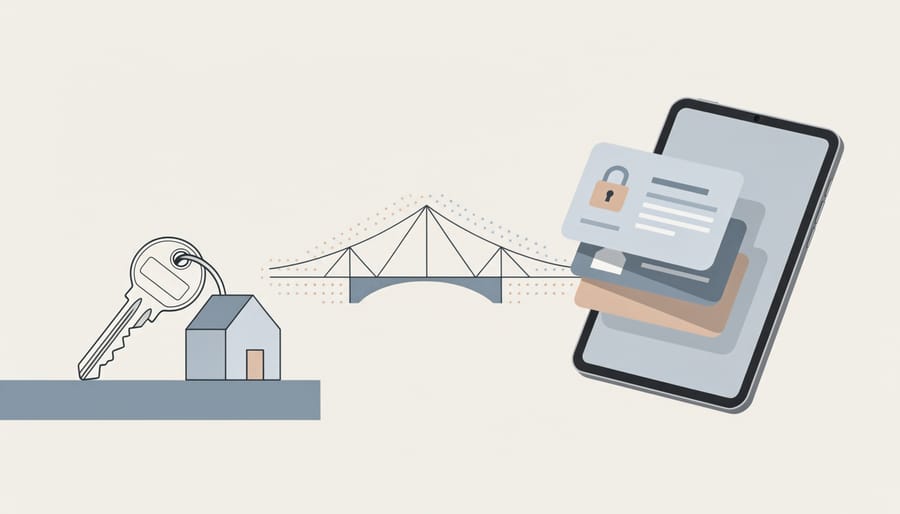
Blockchain-based property assets represent a digital evolution of these same ownership rights. Instead of a paper deed held at the county recorder’s office, your property rights exist as tokens on a blockchain—essentially digital certificates that prove ownership. The core concept remains identical: you own a specific property with defined rights. What changes is how that ownership is recorded and transferred.
In tokenized systems, ownership transfers happen through secure digital wallets rather than title companies. The blockchain itself serves as the permanent record, replacing county registries. Transactions can settle in minutes instead of weeks, and fractional ownership becomes seamlessly possible—you could own 10 percent of a building as easily as 100 percent.
What stays the same? Property rights, zoning laws, tax obligations, and insurance requirements remain unchanged. You still need coverage for physical damage and liability. The difference lies in how you prove and transfer ownership, not in the fundamental nature of property rights themselves.
The Private Key Problem Every Real Estate Investor Needs to Understand
In traditional real estate, ownership is pretty straightforward—you hold a deed, it’s recorded at the county office, and everyone knows the property is yours. But tokenized real estate works differently. Instead of a physical deed, your ownership exists as a digital token on a blockchain, and access to that token requires something called a private key.
Think of a private key like the only key to a safe deposit box that holds your property deed—except there’s no bank vault protecting it, and if you lose this key, there’s no locksmith who can help you. Whoever possesses the private key has complete control over the asset. Period. There’s no “forgot password” button, no customer service hotline, and no way to reverse a transaction if someone gains unauthorized access.
This creates a fundamentally different security challenge than traditional real estate. You’re not just protecting documents that can be replaced with certified copies—you’re protecting the actual means of accessing and transferring ownership. If your private key is stolen, your tokenized property can be transferred to someone else within minutes, with no recourse. If it’s lost, your investment becomes permanently inaccessible, like a property deed locked in a safe you can never open. This is why crypto custody solutions exist—to help investors manage this critical security responsibility effectively.
Three Types of Crypto Custody Solutions for Tokenized Properties
Self-Custody: When You’re Your Own Property Vault
Self-custody puts you in complete control of your tokenized real estate assets, much like holding the only key to a property safe. Hardware wallets, physical devices resembling USB drives, store your digital asset credentials offline and away from internet-connected threats. Popular options include Ledger and Trezor, which protect your private keys—the cryptographic passwords that prove ownership of your blockchain-based property shares.
This approach suits tech-savvy investors comfortable with personal responsibility and those holding significant tokenized property portfolios who want maximum security. You’ll need basic technical literacy to set up your hardware wallet, create secure backups of your recovery phrase (typically 12-24 words), and understand transaction signing procedures. The learning curve is manageable but requires commitment.
The trade-off is straightforward: total control means total responsibility. If you lose your recovery phrase and your device fails, your tokenized property becomes irretrievable. There’s no customer service number to call, no reset button. You become the sole guardian of potentially substantial real estate value.
Estate planning becomes particularly crucial with self-custody. Unlike traditional property deeds filed with county recorders, your tokenized assets exist only where your private keys lead. Consider documenting your custody setup in your will, storing recovery phrases in bank safety deposit boxes, or using multi-signature wallets that require multiple parties to access funds. Some investors employ specialized crypto estate planning attorneys to ensure heirs can access tokenized properties without compromising security during the owner’s lifetime.
Self-custody demands diligence but offers unmatched control over your digital real estate holdings.
Qualified Custodians: The Institutional Safety Net
For investors holding significant tokenized real estate portfolios or institutions managing client assets, qualified custodians offer a professionally managed safety net. Think of them as the Fort Knox of digital asset storage—highly regulated entities specifically licensed to safeguard your blockchain-based property tokens.
These third-party custody providers operate under strict regulatory frameworks, often holding licenses from state banking authorities or the SEC. They’re subject to regular audits, capital requirements, and compliance standards that far exceed what most individuals could implement on their own. This institutional-grade oversight means your tokenized property holdings are protected by multiple layers of security protocols, from cold storage vaults to multi-signature authentication systems.
What truly sets qualified custodians apart is their insurance coverage. Many carry substantial custody insurance policies, sometimes exceeding $100 million, protecting your assets against theft, hacking, or operational failures. This is game-changing for real estate professionals managing client portfolios or developers holding tokenized property inventories worth millions.
The trade-off? You’ll pay annual fees, typically calculated as a percentage of assets under custody, and you’re trusting a third party with access to your holdings. However, for institutional investors, family offices, or anyone holding tokenized real estate exceeding six figures, this cost becomes negligible compared to the peace of mind and regulatory protection offered.
Major players like Coinbase Custody, Fidelity Digital Assets, and BitGo serve institutional clients, bringing Wall Street-level security to the blockchain real estate revolution. They handle the technical complexity while you focus on property investment strategy.

Hybrid Solutions: Balancing Control and Security
For property syndicates and investment partnerships, hybrid custody solutions offer a middle ground between complete self-custody and third-party control. These models use multi-signature wallets, which require multiple private keys to authorize any transaction involving your tokenized real estate assets.
Think of it like requiring multiple signatories on a business bank account. With a multi-sig wallet, you might set up a 2-of-3 arrangement where three parties each hold one key, but only two keys are needed to execute a transaction. This means no single person can unilaterally move or sell the tokenized property.
For real estate syndicates managing a portfolio of tokenized properties, this structure provides crucial checks and balances. The general partner might hold one key, a trusted custodian another, and the limited partners collectively control the third through a representative. This distribution prevents fraud while maintaining operational flexibility.
Hybrid models can also combine institutional custody with investor control. For example, a qualified custodian might hold two keys while the property owner retains one. The custodian provides security and regulatory compliance, but cannot act without the owner’s participation. This arrangement particularly appeals to investors who want professional security infrastructure without surrendering complete control.
These solutions work especially well for partnerships where trust exists but accountability matters. They reduce counterparty risk while providing disaster recovery options if one key holder becomes unavailable. However, all parties must carefully document key management procedures and succession plans to avoid disputes or locked assets down the line.
The Real Risks: What Happens When Crypto Custody Goes Wrong
Lost Keys, Lost Deeds: The Permanence Problem
In traditional real estate, if you lose your house keys, you call a locksmith. If your deed gets damaged, the county records office has backups. With tokenized real estate held in self-custody, there’s no such safety net. Lose your private keys, and you’ve effectively locked yourself out of your property investment permanently—with no locksmith, no customer service hotline, and no password reset option.
This permanence is by design. Blockchain’s security comes from mathematical certainty rather than trusted intermediaries. Your private keys are the only proof of ownership that matters. Unlike your bank, which can verify your identity through documentation if you forget your password, blockchain networks have no central authority to appeal to. Once keys are lost, the tokens remain forever inaccessible, regardless of whether you can prove you’re the rightful owner through traditional legal documents.
The estate planning implications are sobering. Without proper preparation, your tokenized real estate holdings could vanish when you pass away. If heirs don’t have access to your private keys or recovery phrases, those assets become unretrievable—even with a valid will and death certificate. This creates unique challenges for wealth transfer that traditional property doesn’t face.
Smart estate planning for tokenized assets requires balancing security with accessibility. Some investors use multi-signature wallets that require multiple keys to access funds, distributing them among trusted family members or attorneys. Others employ specialized digital asset custodians with inheritance protocols. Whatever approach you choose, documenting your digital holdings and access methods is essential—just keep that documentation secure from both thieves and permanent loss.
Hacks, Scams, and Social Engineering Attacks
When tokenized real estate assets are at stake, the financial consequences of security breaches become dramatically more severe than typical crypto losses. Scammers specifically target real estate token holders because they know these assets represent substantial value—potentially hundreds of thousands or millions of dollars in a single wallet.
Social engineering attacks represent the most common threat vector. Bad actors often impersonate custody platform support staff, sending urgent emails claiming your account has been compromised or requires immediate verification. They’ll create convincing replicas of legitimate websites, complete with similar URLs that differ by just one character. The moment you enter your credentials on these fake sites, attackers gain access to your holdings.
Another prevalent scam involves fake investment opportunities promising tokenized properties at below-market rates. Fraudsters create elaborate presentations, professional-looking websites, and even forged legal documents to appear legitimate. Once you transfer funds or tokens, they disappear entirely.
Warning signs to watch for include unsolicited contact requesting immediate action, pressure to make quick decisions, requests for private keys or seed phrases (legitimate services never ask for these), and deals that seem too good to be true. Custody providers will never ask you to “verify” your account by providing sensitive security information via email or phone.
Protect yourself by enabling multi-factor authentication on all accounts, verifying website URLs carefully before entering credentials, never sharing private keys with anyone, independently confirming requests through official channels, and maintaining healthy skepticism about unsolicited offers. Remember: legitimate real estate tokenization platforms have established verification processes and won’t rush you into decisions.

Insurance and Legal Protection for Digital Property Assets
Custody Insurance: What’s Actually Covered
When your tokenized real estate holdings are stored with a custody provider, you’ll want to understand what protection exists if something goes wrong. Most reputable custodians offer some form of coverage, but it’s not as straightforward as traditional property insurance.
Crypto custody insurance products typically cover losses from hacks, internal theft, and certain technical failures. However, they won’t cover market volatility, regulatory seizures, or losses from unauthorized access using your credentials. Think of it like leaving your house keys under the doormat—the insurance company won’t pay if someone finds them and walks in.
For real estate investors evaluating custody insurance, scrutinize these key terms: coverage limits per incident, exclusions for specific blockchain protocols, waiting periods before claims pay out, and whether the policy covers both hot and cold storage. Many policies have significant gaps, particularly around smart contract failures or transaction errors.
Also verify whether the custodian’s insurance is held directly or through a third party, as this affects claim processing speed. The best coverage combines crime insurance, professional liability, and cyber liability—creating multiple layers of protection for your tokenized property assets.
Legal Recourse When Digital Custody Fails
When digital custody fails—whether through hacking, platform insolvency, or key mismanagement—property owners need clear paths to recovery. Unfortunately, the current legal framework for tokenized real estate disputes remains underdeveloped across most jurisdictions.
The primary challenge is determining which court has authority. Is it where the property sits, where the custody platform operates, or where the token holder resides? These jurisdiction questions complicate even straightforward disputes. Some custody agreements include arbitration clauses that may limit your legal options, so review terms carefully before committing assets.
Emerging case law offers some guidance. Recent decisions in Wyoming and Switzerland—both crypto-friendly jurisdictions—have begun treating tokenized property with frameworks similar to traditional securities custody. Courts are increasingly recognizing that custody providers owe fiduciary duties to token holders, creating accountability when breaches occur.
For real estate professionals, the practical takeaway is documentation. Maintain detailed records of all custody arrangements, transaction histories, and communications with providers. These records become critical evidence if disputes arise. Additionally, consider custody platforms registered in jurisdictions with established digital asset regulations, which provide clearer paths to legal recourse than unregulated alternatives.
Practical Steps to Secure Your Tokenized Real Estate Today
Questions to Ask Before Choosing a Custody Solution
Before entrusting your tokenized real estate holdings to any custody provider, you need to ask the right questions. Think of this like vetting a property management company, but for your digital assets.
Start with security fundamentals. What specific security protocols protect your tokenized properties? Does the provider use multi-signature wallets requiring multiple approvals for transactions? How are private keys generated, stored, and accessed? Request details about their physical security measures, encryption standards, and whether they employ cold storage for the majority of assets. Also ask about their track record: have they ever experienced a security breach, and if so, how did they respond?
Regulatory compliance is equally critical. Is the custody provider registered with relevant financial authorities? What jurisdictions do they operate under, and how does this affect your asset protection? Understanding their compliance framework helps ensure your tokenized real estate investments receive proper legal recognition.
Insurance coverage deserves close scrutiny. What specific risks does their insurance policy cover, and what are the coverage limits? Remember, not all custody insurance treats tokenized real estate the same as standard cryptocurrency. Get clarity on whether coverage includes theft, employee misconduct, and technical failures.
Finally, address succession planning. What happens to your tokenized properties if you’re incapacitated or pass away? How can designated beneficiaries access these assets? A robust custody solution should offer clear inheritance protocols, ensuring your real estate tokens transfer according to your wishes without becoming permanently inaccessible.
Setting Up Your Security Infrastructure
Setting up proper custody for your tokenized real estate holdings requires careful planning and strategic decision-making. Start by evaluating potential custody providers based on their regulatory compliance, insurance coverage, and track record with real estate assets. Look for providers who understand property-specific requirements and can integrate with existing real estate management systems.
Next, establish a clear governance structure. Determine who has authorization to access and transfer assets, implement multi-signature requirements for transactions, and create detailed protocols for different operational scenarios. Document every procedure thoroughly, including wallet addresses, access credentials (stored separately), and transaction approval workflows.
Implement robust security solutions including backup and recovery systems. Create multiple encrypted backups of private keys and store them in geographically separate locations—consider using bank safety deposit boxes or specialized storage facilities. Develop a disaster recovery plan that outlines step-by-step procedures for various emergency scenarios.
Finally, maintain meticulous records of all transactions, custody arrangements, and asset transfers. This documentation proves invaluable for tax purposes, audits, and potential disputes. Schedule regular reviews of your custody infrastructure to ensure it evolves with changing technology and regulatory requirements.
Tokenized real estate represents a genuine evolution in how we think about property ownership and investment. The blockchain technology behind it offers transparency, fractional ownership opportunities, and faster transactions that could reshape the industry. However, none of these benefits matter if the digital keys to your property tokens aren’t properly secured. Just as you wouldn’t close a real estate deal without proper title insurance or a secure escrow process, you shouldn’t participate in tokenized real estate without understanding custody solutions.
For real estate professionals, crypto custody knowledge is quickly becoming a non-negotiable skill. Within the next few years, explaining custody options to clients will likely be as routine as walking them through closing documents or explaining mortgage terms. The good news is that custody solutions are rapidly maturing. We’re moving away from intimidating technical interfaces toward platforms designed specifically for real estate applications, with familiar workflows and built-in protections that mirror traditional safeguards you already trust.
The key takeaway is this: embrace the tokenization trend, but do so with eyes wide open about custody responsibilities. Whether you choose self-custody for maximum control or institutional solutions for peace of mind, make the decision deliberately and educate yourself thoroughly. The future of real estate will blend traditional practices with blockchain innovation, and professionals who understand both worlds will be best positioned to serve their clients and protect valuable assets in this evolving landscape.