
You can sell gold, silver, and platinum for cash in as little as 24 hours by choosing a reputable buyer, getting your items appraised, and accepting the best offer. The process is straightforward: gather your precious metals, verify their authenticity and weight, compare quotes from at least three buyers (both local dealers and online refiners), and complete the sale through secure payment methods like bank transfer or certified check.
For real estate professionals and homeowners, liquidating precious metals offers a fast path to raise capital for property transactions. Whether you need funds for a down payment, closing costs, or emergency home repairs, converting these assets beats waiting for loan approvals or tapping into retirement accounts. The current precious metals market in 2026 remains volatile, making timing crucial. Gold prices fluctuate daily, so checking spot prices before you sell ensures you’re not leaving money on the table.
The challenge isn’t finding buyers (they’re everywhere, from pawn shops to online platforms) but avoiding lowball offers and outright scams. Many sellers lose 20 to 40 percent of their metals’ true value by rushing to the first buyer or failing to verify credentials. Smart sellers take control by understanding the appraisal process, recognizing fair market value, and documenting every transaction. This guide walks you through each step, from testing your metals’ purity to negotiating the best price and protecting yourself from fraud.
What You’ll Need to Sell Your Precious Metals
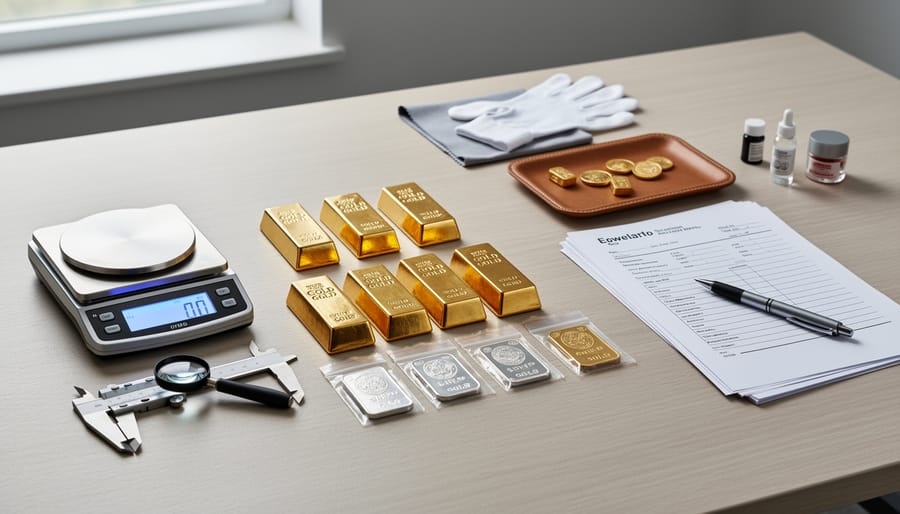
Before you contact buyers or leave your home, gather everything necessary to complete the transaction smoothly and protect yourself throughout the process. Missing even one critical item can delay payment or reduce your negotiating leverage.
Start with valid government-issued photo identification, a driver’s license or passport, since reputable buyers must verify your identity for transactions over certain thresholds. If you inherited the items or received them as gifts, gather any documentation that establishes provenance, including original receipts, certificates of authenticity, appraisal documents, or estate paperwork. While not always mandatory, this documentation often increases buyer confidence and can improve offers.
Essential items to have ready include:
- Valid government-issued photo ID (driver’s license or passport)
- Original purchase receipts or certificates of authenticity if available
- Any previous appraisal documents showing purity and weight
- Small jewelry scale for personal verification (optional but recommended)
- Magnifying glass or loupe to check hallmarks and purity stamps
- Secure transport container or bag for in-person sales
- Notebook or phone to record offers from different buyers
- Camera or smartphone for documenting items before sale
Consider photographing your items before meeting buyers to create a visual record of condition and quantity. If you’re selling to reputable operations like GTA Gold Buyers they’ll handle testing and verification on-site, but bringing your own small scale helps you confirm weights independently. Store everything in a secure, padded container during transport, a small lockbox or zippered pouch prevents loss and protects delicate items from damage that could reduce value.
Important Warnings and Red Flags to Avoid

Before you sell, understand that precious metal transactions attract sophisticated scammers who exploit sellers’ urgency for cash. Protect yourself by recognizing these warning signs and knowing when to refuse a deal.
Legitimate buyers operate transparently with verifiable business licenses and physical locations you can visit. Red flags include vague addresses, PO boxes as primary business locations, or resistance to providing state licensing information. Check your state’s consumer protection agency and Better Business Bureau for complaints before doing business.
Unrealistic pricing promises signal fraud. If a buyer offers significantly more than current spot prices or guarantees you’ll receive 100% of market value, walk away. Honest dealers typically pay 70-90% of spot price depending on item condition and purity, and they’ll explain their margins upfront rather than making inflated promises.
High-pressure tactics reveal predatory operations. Scammers create artificial urgency (“this price is only good today”) or use confusion tactics like switching quotes mid-transaction. Reputable buyers give you time to compare offers and provide written quotes that remain valid for at least 24-48 hours.
Be wary of buyers who discourage getting independent appraisals or refuse to test items in your presence. Legitimate operations welcome verification and use industry-standard testing methods you can observe. If you’ve claimed these items on your jewelry insurance notify your insurer before selling to avoid policy complications.
Watch for bait-and-switch schemes where initial phone quotes drop dramatically during in-person evaluation. Document all communications and get final offers in writing before handing over your metals. Trust your instincts, if something feels wrong, leave immediately and report suspicious operations to local authorities.
Understanding Current Market Values and Pricing
Spot Price vs. What You’ll Actually Receive
When you check today’s spot price, say $2,650 per ounce for gold, don’t expect a buyer to hand you that exact amount. Dealers typically pay 70-95% of spot price, depending on what you’re selling and market conditions.
The gap exists because buyers need profit margin to stay in business. They must cover operating costs, refining fees if needed, and the risk of price fluctuations between when they buy from you and when they resell. Pure bullion coins and bars command the highest percentages, often 90-95% of spot, because they require minimal processing and sell quickly.
Jewelry typically fetches 60-80% of its melt value since it must be refined to extract pure metal, which costs money and time. Scrap gold with mixed purities may bring even less. Platinum and silver follow similar patterns, though silver’s lower per-ounce value means transaction fees eat up a larger percentage.
Pawn shops generally offer the lowest rates (50-70%) because they factor in retail markup if they resell items as jewelry rather than melting them down. Online refiners and local precious metal dealers usually provide better percentages, especially for larger quantities where economies of scale work in your favor.
Step-by-Step Process: Selling Your Precious Metals for Cash

Step 1: Sort and Prepare Your Metals
Begin by separating your items into three distinct piles: gold, silver, and platinum. Within each pile, group pieces by their purity markings, look for stamps like “24K,” “14K,” “18K” on gold, “925” or “Sterling” on silver, and “PLAT” or “950” on platinum. These markings directly affect value, so accurate sorting matters.
Next, separate jewelry from bullion (coins, bars, rounds). Buyers price these categories differently, bullion typically commands prices closer to spot value, while jewelry may sell for less due to craftsmanship and manufacturing costs being factored out.
For cleaning, less is more. Wipe items gently with a soft, dry cloth to remove surface dirt and fingerprints. Never use harsh chemicals, abrasive cleaners, or polishing compounds, these can remove material and reduce weight, directly lowering your payout. Antique or collectible jewelry should not be cleaned at all, as patina can add value.
Keep items in separate containers or bags labeled by metal type and purity to streamline the appraisal process.
Step 2: Get Professional Appraisals
Finding certified appraisers starts with professional associations. Look for members of the National Association of Jewelry Appraisers (NAJA) or the American Society of Appraisers (ASA). Local jewelers who don’t buy metals can provide unbiased appraisals, and some charge flat fees of $50-150 per item rather than percentage-based rates.
The appraisal process involves testing metal purity using acid tests or electronic analyzers, weighing items on calibrated scales, and documenting the results in writing. Legitimate appraisers explain their methodology and show you current spot prices. The appointment typically takes 15-30 minutes depending on how many pieces you’re selling.
Get at least three written appraisals from different sources. This creates competition and reveals if one buyer is lowballing you. When you present competing quotes to dealers, you can negotiate upward by showing you’ve done your homework and know the realistic value range for your metals.
Step 3: Research and Compare Buyers
Your next decision is choosing where to sell, and this choice directly impacts how much cash you receive. Four main buyer categories exist, each with distinct payout rates and trade-offs.
Local precious metal dealers typically offer 70-85% of spot price. They provide immediate payment and face-to-face transactions. Verify their business license through your state’s commerce department and check Better Business Bureau ratings. Look for membership in the Professional Numismatists Guild or similar industry organizations.
Pawn shops usually pay the lowest rates at 50-70% of spot value because they’re betting on resale margins. Use them only when you need cash within hours and have exhausted better options.
Online buyers like Kitco or APMEX often pay 80-90% of spot but require shipping your metals. They’re legitimate but involve 3-5 day processing times. Confirm they provide prepaid insured shipping and have verifiable physical addresses.
Refiners pay the highest rates (85-95%) for larger quantities, typically requiring minimum weights of 100 grams or more. They’re best for bulk sales rather than individual jewelry pieces.
Request written quotes from at least three different buyer types before committing.
Step 4: Request Quotes and Negotiate
Contact at least three to five different buyers to establish a competitive baseline. Request written quotes that specify the exact weight, purity, and price per gram or ounce they’ll pay. Legitimate buyers will provide detailed breakdowns without hesitation.
Present your best offer to other buyers and ask if they can beat it. Many dealers will match or exceed competitor quotes to secure your business. Focus on the percentage of spot price they’re offering rather than total dollar amounts, which makes comparing offers across different item weights easier.
Don’t accept the first offer, even if it seems reasonable. Phrase negotiations as questions: “I have a quote for 92% of spot from another buyer, can you match that?” This approach feels less confrontational while creating room for improvement. Get all final terms in writing before committing, including payment method, timeframe, and any fees.
Step 5: Complete the Transaction Safely
Once you’ve accepted an offer, insist on payment methods that leave a clear paper trail. Cash is immediate but risky for large amounts, if you’re selling items worth over $1,000, cashier’s checks or bank wire transfers offer better security and documentation. Avoid personal checks, which can bounce, and be wary of any buyer suggesting unusual payment apps or cryptocurrency unless you fully understand the risks.
For in-person transactions, meet during business hours at the buyer’s established storefront, never in parking lots or secondary locations. Bring someone with you if possible. Watch the entire weighing and testing process, legitimate buyers won’t rush you or work behind closed doors.
Before leaving, obtain a detailed receipt showing the weight, purity, price per ounce, total amount paid, buyer’s contact information, and business license number. Photograph the receipt immediately. This documentation protects you if disputes arise and proves the transaction for tax purposes. If a buyer resists providing complete paperwork, that’s your signal to walk away regardless of their offer.
Verifying You Got a Fair Deal and Next Steps
After completing your sale, verify you received fair value by calculating the percentage of spot price you were paid. Check the day’s spot price for your metal type and purity, then divide your payout by the total market value of your metals. Most legitimate buyers pay 70-95% of spot price depending on the metal type and transaction size, anything significantly lower suggests you left money on the table.
Document everything immediately while details are fresh. You’ll need comprehensive records for tax purposes and potential disputes:
- Original purchase receipts or proof of acquisition showing cost basis
- Professional appraisal reports with detailed item descriptions and values
- Written offers from all buyers you contacted for comparison
- Final sale receipt showing exact weights, purity levels, and payment amount
- Copy of identification and any forms signed during the transaction
- Payment confirmation whether check, wire transfer, or cash count verification
For tax reporting, the IRS requires dealers to file Form 1099-B for certain precious metal sales exceeding specific thresholds, 25 or more ounces of gold, 1,000 or more ounces of silver, or 25 or more ounces of platinum. Even if your buyer doesn’t file, you must report capital gains or losses on Schedule D of your tax return. Your cost basis (original purchase price plus any improvements) minus the sale price determines your taxable gain.
Strategic deployment of proceeds matters, especially for real estate goals. Homeowners can use cash windfalls for down payments to secure better mortgage rates, eliminating PMI requirements, or funding renovations that increase property value. Real estate investors might deploy funds toward fix-and-flip opportunities or rental property acquisitions. If carrying high-interest debt, consider using proceeds to crush debt faster and improve your debt-to-income ratio for future property financing.
Special Considerations for Real Estate Professionals and Homeowners
Real estate professionals and homeowners often face timing challenges where liquid cash is needed immediately, whether for closing costs, earnest money deposits, or unexpected property repairs that can’t wait for traditional financing. Converting precious metals to cash offers a unique advantage: you can typically complete the entire process within 24-72 hours, making it faster than home equity lines of credit or personal loans that require weeks of approval.
For down payments specifically, selling gold, silver, or platinum can bridge the gap between contract signing and closing when other assets aren’t immediately accessible. Many real estate investors also liquidate metals strategically to fund renovation projects or cover carrying costs during property flips when cash flow is tight.
However, timing matters significantly for tax planning. If you’ve held precious metals as investments, selling them triggers capital gains tax on any appreciation. For real estate professionals, these transactions may intersect with business income considerations, especially if you’re using proceeds directly for property investments or business operations. The IRS requires Form 1099-B reporting for certain precious metal sales, and combining this with real estate transactions means your overall tax picture becomes more complex, making qualified tax advice essential before large liquidations.
Keep detailed records showing the source of funds when using precious metal proceeds for real estate purchases, as lenders and title companies will require documentation proving the money’s origin during closing.
Frequently Asked Questions
Do I need to report precious metal sales to the IRS?
Sales of precious metals may be reportable depending on the amount and type. Dealers must file Form 1099-B for certain transactions, typically involving 25 or more ounces of gold bars or 1,000 ounces of silver. You’re responsible for reporting any capital gains on your tax return regardless of whether you receive a 1099-B.
Is there a best time of year to sell gold, silver, or platinum?
Precious metal prices fluctuate based on economic conditions rather than seasonal patterns. However, gold and silver often strengthen during economic uncertainty, geopolitical tensions, or when the dollar weakens. Monitor spot prices for several weeks and sell when prices trend upward rather than waiting for a perfect moment.
Will I get more money selling jewelry or bullion?
Bullion typically commands higher percentages of spot price (85-95%) because purity is standardized and easy to verify. Jewelry usually sells for 60-80% of melt value since buyers must account for the cost of refining mixed metals and removing stones, though rare or designer pieces may fetch premiums from collectors.
What are alternatives to selling for immediate cash?
Consider using precious metals as collateral for a secured loan if you need temporary liquidity but want to retain ownership. Some dealers offer consignment arrangements where they sell items on your behalf for potentially higher returns, though this takes longer than direct sales.
These questions reflect the most common concerns from first-time sellers navigating the precious metals market. Understanding tax obligations prevents surprises at filing time, while knowing that bullion generally outperforms jewelry helps set realistic expectations. The alternatives to immediate cash sales give homeowners and real estate professionals flexibility when timing matters for property transactions or when market conditions suggest holding metals might yield better long-term value than converting to cash today.