
You’ve likely typed “quick deed” into a search engine when what you really need is a quitclaim deed—one of the most misunderstood yet frequently used documents in real estate transfers. This common misspelling points to a critical knowledge gap that costs homeowners thousands in lost protections and creates legal headaches that last for years.
A quitclaim deed transfers whatever ownership interest you have in a property to someone else, with zero guarantees about what that interest actually is. Unlike a warranty deed that promises clean title, a quitclaim essentially says “I’m giving you whatever rights I might have, but I’m not promising anything.” This makes it perfect for transferring property between family members during divorce settlements or estate planning, but dangerously inadequate for traditional home sales.
The stakes are higher than most people realize. Accept a quitclaim deed from a seller, and you could discover liens, unpaid taxes, or competing ownership claims that the previous owner never disclosed—and you’ll have no legal recourse against them. Use one incorrectly, and you might accidentally create tax consequences or jeopardize your title insurance coverage.
Understanding when quitclaim deeds work in your favor versus when they expose you to unnecessary risk separates savvy property owners from those who learn expensive lessons the hard way. This guide clarifies the terminology, reveals appropriate use cases, and provides the protective measures that keep your real estate transactions secure.
What Is a Quick Claim Deed? (And Why the Name Matters)

The Legal Definition Explained
A quitclaim deed (often mistakenly called a “quick deed”) is a legal document that transfers whatever ownership interest the grantor has in a property to the grantee, without any guarantees or warranties. Think of it as an “as-is” transfer. The grantor essentially says, “I’m giving you whatever rights I have, if any, but I’m not promising the title is clean or that I even own the property.”
This differs significantly from other deed types. A warranty deed, for instance, comes with promises that the grantor actually owns the property, has the right to sell it, and that no undisclosed liens or claims exist. A grant deed sits in the middle, offering some protections but not the comprehensive guarantees of a warranty deed.
The legal mechanics are straightforward: the document identifies the grantor and grantee, includes a property description, contains the grantor’s signature, and must be notarized and recorded with the county recorder’s office. However, the simplicity masks significant risk. Because quitclaim deeds provide zero title insurance or guarantees, they’re best suited for transfers between family members, divorcing spouses, or when clearing title clouds, not typical real estate sales. Using one incorrectly can leave you without recourse if ownership disputes arise later.
What a Quitclaim Deed Actually Transfers (Hint: It’s Not What You Think)
Here’s the reality that catches many people off guard: a quitclaim deed doesn’t guarantee you’re getting anything of value. Unlike other deed types, it transfers only whatever interest the grantor currently has in the property—if any. Think of it as a “take it as-is” transaction with zero warranties attached.
The grantor essentially says, “I’m giving you whatever rights I might have to this property, but I’m making no promises about what those rights actually are.” They’re not guaranteeing they own the property, that the title is clear, or even that they have legal authority to transfer it. If they own 100% of the property free and clear, great—you get that. But if they own nothing, or if there are liens, encumbrances, or competing ownership claims, those problems become yours.
This is why quitclaim deeds work best in low-risk situations like transferring property between family members or adding a spouse to a title after marriage. In these scenarios, you typically know the property’s history and trust the grantor completely. For arm’s-length transactions with strangers or investment properties, this lack of protection creates significant financial exposure that most buyers should avoid.
When Quitclaim Deeds Make Sense (And When They’re a Terrible Idea)
Smart Uses: Family Transfers and Divorce Situations
Quitclaim deeds serve valuable purposes in several family-centered situations where the priority is transferring property quickly between trusted parties rather than guaranteeing clear title. Understanding these legitimate uses helps distinguish when this straightforward approach makes sense.
In marriage and divorce scenarios, quitclaim deeds frequently facilitate property transfers. When couples divorce, one spouse often deeds their interest in the marital home to the other as part of the settlement agreement. This streamlined process avoids the complexity and expense of a traditional sale. Similarly, married couples may use quitclaim deeds to add a spouse to the title after marriage or adjust ownership percentages between spouses for estate planning purposes.
Estate planning represents another common application. Parents transferring property to adult children, creating living trusts, or adjusting ownership structures to minimize estate taxes often utilize quitclaim deeds. Since these transfers occur within families where title concerns are minimal, the deed’s simplicity becomes an advantage rather than a liability.
Adding family members to existing titles also benefits from this approach. Whether bringing an adult child onto the deed for succession planning or adding siblings as co-owners of inherited property, quitclaim deeds accomplish these goals efficiently.
The key distinction in all these scenarios involves the existing relationship and trust between parties. You’re not purchasing property from a stranger where title guarantees matter critically. Instead, you’re reorganizing ownership among family members where everyone understands the property’s history. However, even in family situations, consulting a real estate attorney ensures the transfer aligns with broader financial and tax implications while protecting everyone’s interests appropriately.
Red Flags: When to Avoid Quitclaim Deeds
While quitclaim deeds serve legitimate purposes in specific situations, they’re absolutely the wrong tool for many real estate transactions. Understanding when to avoid them can save you from financial disaster and legal headaches down the road.
Traditional home sales represent the biggest red flag for quitclaim deed use. If you’re purchasing a home on the open market—whether you’re among first-time homebuyers or experienced investors—insist on a warranty deed instead. Unlike warranty deeds, quitclaim deeds offer zero guarantees about the property’s title. The seller essentially says, “I’m giving you whatever rights I might have, but I’m not promising anything.” This means you could discover liens, unpaid taxes, or competing ownership claims after closing, with no legal recourse against the seller.
Purchasing from unknown parties or distant relatives you haven’t verified is equally risky. Without established trust and complete transparency about the property’s history, you’re gambling with potentially your largest investment. The lack of title warranties means you might be buying into existing legal problems or even fraudulent schemes.
Another critical situation requiring caution involves any transaction where you need title insurance. Most title insurance companies refuse to issue policies on properties transferred via quitclaim deed, or they charge substantially higher premiums due to increased risk. This limitation creates problems if you plan to resell the property or need mortgage financing, as lenders typically require title insurance for loan approval.
Conducting thorough property due diligence becomes nearly impossible with quitclaim deeds since they intentionally bypass standard protections. When significant money changes hands or you’re dealing with unfamiliar parties, warranty deeds provide the security and legal protections you need.
Quitclaim Deeds vs. Warranty Deeds: The Protection Gap That Could Bankrupt You
What Warranty Deeds Promise (That Quitclaim Deeds Don’t)
Unlike quitclaim deeds that transfer property “as is” with zero promises, warranty deeds come with powerful legal guarantees that protect buyers. Understanding these deed warranties is crucial when evaluating your property transfer options.
General warranty deeds offer the most comprehensive protection. The seller guarantees clear title for the entire property history, not just their ownership period. This means they promise no undisclosed liens, claims, or encumbrances exist, and they’ll defend your ownership against any future challenges, even if the problem originated decades ago.
Special warranty deeds provide more limited protection, covering only the seller’s ownership period. The grantor guarantees they haven’t created any title problems during their time owning the property but won’t defend against historical issues.
Both warranty types require the seller to compensate you financially if title defects emerge, making them standard in traditional home sales. When purchasing property, especially from unfamiliar parties, warranty deeds provide essential insurance against hidden problems. This protection becomes particularly valuable when securing financing, as most lenders require warranty deeds before approving mortgages. The guarantees essentially shift risk from buyer to seller, creating accountability that quitclaim deeds simply don’t provide.
The Real Cost of Missing Title Guarantees
When you accept property through a quitclaim deed, you’re essentially buying it “as is” with zero guarantees about what problems might be lurking beneath the surface. This gamble can cost you dearly.
Consider liens, for instance. Imagine discovering that the previous owner owed $45,000 in unpaid contractor bills after you’ve already closed. Without title warranties, that lien now attaches to your property, and you’re responsible for paying it. Similarly, hidden tax liens or judgment liens can surface months after transfer, leaving you holding the bag for someone else’s debts.
Ownership disputes present another costly nightmare. You might find that the person who signed your quitclaim deed didn’t actually own the full property, or that undisclosed heirs suddenly emerge claiming rightful ownership. One homeowner in California spent over $80,000 in legal fees fighting an ownership claim that surfaced two years after receiving a quitclaim deed from a distant relative.
The insurance complications compound these problems. Most title insurance companies won’t issue policies for properties transferred via quitclaim deed without extensive additional research, driving up costs significantly. Some insurers refuse coverage altogether, leaving you financially exposed to any title defects that emerge. When selling later, this insurance gap becomes your buyer’s concern, potentially tanking your property value or killing deals entirely.
How to Execute a Quitclaim Deed Properly (Step-by-Step)

Required Information and Documentation
When executing a quitclaim deed (remember, there’s no such thing as a “quick deed”), you’ll need several critical components to ensure the transfer is legally valid. First and foremost is the legal property description, which goes beyond just the street address. This typically includes the parcel number, lot and block information, and metes and bounds description found in your property records. Don’t rely on informal descriptions like “the house on Main Street.”
You’ll also need complete grantor and grantee information. The grantor is the person transferring ownership, while the grantee receives it. Full legal names, current addresses, and marital status are essential. If the property is owned by a married couple in certain states, both spouses may need to sign regardless of whose name appears on the title.
The consideration amount represents what’s being exchanged for the property. Even in gift situations, you must state some value, often listed as “ten dollars and other good and valuable consideration.” This isn’t necessarily the market value but acknowledges that something of value changed hands.
Finally, proper notarization is non-negotiable. Most states require the grantor’s signature to be notarized with witnesses present. Some jurisdictions have additional recording requirements at the county clerk’s office to make the transfer official and publicly documented.
Recording the Deed: County Requirements and Fees
Recording your quitclaim deed with the county recorder’s office is not just a formality—it’s essential for establishing legal public record of the property transfer. Without recording, your deed exists only as a private agreement, leaving you vulnerable to competing claims and title disputes.
The recording process is straightforward. You’ll submit the completed and notarized deed to the county recorder’s office where the property is located. Most counties now offer online submission portals alongside traditional in-person or mail options, making the process more convenient than ever.
Recording fees vary by county but typically range from $15 to $50 for the first page, with additional charges for subsequent pages. Some counties also assess transfer taxes based on the property’s value, which can add hundreds or even thousands of dollars to your total cost. Always check with your specific county recorder’s office for current fee schedules before proceeding.
Once recorded, your deed becomes part of the permanent public record, establishing the timeline of ownership and protecting your interests. This creates constructive notice to the world that the property transfer occurred, which is crucial for future transactions, refinancing, or resolving potential ownership disputes. Most counties return a certified copy of the recorded deed within a few weeks.
State-Specific Variations You Can’t Ignore
Quitclaim deed requirements aren’t one-size-fits-all across America. Each state maintains its own recording procedures, notarization standards, and documentation requirements that can significantly impact your transfer’s validity. Some states require witness signatures beyond notarization, while others mandate specific formatting or even notary acknowledgment language. Recording fees vary wildly, from under $20 to several hundred dollars depending on your location. Certain jurisdictions also impose transfer taxes or require additional disclosures that could delay or complicate your transaction. Before executing any quitclaim deed, verify your state’s exact requirements through your county recorder’s office or consult a local real estate attorney. Failing to follow these regional regulations could render your deed unrecordable or legally questionable, creating title complications down the road that defeat the entire purpose of this quick transfer method.
The Hidden Risks: What Your Quitclaim Deed Doesn’t Tell You
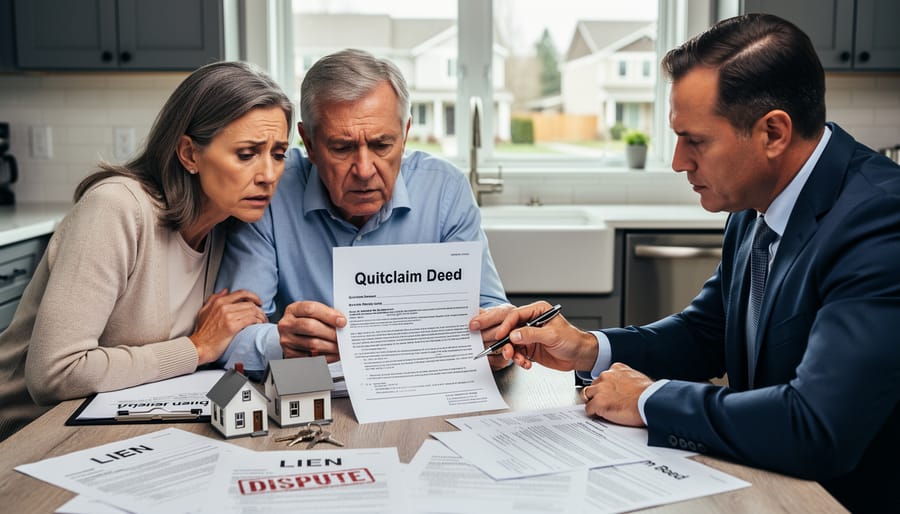
Liens, Encumbrances, and Ownership Clouds
Here’s the critical reality about quitclaim deeds: they transfer property “as-is,” meaning every problem attached to that title becomes yours. Unlike warranty deeds that guarantee a clean title, quitclaim deeds offer zero protection against existing issues.
When you accept a quitclaim deed, you’re inheriting any liens, unpaid taxes, mortgage obligations, or mechanic’s liens attached to the property. That $50,000 contractor lien from renovations the previous owner never paid? Now it’s your responsibility. Outstanding property taxes? You’re on the hook. Even judgments against the former owner can cloud your newly acquired title.
Easements present another layer of complexity. These legal rights allowing others to use portions of the property—like utility access or shared driveways—transfer automatically with quitclaim deeds. You might discover your “private” backyard includes a neighbor’s legal right to cross it daily.
Title defects create the most serious ownership clouds. Undisclosed heirs, fraudulent transfers, or errors in public records can surface years later, potentially challenging your ownership rights. Without title insurance, you’ll bear the legal costs of defending your ownership claim.
This is precisely why real estate professionals strongly recommend title searches and insurance before accepting any quitclaim deed, even from trusted family members. The small upfront investment can prevent devastating financial consequences down the road.
Tax Consequences and Gift Implications
Transferring property through a quitclaim deed might seem straightforward, but the tax implications can catch you off guard if you’re not prepared. Understanding these consequences is essential before signing anything.
When you transfer property for less than fair market value or for no compensation at all, the IRS may view this as a gift. If the property’s value exceeds the annual gift tax exclusion threshold (currently $17,000 per recipient in 2023), you’ll need to file a gift tax return. While you may not owe immediate taxes due to the lifetime exemption amount, this transfer counts against your lifetime gift and estate tax exemption, which could impact your long-term estate planning strategy.
Property tax reassessment represents another critical consideration. Many jurisdictions trigger automatic reassessments when ownership changes hands, potentially increasing your property tax bill significantly. Some states offer exemptions for transfers between family members or specific situations like adding a spouse to the title, so research your local rules carefully.
Capital gains tax becomes relevant when the new owner eventually sells the property. Unlike inherited property that receives a stepped-up basis, quitclaim transfers typically pass along the original owner’s tax basis. This means the recipient assumes the original purchase price for capital gains calculations, potentially facing substantial tax liability upon sale. If you received the property as a gift rather than through purchase, you’ll inherit the donor’s cost basis and holding period, which could result in higher taxes when you decide to sell down the road.
Title Insurance and Quitclaim Deeds: Why You’re Probably Not Protected
Why Title Insurers Fear Quitclaim Deeds
Title insurance companies approach quitclaim deeds with considerable caution, and for good reason. Unlike warranty deeds that come with guarantees and typically involve professional title searches, quitclaim deeds transfer property “as is” without any promises about clear ownership. This creates a significant blind spot for insurers.
When someone transfers property via quitclaim deed, there’s usually no comprehensive title examination beforehand. This means hidden problems like unpaid liens, undisclosed heirs, boundary disputes, or fraudulent claims might lurk beneath the surface. For title insurance companies, these unknown risks translate directly into potential claims they might have to pay out.
The lack of warranties in quitclaim transfers means the grantor isn’t vouching for anything about the property’s history. They’re simply saying, “Here’s whatever interest I might have, if any.” This uncertainty makes insurers nervous because they can’t easily assess their exposure. Many title insurance companies will either refuse to issue policies on properties recently transferred by quitclaim deed or require extensive additional investigation and documentation before providing coverage, often at higher premiums to offset the elevated risk.
Your Options for Protection After a Quitclaim Transfer
If you’ve received property through a quitclaim deed (that “quick deed” everyone mentions), you’re not without recourse to protect yourself. Start with a comprehensive title search through a reputable title company. This investigation reveals existing liens, judgments, or ownership disputes that the grantor’s bare-bones transfer didn’t address. Think of it as due diligence after the fact, though admittedly better done beforehand.
When title issues surface, a quiet title action becomes your legal remedy. This court proceeding clears clouds on your ownership by formally resolving competing claims. Yes, it involves attorney fees and time, but it’s often the only path to marketable title when problems emerge.
Securing title insurance post-quitclaim poses challenges since most insurers hesitate to cover properties transferred this way. However, some companies offer policies after a waiting period, typically six to twelve months of clear ownership. During this time, maintain meticulous records of property taxes paid, improvements made, and continuous possession. These documents demonstrate your legitimate ownership interest.
Consider working with a real estate attorney who specializes in title curative work. They can navigate the intersection of property law and insurance requirements, potentially identifying coverage options or alternative protections you hadn’t considered. Protection exists, but it requires proactive effort on your part.
Alternatives to Consider Before Using a Quitclaim Deed
Grant Deeds and Special Warranty Deeds
If a quitclaim deed feels too risky but a full warranty deed isn’t necessary, consider these middle-ground alternatives. A grant deed, common in Western states, provides two key promises: the grantor hasn’t already transferred the property to someone else, and the property isn’t burdened by liens or encumbrances that the grantor created (though previous owner issues aren’t covered). This offers more protection than a quitclaim without the extensive guarantees of a warranty deed.
Special warranty deeds take a similar approach but are more prevalent in Eastern states. The seller guarantees the title only during their period of ownership, protecting you from problems they caused but not from issues that existed before they owned the property. This makes special warranty deeds popular in commercial transactions and foreclosure sales, where buyers accept some risk in exchange for a lower purchase price. Both options provide reasonable protection for transactions between parties with some existing relationship or when you’ve conducted your own title research and feel confident about the property’s history.
Life Estate Deeds and Transfer-on-Death Deeds
If you’re considering a quitclaim deed primarily for estate planning purposes, you might want to explore two alternative approaches that offer more robust protections. Life estate deeds allow you to transfer property while retaining the right to live there until death, at which point ownership automatically passes to your named beneficiaries. This strategy avoids probate while keeping you in control during your lifetime. Transfer-on-death (TOD) deeds, available in many states, function similarly by designating beneficiaries who inherit the property automatically upon your passing, without triggering immediate gift tax consequences or Medicaid complications. Unlike quitclaim deeds, these options don’t surrender your ownership rights prematurely. They also provide better creditor protection since the property technically remains yours until death. Before choosing between a quitclaim deed and these alternatives, consult an estate planning attorney who understands your state’s laws and your specific financial situation, including any potential insurance implications for your heirs.
Quitclaim deeds offer a straightforward mechanism for transferring property ownership, but they’re not a one-size-fits-all solution. Understanding when they’re appropriate versus when they pose unnecessary risk is essential for protecting your real estate interests.
These documents work best in low-risk scenarios involving trusted parties, such as adding a spouse to a title, transferring property between family members, or correcting title errors. They shine when speed and simplicity matter more than guarantees. However, quitclaim deeds provide zero title protection. The grantor makes no promises about ownership validity, existing liens, or legal claims against the property. This makes them unsuitable for traditional real estate transactions where you need assurance that you’re receiving clear, marketable title.
Before proceeding with any quitclaim deed transfer, consult a qualified real estate attorney who can assess your specific situation. They’ll help determine whether a quitclaim deed serves your needs or if a warranty deed offers better protection. Additionally, work with title professionals to conduct thorough title searches, even in seemingly simple transfers. Unexpected liens, judgments, or ownership disputes can surface years later, creating costly legal headaches.
Consider title insurance as an added safeguard, particularly when receiving property through quitclaim deed. While the deed itself offers no warranties, title insurance can protect against hidden defects in ownership history.
The key takeaway: quitclaim deeds are powerful tools when used correctly in appropriate circumstances. Rushing into a transfer without professional guidance, however, can expose you to significant financial and legal risks that far outweigh any time or money saved upfront.