
A deepfake video shows your company’s CEO authorizing a $2.4 million wire transfer during a property closing. The voice matches perfectly. The mannerisms are identical. Your escrow officer processes the payment without hesitation—and the funds vanish into an untraceable account within minutes. This isn’t a hypothetical scenario from a cybersecurity thriller. It happened to a Hong Kong-based real estate firm in 2024, and similar artificial intelligence-powered fraud attempts have surged by 3,000% in the past eighteen months alone.
Deepfake technology has evolved from a novelty into a sophisticated weapon that criminals deploy to hijack high-value real estate transactions. These hyper-realistic audio and video forgeries can impersonate buyers, sellers, attorneys, and title company representatives with alarming precision. A single successful attack can drain escrow accounts, derail closings, and trigger legal battles that span years. Traditional wire fraud protections weren’t designed for threats that bypass human detection, leaving a dangerous gap in transaction security.
The financial exposure is staggering. The average commercial real estate closing involves transfers exceeding $500,000, while luxury residential deals routinely handle multiple millions. When fraudsters target these transactions with deepfake impersonations, the losses compound rapidly—and standard insurance policies often exclude coverage for AI-facilitated crimes. This emerging threat demands a new category of protection specifically engineered for the digital vulnerabilities inherent in modern property transfers, alongside robust verification protocols that can distinguish authentic communications from sophisticated digital forgeries.
What Are Deepfake Frauds in Real Estate Transactions?
The Technology Behind the Threat
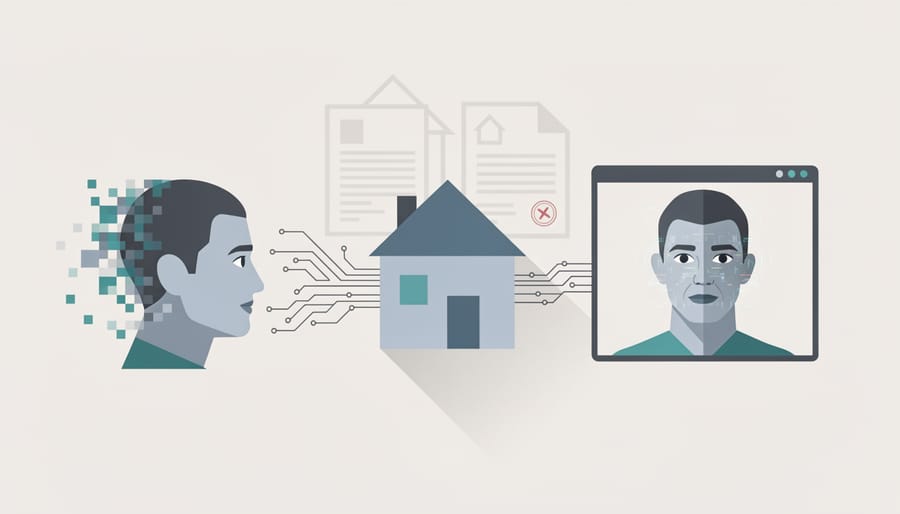
Deepfake technology uses artificial intelligence, specifically a type of machine learning called “deep learning,” to create convincingly realistic but entirely fabricated audio and video content. Think of it as a digital impersonation tool that’s become frighteningly good at its job. The AI analyzes thousands of images or audio clips of a real person, then learns to replicate their facial expressions, voice patterns, and mannerisms with stunning accuracy.
What makes deepfakes particularly dangerous for real estate transactions is their accessibility. Just five years ago, creating a convincing deepfake required specialized equipment and technical expertise. Today, fraudsters can download user-friendly apps and software that do the heavy lifting in minutes. Some programs need as little as three seconds of audio to clone someone’s voice, while others can animate a still photo into a talking, moving person using just a smartphone.
The technology has reached a tipping point where detecting fakes has become nearly impossible for the untrained eye. When you’re conducting a digital closing and see what appears to be your buyer on a video call, you might actually be watching a sophisticated AI puppet controlled by a criminal halfway across the world.
Common Deepfake Schemes Targeting Digital Closings
Digital real estate closings have become prime targets for increasingly sophisticated deepfake schemes. Understanding these specific threats is essential for protecting your transaction from fraud.
One of the most alarming scenarios involves impersonated video calls. Fraudsters use AI-generated video to pose as buyers, sellers, or even attorneys during virtual meetings. These deepfakes can mimic facial expressions, voice patterns, and manmannerisms so convincingly that participants believe they’re speaking with legitimate parties. The scammer then proceeds with the transaction, often rerouting funds or stealing sensitive information.
Fake wire transfer instructions represent another common attack vector. Criminals intercept email communications and use deepfake audio or video messages to “confirm” modified wiring details. A buyer might receive what appears to be a video message from their title company representative verifying new account numbers, only to discover later that hundreds of thousands of dollars were sent to fraudulent accounts.
Forged identity verifications have also evolved dramatically. Traditional photo ID checks are no longer sufficient when deepfake technology can generate real-time video of someone holding identification documents. This makes remote identity verification during digital closings particularly vulnerable to exploitation.
Perhaps most insidious are spoofed attorney communications. Fraudsters create deepfake videos or audio clips of lawyers providing transaction guidance, approving document changes, or authorizing fund transfers. Because attorneys hold trusted positions in real estate transactions, these impersonations can bypass typical verification protocols and cause significant financial damage before anyone realizes the deception.
The Growing Risk: Why Digital Real Estate Closings Are Prime Targets
Remote Closings Open New Doors for Fraudsters
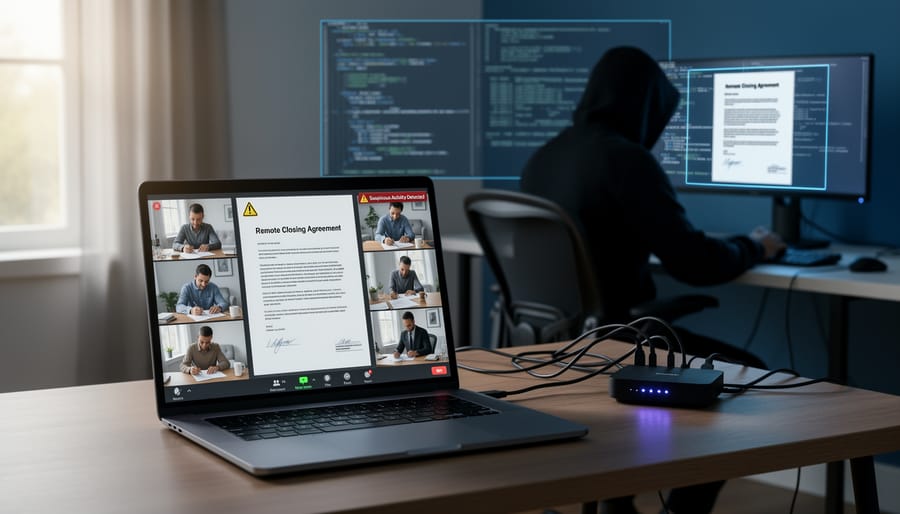
The COVID-19 pandemic fundamentally transformed real estate closings, ushering in an era of convenience that fraudsters quickly learned to exploit. As social distancing requirements took hold, the industry rapidly adopted remote online notarization (RON) and fully digital closing processes. What seemed like a temporary solution became the new standard, with video conferencing replacing face-to-face meetings and digital signatures supplanting wet ink.
This shift created a perfect storm for sophisticated criminals. Traditional closings relied heavily on in-person verification—you could assess body language, verify photo IDs under proper lighting, and build trust through human interaction. Remote closings stripped away these safeguards, replacing them with webcams and screen-shared documents. While reputable platforms employ security measures for protecting digital transactions, they can’t always catch deepfake technology that convincingly mimics a legitimate party’s appearance and voice.
The numbers tell the story: wire fraud attempts in real estate increased by 64% between 2020 and 2022. Fraudsters now target the weakest link in digital closings—the assumption that the person on screen is who they claim to be.
The Financial Stakes Are Astronomical
The numbers are sobering. According to the FBI’s Internet Crime Complaint Center, wire fraud targeting real estate transactions results in average losses exceeding $300,000 per incident. When criminals strike during the closing process, they’re not looking for pocket change—they’re after the entire down payment or purchase price being transferred between parties.
What makes these losses particularly devastating is the near-impossibility of recovery. Unlike credit card fraud where charges can be reversed, wire transfers are typically irreversible once completed. Studies show that victims recover funds in fewer than 15 percent of wire fraud cases, and even when partial recovery occurs, it often takes months or years of legal battles.
Criminals specifically target the closing process because it creates the perfect storm of conditions. Large sums of money are moving on tight deadlines, multiple parties are coordinating communications, and buyers are often anxious and eager to complete the transaction. This three-to-five-day window before closing represents a vulnerability where a single compromised email account or convincing deepfake video call can redirect hundreds of thousands of dollars into untraceable accounts. The pressure to close on schedule makes people less likely to question last-minute instructions, giving fraudsters their opening.
Real Victims, Real Losses: Case Studies
The financial and emotional toll of deepfake fraud becomes starkly clear when examining real-world deepfake fraud cases that have devastated families and professionals alike.
Consider the Tampa Bay couple who lost their $450,000 dream home in 2023. Days before closing, they received what appeared to be a video call from their title company representative, complete with the company’s branding and the agent’s familiar face. The “agent” instructed them to wire their down payment to an updated account due to a banking system migration. The deepfake was so convincing that the buyers never questioned it. Within hours of transferring $87,000, they discovered the real agent had never made that call. The funds vanished into untraceable offshore accounts.
In another case, a Seattle property owner nearly lost her $1.2 million investment property when fraudsters used AI-generated voice cloning to impersonate her during verification calls with the title company. They had scraped audio from her real estate podcast appearances to create a perfect vocal replica. Only a vigilant closing attorney who noticed inconsistencies in supporting documentation prevented the fraudulent sale from completing.
A commercial real estate firm in Austin wasn’t as fortunate. Scammers used deepfake video to pose as the firm’s managing partner during a virtual closing for a $3 million office building. The sophisticated fraud included manipulated identification documents and real-time video that mimicked the partner’s mannerisms. The firm lost $600,000 in client funds and faced additional legal liability, ultimately requiring cybersecurity insurance claims and specialized legal intervention to partially recover losses.
What Is Deepfake Fraud Insurance for Digital Real Estate Closings?
Coverage That Traditional Policies Miss
Traditional cyber insurance policies were designed for yesterday’s threats, like data breaches and ransomware attacks. While valuable, they often fall short when it comes to the sophisticated social engineering tactics behind deepfake fraud in real estate transactions. Standard policies typically focus on network security failures and unauthorized system access, not the manipulation of human perception through hyper-realistic fake audio and video.
Here’s where the gap becomes critical: most conventional policies don’t cover losses from wire fraud initiated through deepfake impersonation, even though these scams can drain six or seven-figure closing funds in minutes. Traditional fraud coverage usually requires proof of unauthorized system access, but deepfakes work differently. They exploit trust by making victims willingly transfer funds to fraudulent accounts, believing they’re following legitimate instructions from their title company, real estate agent, or attorney.
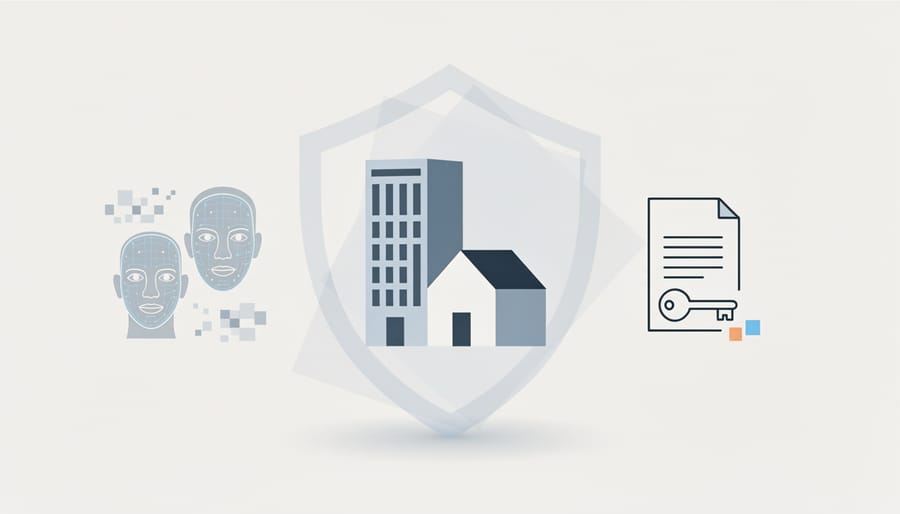
Deepfake fraud insurance specifically addresses this modern threat landscape. It covers financial losses from fraudulent wire transfers initiated through AI-generated voice clones, video impersonations, and synthetic identity fraud targeting real estate closings. This specialized coverage extends to social engineering attacks that bypass traditional security measures, recognizing that the human element has become the new vulnerability in digital transactions. For real estate professionals handling multiple high-value closings monthly, this targeted protection fills a dangerous void that standard policies simply weren’t built to address.
Who Should Consider This Coverage?
Deepfake fraud insurance isn’t just for tech companies anymore—it’s becoming essential protection for anyone involved in high-stakes digital real estate transactions. Title companies and escrow agents should seriously consider this coverage, as they’re often the first line of defense when wire transfers and identity verification happen remotely. You’re handling millions of dollars in transactions, and a single compromised video call or doctored document could expose your business to devastating liability.
Real estate brokerages facilitating remote closings face similar risks, especially when representing clients they’ve never met in person. If you’re a buyer or seller involved in a high-value property transaction—typically those exceeding $500,000—this coverage provides crucial peace of mind. Real estate attorneys and closing professionals who’ve shifted to digital platforms should also evaluate their exposure, particularly if you’re handling multiple virtual closings monthly.
Even individual homeowners participating in remote closings might find this protection valuable, especially in markets where virtual transactions have become standard practice. The bottom line? If your real estate transaction involves digital identity verification, remote notarization, or electronic fund transfers, you’re potentially vulnerable to deepfake schemes—and worth exploring specialized insurance coverage.
How Deepfake Fraud Insurance Actually Works
Securing deepfake fraud insurance starts with a straightforward but thorough application process designed specifically for real estate transactions. Title companies, closing attorneys, and real estate brokerages typically apply on behalf of their operations, though high-net-worth individuals involved in significant property transactions can often obtain standalone policies.
The application requires detailed documentation about your transaction security protocols. Insurers want to see what verification measures you already have in place, such as multi-factor authentication systems, callback procedures for wire transfer confirmations, and employee training records on fraud prevention. Think of it as proving you’re not an easy target before an insurer will take on your risk.
Verification requirements are substantial. Most carriers conduct security audits of your closing procedures and may require implementation of specific authentication technologies before approval. Some policies mandate video conferencing with identity verification for high-value transactions, while others require dual-authentication on all wire transfer requests above certain thresholds.
When it comes to claims procedures, time is critical. If you suspect deepfake fraud, you must notify your insurer within 24 to 48 hours. The claims process involves submitting evidence of the fraudulent communication, transaction records, and documentation showing you followed required security protocols. Insurers typically investigate within 10 to 15 business days, though complex cases take longer.
Policy limits vary considerably based on your transaction volume and property values. Entry-level policies for smaller brokerages start around 500,000 dollars in coverage, while enterprise-level policies for major title companies can reach 10 million dollars or higher. Most policies include per-incident limits alongside annual aggregate caps, with deductibles ranging from 10,000 to 50,000 dollars depending on coverage level.
Beyond Insurance: Protecting Your Closing from Deepfake Threats
Verification Protocols That Work
Protecting your real estate transaction from deepfake fraud requires implementing straightforward verification protocols that create multiple layers of security. Think of these as your digital chain of title for communications.
Start by establishing verbal code words or security questions with all parties before closing begins. Choose something memorable but not publicly available—like the address of your first property purchase or a childhood pet’s name. Every time someone requests a wire transfer or changes payment instructions, verify using this code word first.
Never rely on a single communication channel. If you receive wire instructions via email, pick up the phone and call a known, verified number—not one provided in the email. This simple cross-channel verification catches most fraud attempts. For high-value transactions, consider video calls where you can see the person in real time, though remember that even video can be manipulated with sophisticated deepfakes.
Implement mandatory callback procedures for any changes to closing instructions. Your title company should have a policy requiring verification through pre-established phone numbers within 24 hours of any modification request. This cooling-off period disrupts the urgency that fraudsters rely on.
Multi-factor authentication should be non-negotiable for all digital platforms handling transaction data. Modern identity verification systems now combine biometric data, device recognition, and behavioral analytics to confirm authenticity. While no system is foolproof, layering these protocols significantly reduces your vulnerability to deepfake attacks and demonstrates due diligence that insurers value when underwriting cyber fraud coverage.
Technology Tools for Detection
The fight against deepfake fraud is mobilizing an impressive arsenal of technological defenses. Deepfake detection software now uses artificial intelligence to analyze video and audio for telltale signs of manipulation—inconsistent lighting, unnatural facial movements, or audio irregularities that human eyes and ears might miss. These tools are becoming standard features in secure communication platforms used by title companies and real estate firms.
For property transactions, blockchain verification systems are proving invaluable. These platforms create immutable records of communications and document exchanges, making it nearly impossible for fraudsters to alter transaction histories after the fact. Multi-factor authentication systems that combine biometric verification with knowledge-based questions add another critical layer of protection.
Some forward-thinking firms are adopting video verification protocols that require participants to perform specific real-time actions during calls, making pre-recorded deepfakes ineffective. Meanwhile, digital watermarking technology embeds invisible signatures in legitimate documents and videos, allowing quick authentication. As these tools become more accessible and affordable, they’re shifting from optional safeguards to industry necessities for protecting high-value real estate transactions.
The Future of Digital Real Estate Security
The digital real estate landscape is rapidly evolving, and so are the safeguards protecting it. Regulatory bodies are taking notice, with several states already introducing legislation requiring enhanced identity verification for remote closings. The American Land Title Association (ALTA) is developing comprehensive guidelines specifically addressing deepfake threats, which will likely become industry standard within the next two years.
We’re seeing insurance carriers respond with increasingly sophisticated coverage options. Early deepfake fraud policies were essentially add-ons to existing cybersecurity insurance, but dedicated products are emerging that specifically address wire fraud, identity manipulation, and authentication failures in real estate transactions. These policies are incorporating AI-powered fraud detection tools as part of their risk assessment process, meaning policyholders may soon receive real-time threat alerts during closings.
Title companies and escrow services are investing heavily in multi-factor authentication systems that go beyond video calls. Expect to see biometric verification, blockchain-based identity ledgers, and encrypted communication platforms become standard practice. Some forward-thinking insurers are even offering premium discounts to firms that adopt these advanced security measures.
The cost of protection will likely decrease as technology matures and becomes more accessible. What’s currently considered cutting-edge will become table stakes for any serious real estate transaction within five years. For property professionals and buyers alike, staying informed about these developments isn’t optional anymore—it’s essential business practice in an increasingly digital marketplace.
The digital transformation of real estate has brought incredible efficiency, but it’s also opened doors to sophisticated fraud schemes that demand equally sophisticated responses. Protecting yourself from deepfake fraud isn’t about choosing between prevention and protection—it’s about embracing both. Start today by implementing verification protocols in your transactions: insist on multi-factor authentication, establish secure communication channels with all parties, and never rush through digital closings, no matter the pressure.
But here’s the reality: even the most vigilant professionals can fall victim to these AI-powered scams. That’s precisely why deepfake fraud insurance has evolved from a nice-to-have into an essential component of modern real estate risk management. Think of it as your financial safety net in an era where seeing is no longer believing. Whether you’re a real estate professional handling multiple transactions monthly or a homeowner making the largest purchase of your life, this coverage fills a critical gap that traditional policies simply don’t address.
The question isn’t whether deepfake fraud will affect real estate—it already has. The question is whether you’ll be prepared when it happens in your transaction.