
Transform your insurance team’s training approach by implementing virtual reality simulations that place agents directly into high-stakes property assessment scenarios. Rather than classroom lectures about flood damage evaluation or fire risk inspection, VR technology allows trainees to walk through damaged properties, identify coverage gaps, and practice client conversations in realistic 3D environments—all without leaving the office.
Replace costly field training programs with immersive VR modules that compress months of hands-on experience into focused hours. Insurance professionals can practice conducting property inspections across multiple scenarios—from earthquake-damaged foundations to wind-compromised roofing systems—building muscle memory and decision-making skills that translate directly to real claims situations. This approach reduces training costs by up to 60% while improving knowledge retention rates to 75% compared to traditional methods’ 10-20%.
Integrate VR professional development alongside other insurance tech solutions already transforming the industry. Modern VR platforms offer repeatable, standardized training experiences that ensure every team member receives identical instruction quality, eliminating the inconsistencies inherent in mentor-based programs. Trainees can repeat complex scenarios until mastery is achieved, receiving immediate feedback on their assessment accuracy and customer interaction skills.
Deploy VR training to address your most pressing challenges: onboarding new adjusters faster, preparing teams for emerging risks like climate-related damages, and maintaining compliance with evolving regulations. The technology creates measurable competency benchmarks, providing management with concrete data on each team member’s readiness for independent fieldwork while dramatically reducing the time from hiring to productivity.
The Real Problem with Traditional Insurance Training
Traditional insurance training methods have served the industry for decades, but they’re increasingly falling short in preparing insurance professionals for the complex realities of property assessment and claims management. Let’s examine why conventional approaches struggle to meet modern training needs.
Classroom learning and PowerPoint presentations can effectively convey theoretical concepts like policy structures and coverage limits. However, they fail to bridge the critical gap between understanding insurance principles on paper and applying them in unpredictable real-world scenarios. When an adjuster encounters a home with hidden water damage or structural issues masked by cosmetic repairs, textbook knowledge alone proves insufficient. The ability to spot red flags, assess risk factors, and make quick judgments under pressure requires experiential learning that traditional methods simply cannot provide.
Shadowing experienced adjusters offers some practical exposure, but this approach comes with significant limitations. Training opportunities depend entirely on the types of claims that happen to occur during the shadowing period. A trainee might spend months without encountering critical scenarios like fire damage assessment, catastrophic weather claims, or complex fraud situations. This randomness creates inconsistent skill development across training cohorts and leaves dangerous knowledge gaps.
The financial burden of traditional training is substantial. Companies invest in instructor time, travel costs for field training, rental spaces for workshops, and printed materials. Even more costly is the productivity loss when experienced adjusters must dedicate hours to mentoring instead of processing claims. For smaller agencies, these expenses can be prohibitive.
Perhaps most critically, traditional training cannot safely replicate dangerous situations. How do you teach someone to assess a structurally compromised building, identify asbestos, or evaluate fire-damaged properties without actual exposure? The answer has always been: you cannot. This fundamental limitation has forced the industry to accept that some skills can only be learned through years of on-the-job experience, extending the timeline before new hires reach full competency.

How VR Training Works for Real Estate Insurance Professionals
Immersive Property Assessment Simulations
Virtual reality technology now enables insurance professionals to examine countless property scenarios without ever stepping foot on-site. These immersive simulations recreate everything from single-family homes to commercial complexes, complete with realistic architectural details, materials, and structural elements that adjusters need to evaluate accurately.
Training scenarios can include fire damage with charred walls and smoke residue, water damage showing various stages of mold growth, or storm impacts featuring roof punctures and shattered windows. Trainees walk through these virtual properties, identifying damage indicators just as they would during actual field assessments. The technology even replicates challenging environmental conditions like poor lighting, tight crawl spaces, or weather obstacles that make real-world inspections difficult.
What makes VR particularly valuable is its integration with AI-powered risk assessment tools, allowing trainees to compare their evaluations against data-driven benchmarks. Insurance staff can practice assessing foundation cracks, HVAC system conditions, or electrical hazards repeatedly until their skills sharpen, all while your company avoids travel costs and scheduling complications. This hands-on experience builds confidence before adjusters face actual claims, reducing errors and improving customer satisfaction when real property assessments occur.
Client Interaction and Communication Training
Virtual reality training transforms how insurance professionals handle challenging client interactions by creating realistic, pressure-free practice environments. Instead of learning from costly real-world mistakes, your team can repeatedly rehearse difficult conversations until they master the nuances of tone, pacing, and persuasion.
Consider claim disputes, one of the most stressful aspects of property insurance. VR simulations place agents in virtual offices or homes where they face upset homeowners questioning coverage decisions. These scenarios include varied client personalities—from calmly skeptical to emotionally charged—allowing professionals to develop situational awareness and de-escalation techniques. The immersive nature creates genuine emotional responses, making the learning experience far more impactful than role-playing exercises.
Policy explanation scenarios are equally valuable. When agents need to clarify complex coverage details for title insurance, flood policies, or homeowners insurance exclusions, VR provides a safe space to refine their communication approach. They can practice breaking down complicated terms into digestible explanations without the pressure of losing a potential sale or damaging client relationships.
The technology also enables supervisors to observe these interactions and provide targeted feedback. Trainees can review their own performance, noticing verbal tics, unclear explanations, or missed opportunities to build rapport. This immediate feedback loop accelerates skill development dramatically.
For real estate insurance professionals, this training method addresses a critical gap: technical knowledge alone doesn’t guarantee successful client relationships. VR bridges that gap by building confidence, empathy, and communication skills that directly impact customer satisfaction and retention rates.
The Bottom-Line Benefits for Your Insurance Team
Cost Savings That Actually Matter
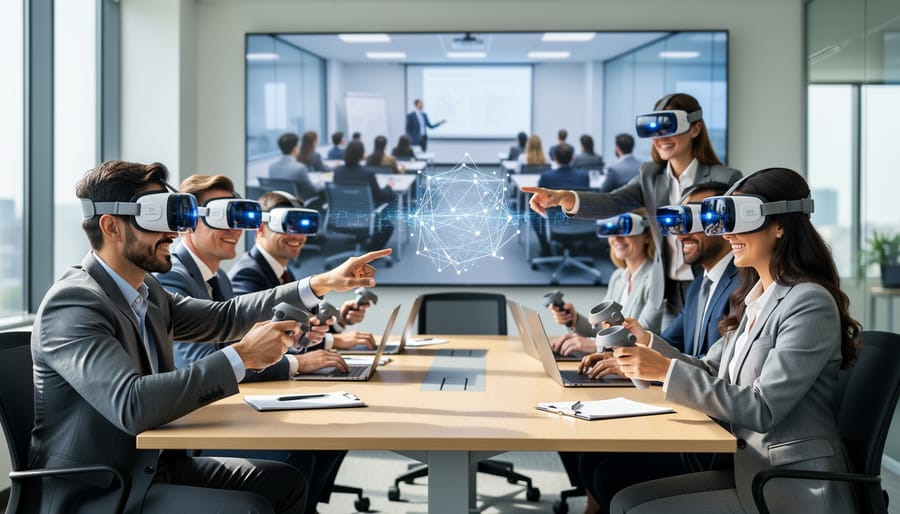
Let’s talk numbers that impact your bottom line. Virtual reality training transforms your professional development budget from a cost center into a strategic investment.
Travel expenses disappear almost entirely. Instead of flying agents to centralized training facilities—with associated hotel stays, meals, and time away from clients—your team learns from anywhere. A typical in-person training session costs $1,200 per attendee when you factor in logistics. VR training reduces this to the cost of equipment amortization and software licensing, typically under $200 per person annually.
Property staging for training scenarios becomes obsolete. Traditional role-play exercises require physical spaces, props, and setup time. VR environments replicate everything from luxury condos to fire-damaged properties instantly, eliminating rental fees and preparation costs that can exceed $5,000 per training cycle.
Training time compression delivers hidden savings. Employees complete VR modules 40% faster than traditional methods while achieving better retention rates. This means less time away from revenue-generating activities and faster onboarding for new hires. When an insurance adjuster can practice property assessments in virtual environments, they reach full productivity weeks earlier than conventional training allows.
The quality doesn’t suffer—it improves. Trainees can repeat scenarios until mastery, something impossible with traditional one-and-done workshops. Your investment pays dividends through better-prepared professionals who handle claims more efficiently and serve clients more confidently.
Measurable Performance Improvements
The numbers tell a compelling story when it comes to VR-trained professionals in the property insurance sector. Organizations implementing virtual reality training programs report measurable improvements across three critical performance areas that directly impact their bottom line.
Claim accuracy rates show the most dramatic improvements. Insurance companies using VR training report accuracy increases of 15-25% compared to traditional training methods. This improvement stems from the immersive nature of VR, which allows adjusters to practice identifying property damage, water intrusion patterns, and structural issues in realistic scenarios before they ever step foot on an actual claim site. When dealing with high-value real estate claims, this accuracy boost translates to thousands of dollars saved per case through proper damage assessment and appropriate settlement recommendations.
Customer satisfaction scores provide equally impressive evidence. VR-trained staff consistently receive ratings 20-30% higher than their traditionally-trained counterparts. These professionals demonstrate greater confidence during property inspections, communicate more clearly about policy coverage, and handle homeowner concerns with increased empathy—all skills honed through repeated VR simulations where they interact with virtual clients in various emotional states.
Perhaps most valuable from an operational standpoint is the reduction in case resolution times. Companies report that VR-trained adjusters close property damage claims 18-35% faster than the industry average. This efficiency gain results from muscle memory developed during countless virtual inspections and a deeper understanding of documentation requirements. For homeowners anxiously awaiting claim settlements after property damage, this speed improvement makes a significant difference in their overall experience and their perception of your company’s reliability.
Real-World VR Training Scenarios for Property Insurance
Virtual reality training modules for property insurance have evolved beyond basic simulations to address the complex realities adjusters and underwriters face daily. These immersive scenarios provide hands-on experience without the logistical challenges and safety concerns of traditional field training.
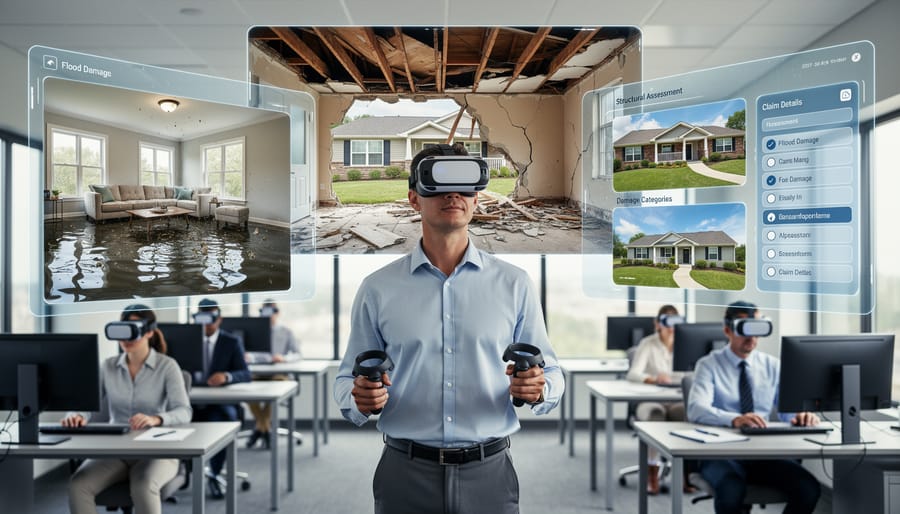
One of the most valuable VR applications focuses on flood damage assessment. Trainees can virtually walk through water-damaged properties at various stages, from immediate aftermath to weeks later when mold and structural issues become apparent. These modules teach proper documentation techniques, help adjusters identify secondary damage often missed by inexperienced eyes, and demonstrate how water infiltration affects different building materials. The beauty of this approach is that learners can repeatedly practice in diverse scenarios, from basement flooding in older homes to hurricane damage in coastal properties, without waiting for actual weather events.
Structural integrity evaluation represents another critical training area where VR excels. Insurance professionals can examine foundation cracks, roof damage, and load-bearing wall issues in a safe, controlled environment. The technology allows trainees to see inside walls and beneath floors, understanding how hidden damage manifests in visible symptoms. This x-ray vision capability, impossible in real-world training, accelerates learning and builds confidence in making accurate assessments that protect both the insurer and policyholder.
Fraud detection training through VR offers particularly innovative applications. Trainees encounter staged claim scenarios where they must identify inconsistencies and red flags. These might include discrepancies between reported damage and actual conditions, suspicious burn patterns in fire claims, or timing irregularities in theft reports. By experiencing hundreds of scenarios compressed into hours rather than years, adjusters develop the pattern recognition skills that typically come only from extensive field experience.
Advanced modules combine multiple challenges simultaneously. For example, a trainee might assess earthquake damage while interviewing a virtual policyholder, managing time constraints, and documenting findings using simulated claims software. This multitasking mirrors real-world pressure and builds competency faster than traditional classroom instruction.
The technology also enables rare scenario training, such as assessing damage from sinkholes, tornadoes, or wildfires, events that many adjusters might never encounter during their careers but must be prepared to handle professionally when they occur.
Implementing VR Training Without the Headaches
Rolling out VR training at your insurance firm doesn’t require a Silicon Valley budget or a team of tech wizards. Start with a pilot program focused on one specific training need, like claims assessment or client communication scenarios. This approach typically costs between $10,000-$30,000 for a small group, significantly less than building a full training center.
When selecting a platform, look for solutions designed specifically for professional training rather than gaming hardware. Standalone headsets like the Meta Quest series offer the best balance of affordability and functionality, eliminating the need for expensive computers. Many vendors now offer subscription-based models, spreading costs over time and including regular content updates.
Integration with existing programs is simpler than you might think. VR modules work best as supplements to traditional training, not replacements. Consider inserting VR scenarios at key points in your current curriculum where hands-on practice would be valuable. For example, after classroom instruction on property damage assessment, agents can practice in a virtual damaged home before their first real-world inspection.
Staff adoption concerns are legitimate but manageable. Start by identifying enthusiastic early adopters who can become internal champions. Schedule short 10-15 minute initial sessions to prevent overwhelm and motion sickness concerns. Most people adapt within 2-3 uses. Address the “this is just a gimmick” skepticism by demonstrating clear connections between VR scenarios and real job challenges.
Budget for ongoing costs beyond hardware. Quality content creation runs $5,000-$20,000 per module, though many platforms offer industry-standard libraries. Factor in a dedicated coordinator to manage scheduling, equipment maintenance, and user support, at least part-time initially.
The biggest obstacle isn’t technology or cost, it’s organizational commitment. Successful implementations happen when leadership treats VR as a strategic training investment, not an experimental toy. Set measurable goals like reducing onboarding time by 20% or improving claims accuracy scores, then track results rigorously to justify continued investment.
What to Look for in a VR Training Solution
Selecting the right VR training platform requires careful evaluation of several critical factors that will directly impact your return on investment and training outcomes.
Start with content relevance. The best platforms offer extensive libraries of real estate insurance-specific scenarios, from property risk assessment walkthroughs to client consultation simulations. Generic corporate training modules won’t cut it. Look for vendors who understand the nuances of property insurance, homeowner coverage decisions, and risk management strategies specific to real estate transactions.
Customization capabilities matter significantly. Your brokerage handles unique property types and client situations, so you need a platform that allows you to modify existing scenarios or build custom training modules. This flexibility ensures your team practices with scenarios they’ll actually encounter, whether that’s explaining coverage options for luxury condos or navigating flood insurance requirements.
Analytics and reporting features separate mediocre platforms from exceptional ones. You need detailed insights into trainee performance, completion rates, decision-making patterns, and areas requiring additional support. Advanced platforms track everything from head movements to response times, giving you actionable data to refine your training approach.
Hardware requirements deserve attention upfront. Some solutions require expensive, high-end headsets, while others work with more affordable options or even mobile VR devices. Consider your budget, scalability needs, and whether the vendor provides equipment or if you’re purchasing separately.
Technical support and training shouldn’t be afterthoughts. Implementing PropTech innovation like VR requires ongoing vendor support, regular content updates, and troubleshooting assistance. Ask potential vendors about their onboarding process, response times for technical issues, and whether they provide train-the-trainer programs.
Finally, request demonstrations and pilot programs before committing. The best way to avoid costly mistakes is experiencing the platform firsthand and gathering feedback from actual users who will benefit from the training.
The competitive landscape of real estate insurance demands that firms equip their teams with cutting-edge training tools, and virtual reality has moved from experimental technology to proven professional development solution. Organizations that adopt VR training now gain immediate advantages in staff competency, risk assessment accuracy, and client service quality, while those delaying implementation risk falling behind competitors who are already reaping these benefits.
The window for early adoption is closing as VR becomes increasingly mainstream across financial services sectors. Forward-thinking insurance firms should begin by conducting internal needs assessments to identify specific training gaps where immersive learning offers the greatest impact. Next, pilot programs with select teams can demonstrate ROI before full-scale rollout, minimizing risk while building organizational buy-in.
The future of insurance professional development will undoubtedly blend traditional methods with immersive technologies, creating hybrid learning environments that leverage the best of both approaches. As VR hardware becomes more affordable and content libraries expand, firms that establish VR training infrastructure today will be positioned to seamlessly integrate tomorrow’s innovations, from artificial intelligence-powered scenarios to augmented reality field applications, ensuring their teams remain at the forefront of industry expertise.