
Securing a mortgage while self-employed demands a strategic approach to what lenders actually want. Traditional income verification methods don’t apply, but that doesn’t mean homeownership is out of reach. Leading mortgage lenders like Rocket Mortgage, Chase, and SoFi now offer specialized programs designed specifically for entrepreneurs and freelancers, recognizing the unique financial patterns of self-employed professionals.
The key difference lies in documentation requirements. While W-2 employees simply submit pay stubs, self-employed borrowers must demonstrate income stability through two years of tax returns, profit and loss statements, and bank statements showing consistent revenue. This comprehensive approach actually gives self-employed individuals multiple ways to prove their creditworthiness, often resulting in competitive interest rates and terms comparable to traditional borrowers.
Today’s mortgage market has evolved to accommodate the growing self-employed workforce, with some lenders even specializing in non-traditional income verification methods. Understanding these options and preparing the right documentation package can transform what many see as a challenging process into a straightforward path to homeownership.
Why Traditional Lenders Often Hesitate with Self-Employed Borrowers
Income Verification Challenges
Self-employed individuals often face unique challenges when applying for mortgages due to their variable income patterns. Unlike traditional W-2 employees, self-employed borrowers typically experience fluctuating monthly earnings, seasonal variations, and business cycle impacts that can complicate the income verification process.
Lenders are particularly concerned about income stability and sustainability. They typically analyze tax returns from the past two years, looking for consistent or upward trends in earnings. Business deductions, while beneficial for tax purposes, can significantly reduce reported income, making it harder to qualify for larger loan amounts.
Another common hurdle is the impact of recent changes in business performance. If your income has recently increased, lenders might not fully consider the higher earnings until you have a longer track record. Conversely, temporary downturns or revenue gaps might raise red flags, even if your business has recovered.
To address these challenges, many self-employed borrowers need to provide additional documentation, including profit and loss statements, business bank statements, and client contracts, to paint a complete picture of their financial health.
Tax Return Complexities
Tax write-offs present a unique challenge when applying for a mortgage as a self-employed individual. While business deductions help reduce your tax liability, they also lower your reported income, which lenders use to determine your borrowing capacity. Common write-offs like vehicle expenses, home office deductions, and depreciation can significantly impact your qualifying income.
Lenders typically look at your net income after deductions, not your gross revenue. This means that aggressive tax strategies that minimize your taxable income could work against you when seeking mortgage approval. Some lenders may offer to add back certain deductions to your income, such as depreciation or one-time expenses, to paint a more accurate picture of your true earnings.
To strike the right balance, consider working with a tax professional who understands both tax optimization and mortgage qualification requirements. They can help structure your returns to maintain reasonable write-offs while demonstrating sufficient income for loan approval. Planning ahead for at least two years before applying for a mortgage can make a significant difference in your qualification odds.
Best Mortgage Lenders for Self-Employed Professionals
Non-Bank Lenders
For self-employed individuals seeking more flexible lending options, non-bank lenders have emerged as valuable alternative financing solutions. These institutions typically offer more accommodating income verification processes and understand the unique financial situations of entrepreneurs and freelancers.
Private lenders, credit unions, and online mortgage companies often evaluate applications on a case-by-case basis, considering factors beyond traditional income documentation. They may look at bank statements, business revenue trends, and industry experience rather than focusing solely on tax returns.
Many non-bank lenders specialize in specific industries or business types, making them particularly attractive to self-employed professionals in those sectors. They might offer specialized programs for real estate investors, medical professionals, or technology consultants.
While these lenders may charge slightly higher interest rates compared to traditional banks, they often compensate with benefits like faster approval times, reduced documentation requirements, and more flexible terms. Some even offer programs that consider business bank deposits rather than tax returns for income verification.
Before applying, ensure you have a strong credit score and substantial cash reserves, as these factors can significantly influence your approval odds and interest rates with non-bank lenders. It’s also wise to compare multiple offers, as terms and requirements can vary considerably between different institutions.
Portfolio Lenders
Portfolio lenders offer a breath of fresh air for self-employed borrowers who struggle with traditional mortgage qualification requirements. These institutions keep loans on their own books rather than selling them to government-sponsored enterprises like Fannie Mae or Freddie Mac, allowing them to set their own lending criteria.
What makes portfolio lenders particularly attractive is their ability to offer flexible lending programs that consider the unique financial situations of self-employed individuals. They typically evaluate applications on a case-by-case basis, looking beyond standard documentation requirements to understand the full picture of a borrower’s financial health.
Many portfolio lenders accept alternative income verification methods, such as bank statements, profit and loss statements, and asset depletion calculations. They might also be more forgiving of fluctuating income patterns common among self-employed professionals. While these loans often come with slightly higher interest rates compared to conventional mortgages, they can provide access to financing when traditional routes aren’t viable.
Local and regional banks are common portfolio lenders, as are credit unions with strong community ties. These institutions often have deeper understanding of local market conditions and may be more willing to work with self-employed borrowers who have established businesses in the community. Building a relationship with a portfolio lender can be particularly beneficial for long-term financial planning and future borrowing needs.
Credit Unions
Credit unions have emerged as valuable allies for self-employed borrowers, offering a more personalized approach to mortgage lending compared to traditional banks. As member-owned institutions, credit unions often provide more flexible underwriting criteria and competitive rates specifically tailored to self-employed individuals.
One of the key advantages of working with credit unions is their manual underwriting process. Unlike larger banks that rely heavily on automated systems, credit unions typically review applications on a case-by-case basis, considering factors beyond just income statements and tax returns. This human-centric approach can be particularly beneficial for self-employed borrowers with complex income situations.
Many credit unions offer specialized mortgage programs designed for business owners and independent contractors. These programs might include features like reduced documentation requirements, alternative income verification methods, or consideration of business assets as qualifying factors. Some credit unions even provide dedicated mortgage advisors who understand the unique challenges of self-employed income verification.
To qualify for a credit union mortgage, you’ll typically need to become a member first. Membership requirements vary but are usually straightforward, often based on your location, profession, or association with certain groups. While credit unions might have smaller lending portfolios than big banks, they frequently offer more competitive interest rates and lower fees due to their non-profit status and member-focused structure.
Documentation That Strengthens Your Application

Bank Statement Programs
For self-employed borrowers who may struggle with traditional income documentation, bank statement programs offer a practical alternative path to mortgage approval. These programs evaluate your income based on your business or personal bank deposits over a period typically ranging from 12 to 24 months.
Lenders using bank statement programs generally calculate your monthly income by averaging your deposits, then applying a predetermined expense factor. For example, if you have average monthly deposits of $15,000, the lender might use 50% of that amount as qualifying income, accounting for typical business expenses and variations in cash flow.
Most bank statement programs accept either personal or business bank statements, though business statements often receive more favorable terms. Personal statements usually require a higher expense factor deduction, while business statements might allow for actual expense analysis through profit and loss statements.
To strengthen your application under these programs, maintain consistent deposit patterns and keep personal and business accounts separate. Clean bank statements without numerous overdrafts or irregular large deposits will improve your chances of approval. Some lenders may also request a written statement from your accountant verifying your business’s stability and cash flow patterns.
While these programs typically carry slightly higher interest rates than conventional loans, they provide a valuable option for self-employed borrowers who maintain strong cash flow but may not show significant taxable income on returns.
Business Performance Records
Strong business performance records can significantly strengthen your loan application as a self-employed borrower. Lenders typically want to see a comprehensive picture of your business’s financial health through various documents that demonstrate stable or growing income.
Key business records that can support your application include profit and loss statements, which provide a detailed overview of your business’s revenue and expenses. Balance sheets are equally important, showing your company’s assets, liabilities, and overall financial position. Monthly or quarterly business bank statements help verify consistent cash flow and business activity.
Professional invoices, contracts with ongoing clients, and records of recurring revenue streams can demonstrate income stability. If you have business insurance policies or professional licenses, these documents add credibility to your application. For service-based businesses, client testimonials and portfolio samples can provide additional context about your business’s reputation and sustainability.
Many lenders also value seeing business growth metrics, such as year-over-year revenue increases, expansion plans, or new client acquisition rates. Keep detailed records of any major business achievements, industry awards, or professional certifications, as these can strengthen your profile as a borrower.
Remember to maintain organized digital and physical copies of all business records, ideally going back at least two to three years. This level of documentation helps lenders feel confident about your business’s long-term viability and your ability to maintain mortgage payments.
Strategies to Improve Your Approval Odds
Down Payment Considerations
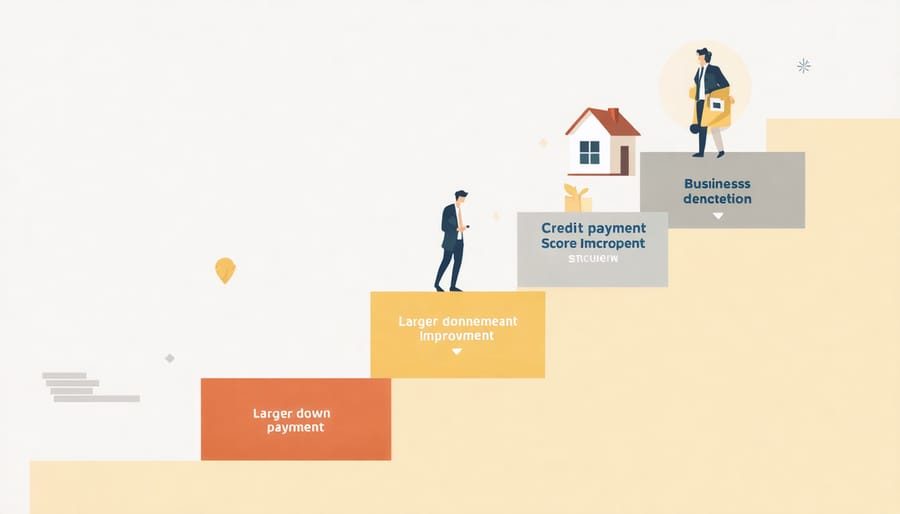
For self-employed borrowers, a larger down payment can significantly strengthen your mortgage application and potentially offset some income verification challenges. Lenders typically view substantial down payments as a sign of financial stability and lower lending risk, which can work in your favor when traditional income documentation might be complex.
Making a down payment of 20% or more can open doors to better lending options and more favorable terms. Some lenders may be more flexible with their income verification requirements when you bring more equity to the table. This is because a larger down payment reduces the lender’s risk exposure and demonstrates your ability to save and manage money effectively.
Additionally, a bigger down payment can help you:
– Secure lower interest rates
– Avoid private mortgage insurance (PMI)
– Increase your chances of approval
– Potentially reduce documentation requirements
– Lower your monthly payments
Consider that while saving for a larger down payment requires more upfront capital, it could be a strategic move that makes the difference between approval and denial. Some self-employed borrowers choose to liquidate business assets or use retirement funds to increase their down payment, though it’s crucial to weigh these options carefully with a financial advisor.
Remember, different lenders have varying policies regarding down payments and their impact on income verification requirements, so shop around to find the most favorable terms for your situation.
Credit Score Impact
For self-employed borrowers, maintaining a strong credit score is particularly crucial when seeking mortgage approval. While traditional employees might have more flexibility with their credit scores, self-employed individuals often need to aim higher to offset the perceived lending risks associated with variable income.
Most lenders view a credit score of 720 or above as ideal for self-employed applicants, though some may work with scores as low as 680. However, a higher score not only increases your approval chances but also helps secure better interest rates and more favorable loan terms.
To maintain a healthy credit score, focus on consistent, on-time payments across all credit accounts. Keep your credit utilization below 30% of available credit, and avoid opening new credit lines in the months leading up to your mortgage application. Also, regularly monitor your credit report for errors, as discrepancies can significantly impact your score.
Remember that recent late payments or collections can be particularly damaging when applying for a mortgage while self-employed. Many lenders will want to see at least two years of clean credit history, alongside your business documentation, to feel confident in your ability to manage the loan responsibly.
Securing a mortgage while self-employed presents unique challenges, but with the right preparation and lender choice, homeownership is absolutely achievable. Throughout this guide, we’ve explored how various lenders approach self-employed borrowers and the specific documentation they require to verify income and business stability.
Remember that traditional banks, credit unions, and specialized mortgage lenders each offer distinct advantages for self-employed borrowers. The key to success lies in maintaining detailed financial records, separating personal and business expenses, and working with tax professionals to optimize your reported income while remaining compliant with tax laws.
To maximize your chances of approval, focus on building a strong credit score, maintaining a healthy debt-to-income ratio, and saving for a substantial down payment. Consider working with a mortgage broker who specializes in self-employed borrowers, as they can match you with lenders most likely to approve your application.
Start preparing for your mortgage application at least two years before you plan to buy, as this gives you time to organize your finances and establish the income history lenders require. Don’t be discouraged by initial rejections – different lenders have different risk appetites, and persistence often pays off in finding the right match for your situation.
With thorough preparation and the right lender partnership, self-employed individuals can successfully navigate the mortgage process and achieve their homeownership goals.