
Digital twin technology is pulling venture capital dollars into real estate at unprecedented rates, with investments in property technology reaching $32 billion globally in recent years. The reason is simple: these virtual replicas of physical buildings solve expensive problems that have plagued the industry for decades—from unpredictable maintenance costs to energy waste and tenant dissatisfaction.
Understand that digital twins create living, breathing data models of properties that update in real time, allowing building owners to predict equipment failures before they happen, optimize energy consumption minute by minute, and reduce operational costs by up to 35%. This isn’t theoretical—companies like Willow and Matterport have already secured hundreds of millions in funding by proving these savings at scale.
Recognize that venture capitalists see digital twins as the backbone of the next generation of PropTech innovations, connecting Internet of Things sensors, artificial intelligence, and building management systems into unified platforms. The technology transforms static real estate assets into dynamic, data-driven investments that perform better and command higher valuations.
For real estate professionals and investors, the investment surge signals a fundamental shift in how properties will be managed, valued, and financed. The question isn’t whether digital twins will become standard practice—venture capital has already answered that—but rather which companies and approaches will dominate the market and deliver sustainable returns.
What Digital Twins Mean for Real Estate Asset Management
Beyond Virtual Tours: The Real Power of Digital Twins
While virtual tours offer an impressive visual experience of a property, digital twins represent something far more sophisticated and valuable for investors and property managers. Think of a virtual tour as a snapshot—beautiful but static. A digital twin, by contrast, is a living, breathing replica of a physical asset that evolves in real time.
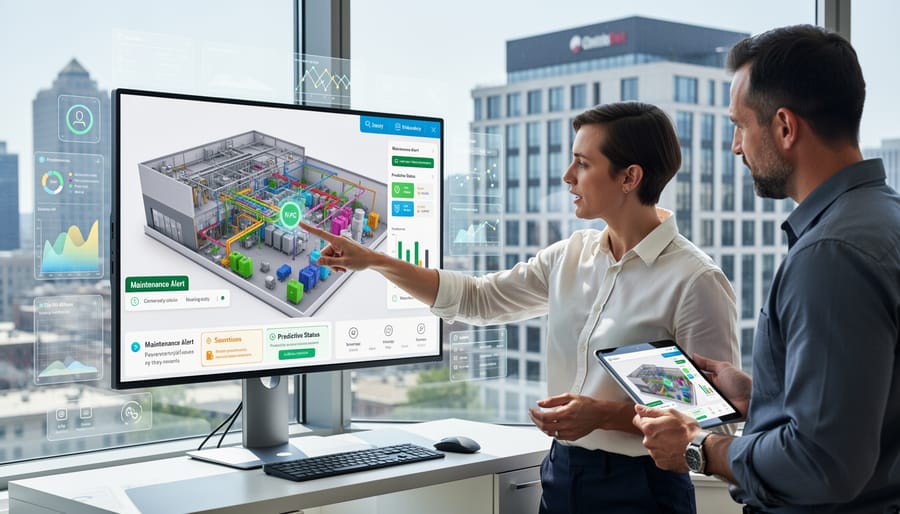
The transformative difference lies in continuous data integration. Digital twins connect to IoT sensors throughout a building, constantly feeding information about HVAC performance, energy consumption, occupancy patterns, water usage, and structural integrity into a centralized platform. This creates a dynamic model that reflects the actual condition and performance of your property at any given moment.
For portfolio optimization, this capability is game-changing. Rather than relying on periodic inspections or reactive maintenance, property managers can use predictive analytics to anticipate equipment failures before they occur, optimizing capital expenditure timing and avoiding costly emergency repairs. One commercial real estate firm reduced maintenance costs by 30 percent simply by shifting from scheduled to predictive maintenance using their digital twin platform.
From a venture capital perspective, this explains why investors are pouring hundreds of millions into digital twin technology. The recurring revenue potential is substantial—these aren’t one-time software purchases but ongoing subscriptions that deliver measurable ROI through reduced operating expenses, extended asset lifecycles, and improved tenant satisfaction. For property owners managing large portfolios, digital twins transform buildings from passive holdings into actively optimized investments.

Real-World Applications Driving Value
Proptech companies leveraging digital twin technology are delivering measurable returns across the real estate spectrum, which explains why venture capitalists are increasingly bullish on this sector. The practical applications translate directly into bottom-line improvements that property owners and managers can quantify.
In commercial real estate, predictive maintenance powered by digital twins is revolutionizing building operations. Companies like Willow and IWMS providers use sensor data integrated into virtual building models to predict equipment failures before they occur. One New York office tower reduced HVAC maintenance costs by 28% and extended equipment lifespan by identifying performance degradation patterns invisible to traditional monitoring systems. This isn’t just about avoiding repair bills—it’s about preventing costly tenant disruptions and preserving property values.
Energy optimization represents another compelling value proposition. Digital twins analyze real-time consumption data against building performance models to identify inefficiencies. A portfolio manager in Chicago implemented digital twin technology across 12 properties and achieved a 23% reduction in energy costs within the first year, directly improving net operating income and property valuations.
The residential sector benefits equally. Property management firms use digital twins to enhance tenant experiences through personalized climate control and predictive service scheduling. When residents report fewer maintenance issues and enjoy more responsive building management, retention rates climb—a critical metric given that tenant turnover typically costs one to three months’ rent.
Perhaps most intriguing for investors is the impact on property valuation accuracy. Digital twins provide granular performance data that traditional appraisal methods can’t capture. Lenders and insurers increasingly recognize that properties with comprehensive digital models carry lower risk profiles, potentially qualifying for better financing terms and reduced insurance premiums—a financial advantage that compounds over time.

Why Venture Capitalists Are Betting Big on PropTech Digital Twins
The Numbers Behind the Hype
The PropTech digital twin market isn’t just generating buzz—it’s attracting serious capital. Global investment in PropTech reached $32 billion in 2021, with digital twin technology capturing an increasingly substantial share. Market analysts project the real estate digital twin sector will grow at a compound annual growth rate of 38% through 2030, potentially reaching a $26 billion valuation.
Recent funding rounds tell a compelling story. Matterport, a leader in spatial data and digital twins, went public via SPAC in 2021 at a $2.9 billion valuation. Competitor Cupix raised $7 million in Series B funding, while AI-powered platform Archistar secured $11 million to expand its digital twin capabilities for real estate development. These figures demonstrate that venture capitalists see tangible returns in digitizing physical spaces.
Leading VC firms actively deploying capital in this space include Fifth Wall, the largest PropTech-focused venture fund with over $3 billion under management, alongside JLL Spark, Camber Creek, and MetaProp. These investors aren’t simply chasing technology trends—they’re betting on fundamental transformation in how properties are valued, managed, and insured.
For real estate professionals, this influx of capital signals maturation. When top-tier VCs commit billions, it validates digital twins as more than experimental tools. It suggests the technology will become infrastructure, similar to how smartphones transformed communication. The investment wave also means more accessible, refined solutions will emerge as competition intensifies and innovation accelerates.
What VCs Look for in Digital Twin Startups
When venture capitalists evaluate digital twin startups in proptech, they’re essentially asking: “Can this company scale rapidly and deliver measurable value to real estate stakeholders?” Understanding these criteria helps real estate professionals recognize which solutions have staying power and institutional backing.
Scalability sits at the top of every VC’s checklist. Investors want platforms that can expand from managing 100 properties to 100,000 without proportional cost increases. The best digital twin startups achieve this through cloud-based infrastructure and automated data processing that doesn’t require hiring armies of technicians for each new client.
Data integration capabilities separate promising ventures from also-rans. VCs look for startups that can seamlessly pull information from IoT sensors, building management systems, and property databases into a unified platform. The more data sources a digital twin can harmonize, the more comprehensive insights it delivers, making it indispensable to property managers and investors.
ROI metrics matter immensely because real estate operates on tight margins. Venture capitalists favor startups that demonstrate concrete financial benefits: reduced energy costs by 20-30%, decreased maintenance expenses through predictive analytics, or improved tenant retention rates. These aren’t just talking points; they’re the foundation of client acquisition strategies that convert skeptical property owners into paying customers.
Finally, competitive moats determine long-term viability. VCs invest in companies with proprietary algorithms, exclusive partnerships with major property management firms, or network effects where each additional user makes the platform more valuable. These barriers protect market share and justify premium valuations in what’s becoming an increasingly crowded space.
Leading PropTech Companies Pioneering Digital Twin Solutions
The digital twin revolution in real estate has attracted substantial venture capital investment, with several companies emerging as clear leaders in this transformative space. These PropTech pioneers are reshaping how properties are managed, marketed, and monetized through innovative virtual replication technologies.
Matterport stands as perhaps the most recognized name in digital twin solutions, having secured over $150 million in funding before going public via SPAC merger in 2021. The company’s differentiator lies in its comprehensive spatial data platform that creates detailed 3D digital twins of physical spaces. Originally focused on residential real estate, Matterport has expanded aggressively into commercial and industrial sectors, with major clients including WeWork and Airbnb. What makes Matterport investment-worthy is its first-mover advantage and extensive library of over 10 million digitized spaces, creating a powerful network effect that’s difficult for competitors to replicate.
Cupix has carved out a unique niche by targeting the construction and industrial sectors specifically. With backing from leading VC firms, Cupix offers 360-degree virtual tours combined with AI and PropTech analytics to track project progress and identify potential issues before they become costly problems. Their technology allows project managers to remotely inspect sites and collaborate with stakeholders, reducing travel costs and improving decision-making speed. For investors, Cupix represents a play on the massive construction industry’s digital transformation, where efficiency gains translate directly to bottom-line savings.
Giraffe360 has attracted significant European VC backing by addressing a critical pain point in residential real estate: the time and cost of property photography and documentation. Their automated camera system captures complete property data in minutes rather than hours, generating floor plans, virtual tours, and marketing materials simultaneously. This efficiency focus resonates strongly with real estate agents and property managers operating on thin margins, making Giraffe360’s subscription model highly scalable and predictable for investors.
VTS (View the Space), which has raised over $160 million in funding, focuses exclusively on commercial real estate leasing and asset management. Their digital twin platform integrates with property management systems to provide real-time visibility into space utilization, lease performance, and tenant engagement. The company’s value proposition centers on helping commercial landlords maximize revenue per square foot through data-driven insights, a particularly compelling pitch as hybrid work reshapes office space demand.
What unites these investment-worthy companies is their focus on solving specific, expensive problems in real estate: inefficient property documentation, poor space utilization, costly site inspections, and limited transparency in property conditions. Each has demonstrated clear ROI for customers, built defensible technology moats, and identified scalable market opportunities worth billions of dollars.
The Financial Impact: ROI and Cost Savings for Property Owners
Let’s talk numbers, because at the end of the day, property owners need to see a clear path to profitability before adopting any new technology. Digital twin platforms typically require an initial investment ranging from $50,000 to $500,000 depending on building size and complexity, but the financial returns can be substantial when you break down the cost savings across multiple categories.
Energy efficiency improvements alone often justify the investment. Property owners implementing digital twin technology report energy cost reductions of 15-30% within the first year. For a commercial building spending $200,000 annually on utilities, that translates to $30,000-$60,000 in immediate savings. The technology achieves this by continuously monitoring HVAC systems, lighting, and other energy-consuming equipment, making micro-adjustments that human facility managers simply cannot match in real-time.
Maintenance cost reduction represents another significant benefit. Predictive maintenance capabilities help property owners shift from reactive to proactive maintenance strategies, reducing unplanned downtime by up to 50% and extending equipment lifespan by 20-30%. Industry data suggests this can lower overall maintenance expenses by 25-40%, which for a mid-sized commercial property could mean $75,000-$150,000 in annual savings.
Occupancy rates see measurable improvements too. Buildings with digital twin integration report 10-15% higher tenant retention rates, primarily because predictive maintenance reduces service disruptions and creates more comfortable environments. For property owners, this means reduced vacancy periods and lower tenant turnover costs, which typically run 3-6 months of rent per unit.
Most compelling is the impact on asset valuations. Properties equipped with modern finance tools and digital twin technology command 5-10% premium valuations compared to comparable buildings without these features. This premium reflects both the operational efficiencies and the appeal to tech-forward tenants willing to pay higher rents.
The typical ROI timeline runs 18-36 months for most commercial properties, though high-energy buildings or those with aging infrastructure often see payback periods under 24 months. These timeframes make digital twin technology one of the more compelling capital investments in today’s competitive real estate market.
Insurance and Risk Management Benefits
Digital twins are fundamentally changing how insurance companies assess risk and calculate premiums for commercial and residential properties. By creating precise virtual replicas of physical buildings, these technologies provide insurers with unprecedented visibility into property conditions, maintenance histories, and potential vulnerabilities—transforming traditional actuarial models into dynamic, data-driven systems.
The insurance implications are substantial. Predictive risk modeling powered by digital twins allows carriers to identify potential issues before they become costly claims. Sensors embedded throughout a building continuously monitor everything from water pressure and HVAC performance to structural stress points. This real-time data feeds into algorithms that can predict equipment failures, detect moisture accumulation that might lead to mold, or identify fire hazards weeks or months before disaster strikes.
For property owners, this translates into tangible financial benefits. Buildings equipped with comprehensive digital twin systems are seeing premium reductions of 10 to 25 percent as insurers recognize the lower risk profile. Some forward-thinking carriers now offer incentive programs specifically for digital twin adoption, similar to how homeowners receive discounts for installing security systems or smart home devices.
Claims prevention represents another major advantage. When digital twins alert facility managers to a deteriorating roof membrane or a malfunctioning sprinkler system, repairs can happen proactively. This prevents the catastrophic losses that trigger major insurance claims—a win-win scenario where property owners avoid operational disruptions while insurers reduce payout exposure.
As venture capital continues flowing into proptech companies specializing in digital twin technology, expect the insurance industry to deepen its involvement. Major carriers are already partnering with digital twin providers, recognizing that this technology doesn’t just assess risk—it actively reduces it, creating a more sustainable insurance model for everyone involved.
What Real Estate Professionals Need to Know Now
As digital twins become increasingly prominent among real estate tech trends, professionals need a practical framework for evaluating and implementing these solutions. Here’s what you should know to stay ahead of the curve.
When evaluating digital twin vendors, start by asking pointed questions about data security and ownership. Who owns the data generated by the platform? How is sensitive building information protected? Given that digital twins aggregate vast amounts of operational and financial data, understanding privacy protocols is non-negotiable. Request case studies demonstrating ROI within your property type, whether commercial, residential, or mixed-use developments.
Integration capabilities should be at the top of your checklist. The best digital twin solutions don’t operate in isolation—they connect seamlessly with your existing property management software, building automation systems, and financial reporting tools. Ask vendors about API availability, data migration processes, and whether their platform supports industry-standard protocols like BACnet or MQTT. A solution that creates data silos will ultimately cost you more in lost efficiency.
Consider your team’s technical capabilities honestly. Some platforms require dedicated IT resources, while others offer intuitive interfaces designed for property managers without extensive technical backgrounds. Factor in training costs and the learning curve when calculating total cost of ownership.
From an investment perspective, look for solutions backed by venture capital firms with proven proptech track records. These companies typically have stronger financial backing to support ongoing development and customer service. However, don’t dismiss innovative startups—sometimes they offer more specialized solutions tailored to specific property challenges.
Start small with pilot programs before committing to building-wide implementations. Test digital twin technology on a single property or specific building system to measure actual energy savings, maintenance cost reductions, and operational improvements. This approach minimizes risk while providing concrete data to justify broader adoption and secure stakeholder buy-in for future investments.

The investment momentum behind PropTech digital twins shows no signs of slowing. With venture capital flowing steadily into companies developing these sophisticated platforms, we’re witnessing a fundamental shift in how real estate assets are managed, valued, and optimized. The technology has moved beyond proof-of-concept to deliver measurable returns through reduced operating costs, improved tenant experiences, and data-driven decision-making that directly impacts property valuations and insurance premiums.
Looking ahead to the next 3-5 years, expect digital twins to become standard infrastructure rather than competitive advantage. Integration with artificial intelligence will enable predictive maintenance that prevents costly failures before they occur, while real-time valuation models will transform how properties are bought, sold, and financed. Insurance carriers will increasingly require digital twin data for premium calculations, making adoption essential rather than optional.
For real estate professionals exploring this space, start by identifying pain points in your current asset management processes. Request demonstrations from established vendors, calculate potential ROI based on your portfolio size, and consider pilot programs on select properties. Investors should evaluate PropTech companies based on their integration capabilities, data security protocols, and proven client outcomes rather than flashy features alone. The digital transformation of real estate is here, and early adopters will capture significant competitive advantages.