
Create a three-bucket spreadsheet dividing your retirement portfolio into immediate cash needs (1-2 years), short-term reserves (3-7 years), and long-term growth assets (8+ years). This systematic approach transforms complex retirement planning into manageable columns, ensuring you never sell investments during market downturns while maintaining steady income flow. Label your first bucket “Cash Reserve” and fill it with highly liquid assets like money market funds and rental property income streams. Your second bucket, “Income Generator,” should house bonds, dividend stocks, and REITs that replenish bucket one annually. The third bucket contains growth-oriented investments including appreciation-focused real estate and equity funds that fuel your retirement over decades.
Configure automatic calculations showing withdrawal rates, rebalancing triggers, and depletion timelines for each bucket. Include rows tracking rental income separately, as property cash flow provides unique advantages in retirement bucket strategies—it’s predictable, inflation-adjusted, and often covers bucket one needs without touching principal. Add conditional formatting that flags when bucket one drops below 18 months of expenses, signaling time to transfer assets from bucket two.
This spreadsheet becomes your retirement command center, eliminating emotional decision-making during volatile markets. Real estate investors particularly benefit because rental properties naturally align with the bucket philosophy: reliable monthly income fills immediate needs while property appreciation builds long-term wealth. By implementing smart withdrawal strategies through a well-structured spreadsheet, you’ll maintain financial stability regardless of economic conditions while preserving your portfolio for 30-plus retirement years.
What Is a Retirement Bucket Strategy (And Why Real Estate Investors Need It)
The retirement bucket strategy is a time-tested approach to managing your nest egg by dividing your assets into three distinct “buckets” based on when you’ll need the money. Think of it like organizing your pantry: items you’ll use this week go in front, monthly staples sit in the middle, and long-term reserves stay in the back.
Here’s how it works in practice. Your first bucket holds 1-3 years of living expenses in cash or cash-equivalents like money market accounts and short-term bonds. This is your safety net, protecting you from having to sell investments during market downturns. Your second bucket covers years 4-10 with moderately conservative investments such as dividend-paying stocks, balanced funds, and potentially income-producing real estate investments. The third bucket contains your long-term growth assets for year 11 and beyond, including stocks, growth-oriented mutual funds, and appreciating properties.
For real estate investors, this strategy becomes particularly valuable because property investments don’t always align neatly with traditional portfolio thinking. You can’t sell half a rental property when you need cash next month. The bucket approach helps you balance the illiquidity of real estate holdings with the flexibility you need in retirement.
The core principle revolves around matching investment risk with time horizons. Money you need soon stays safe and accessible, while funds you won’t touch for decades can ride out market volatility and generate higher returns. This is especially crucial when your portfolio includes rental properties generating monthly income, REITs with quarterly distributions, and traditional retirement accounts with different tax treatments.
The beauty of this strategy for property investors is how rental income can systematically refill your short-term bucket, creating a predictable cash flow stream that complements your other retirement assets. Meanwhile, your long-term bucket can hold appreciating real estate that you won’t need to liquidate for years, allowing time to maximize value and minimize transaction costs.
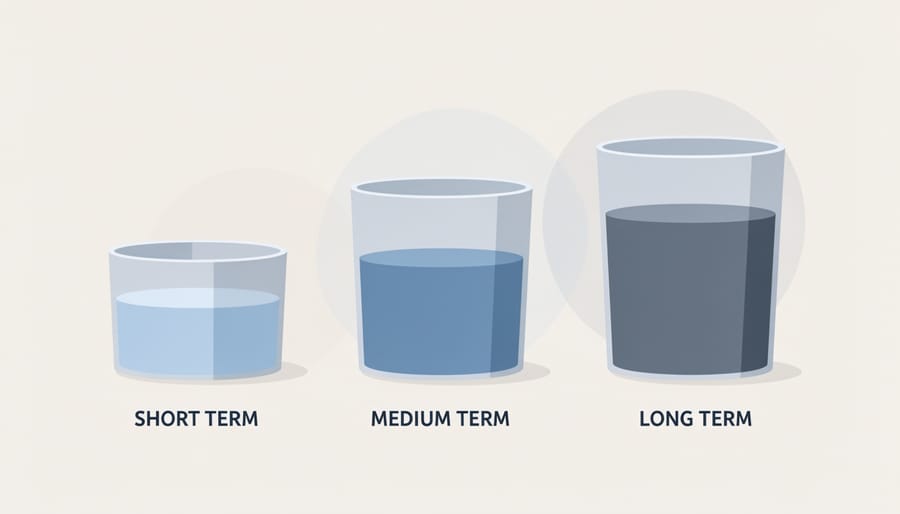
The Three Buckets That Keep Your Retirement Safe
Bucket 1: Your Cash Safety Net (0-2 Years)
Your first bucket serves as your financial cushion for immediate living expenses—typically covering the next one to two years of retirement needs. This is where you’ll hold the most liquid, stable assets: traditional savings accounts, money market accounts, and short-term certificates of deposit (CDs) with maturities under 12 months. Think of this bucket as your shock absorber against market volatility.
The beauty of maintaining this cash reserve is simple yet powerful: when the stock market takes a dive, you won’t be forced to sell your long-term investments at a loss just to pay bills. Instead, you’ll draw from this stable bucket while waiting for markets to recover. For real estate investors, this might also include a portion of rental income reserves or proceeds from a recently sold property that you’re keeping liquid.
Most financial advisors recommend allocating between 10-20% of your total retirement portfolio to this bucket, though the exact percentage depends on your monthly expenses and comfort level. If your monthly retirement expenses run $5,000, you’d want roughly $60,000 to $120,000 in this bucket. The trade-off? These safe assets earn minimal returns—often barely keeping pace with inflation—but that’s acceptable because safety and accessibility are the priorities here, not growth.
Bucket 2: Your Income Bridge (3-10 Years)
This middle bucket serves as your financial bridge, designed to refill Bucket 1 as you deplete those immediate reserves. Think of it as your stability layer—positioned to generate moderate growth while maintaining reasonable safety. Typically, this bucket contains a balanced mix of investments including intermediate-term bonds, dividend-paying stocks, real estate investment trusts (REITs), and conservative real estate holdings.
For property-focused retirees, this bucket presents an excellent opportunity to leverage real estate assets. A well-maintained rental property can provide consistent rental income streams that flow directly into Bucket 1, reducing the need to liquidate other investments. Consider including paid-off rental properties or REITs that distribute regular dividends, creating predictable cash flow.
Your spreadsheet should track each investment category within this bucket, monitoring performance and dividend yields quarterly. Set automatic transfers or scheduled reviews to move gains into Bucket 1 annually, ensuring your cash reserves stay replenished. The goal is maintaining 5-7 years of income needs here, allowing enough time for investments to recover from market downturns while keeping volatility lower than pure equity positions. This strategic positioning protects you from selling assets during market dips while your longer-term investments continue growing.
Bucket 3: Your Growth Engine (10+ Years)
Your growth bucket is the powerhouse that keeps your retirement strategy sustainable for decades. With a 10+ year time horizon, this bucket focuses exclusively on growth-oriented investments that can weather market volatility while building wealth over time.
This bucket typically includes 60-70% stocks or equity index funds, providing exposure to market growth potential. For real estate professionals and property investors, equity real estate investments belong here too—think REITs (Real Estate Investment Trusts), real estate syndications, or equity positions in rental properties. These investments have historically outpaced inflation and generated substantial long-term returns, though they experience short-term fluctuations.
The beauty of Bucket 3 lies in its time advantage. Since you won’t need these funds for at least a decade, temporary market downturns become irrelevant. A 30% market drop in year one doesn’t affect your retirement income because you’re drawing from Buckets 1 and 2 instead. This insulation allows your growth investments to recover and compound without forcing you to sell at a loss.
For property-focused portfolios, consider growth-oriented real estate investments like development projects or properties in emerging markets. These carry higher risk but offer substantial appreciation potential over extended periods.
This bucket ensures your retirement funds don’t just sustain you—they potentially grow throughout retirement, protecting against inflation and funding later years when healthcare costs typically increase. Regular rebalancing moves gains from Bucket 3 into Buckets 1 and 2, creating a self-replenishing system.
Building Your Bucket Strategy Spreadsheet: Step-by-Step
Essential Spreadsheet Components You Need
Building an effective retirement bucket strategy spreadsheet requires several foundational components that work together to give you complete visibility into your financial picture. At the core, you’ll need a current asset inventory section that catalogs everything you own—bank accounts, investment portfolios, retirement accounts, and importantly, real estate holdings including rental properties. This comprehensive snapshot forms the baseline for your entire strategy.
Next, establish bucket allocation targets that clearly define how much money belongs in each bucket based on your time horizon. Your short-term bucket (years 1-3) might hold cash and money markets, your mid-term bucket (years 4-10) could contain bonds and dividend stocks, while your long-term bucket (years 11+) houses growth investments and potentially rental property equity.
Withdrawal tracking is essential for monitoring how much you’re drawing from each bucket and ensuring you’re not depleting resources too quickly. This section should record every distribution with dates and amounts, helping you spot patterns and adjust as needed.
Include rebalancing triggers that alert you when it’s time to refill your short-term bucket from mid-term assets or when market conditions warrant portfolio adjustments. Simple percentage-based thresholds work well here.
Finally, document all income sources separately—Social Security, pensions, annuities, and crucially for property investors, rental income. Rental revenue can reduce withdrawal pressure on your buckets, extending your portfolio’s longevity while providing inflation-adjusted income streams that complement your overall retirement strategy.
Setting Up Your Asset Inventory
Before you can allocate your assets into buckets, you need a complete picture of what you’re working with. Start by creating a comprehensive inventory in your spreadsheet that captures every retirement asset you own.
Begin with column headers: Asset Type, Description, Current Value, Liquidity Rating, and Bucket Assignment. Under Asset Type, categorize everything you have. This includes obvious items like 401(k)s, IRAs, and brokerage accounts, but don’t overlook real estate holdings. If you own rental properties, list each one separately with its estimated market value. Investment real estate can play a strategic role in your bucket strategy, particularly for income generation.
Next, document income sources that aren’t traditional assets. Social Security deserves its own row with the estimated monthly benefit. If you have a pension, record both the monthly payout and any lump-sum option value. Rental income from properties should also be listed, as this ongoing cash flow can potentially fund your short-term bucket without touching principal.
The Liquidity Rating column is crucial. Rate each asset on a simple scale: High (cash, money market accounts), Medium (stocks, bonds that can sell within days), or Low (real estate, which may take months to convert to cash). This rating will guide your bucket assignments. Real estate typically falls into the low-liquidity category, making it better suited for your long-term bucket or as an income-producing asset rather than something you’d tap for immediate needs.
Creating Automatic Rebalancing Alerts
One of the most powerful features you can build into your retirement bucket spreadsheet is an automatic alert system that tells you exactly when it’s time to rebalance. Think of these alerts as your financial smoke detectors—they’ll warn you before small issues become big problems.
Start by setting up percentage thresholds for each bucket. For Bucket 1 (your immediate cash needs), you’ll want to create a formula that monitors when your balance drops below a certain safety level. A good rule of thumb is to trigger an alert when Bucket 1 falls to 50% of its target amount. In a spreadsheet cell, use a simple IF formula: =IF(B2<(Target_Amount*0.5),"REFILL BUCKET 1 NOW","OK"). Replace B2 with your actual Bucket 1 balance cell reference. For Bucket 2, your intermediate holdings, set up an alert when it reaches 80% or more of its target value. This signals it's time to consider transferring gains to Bucket 1. The formula would look like: =IF(C2>(Target_Amount*0.8),”Consider Transfer to Bucket 1″,”OK”).
Bucket 3 requires a growth threshold alert. When your long-term investments exceed their target by 15-20%, it’s time to harvest some gains and replenish Bucket 2. Use: =IF(D2>(Target_Amount*1.15),”Transfer Excess to Bucket 2″,”OK”).
To make these alerts visually impossible to miss, apply conditional formatting. Highlight cells in red when they display warning messages and green when everything’s on track. You can also add a master dashboard cell that consolidates all alerts, giving you a single place to check your rebalancing status at a glance. This way, whether you’re managing rental property income or traditional investment accounts, you’ll always know when action is needed.

Integrating Real Estate Assets Into Your Buckets
Real estate presents unique challenges and opportunities when building your retirement bucket strategy. Unlike stocks or bonds that you can sell with a few clicks, property investments require special consideration due to their illiquid nature and income-generating potential.
Start by determining where your real estate fits within the three-bucket framework. Rental properties generating consistent monthly income naturally align with your short-term bucket, as this cash flow can cover immediate living expenses. In your spreadsheet, create a dedicated row for rental income under your short-term bucket sources. Be conservative here—factor in vacancy rates, maintenance costs, and property management fees. If your rental generates $2,000 monthly but averages $300 in expenses, only count $1,700 as reliable income.
REITs (Real Estate Investment Trusts) offer more flexibility than physical properties and can span multiple buckets based on their type. High-dividend REITs producing steady income work well in your short-term bucket, while growth-oriented REITs belong in your long-term bucket. The key advantage? REITs trade like stocks, providing the liquidity that physical properties lack. Track these separately in your spreadsheet to monitor your overall real estate exposure.
Home equity represents a more complex decision. Your primary residence doesn’t generate income, but it holds substantial value that can serve as a financial safety net. Consider positioning home equity as a bridge between your medium and long-term buckets. You might tap this through a reverse mortgage (for homeowners 62 and older), a home equity line of credit, or eventual downsizing. Document these potential sources in a separate “backup strategies” section of your spreadsheet, noting when and how you might access them.
The liquidity challenge is real estate’s biggest hurdle in bucket planning. Selling a property typically takes 30-90 days minimum, making it unsuitable for emergency funding. That’s why maintaining adequate liquid assets in your short-term bucket becomes even more critical for real estate-heavy portfolios. Plan for at least 12-18 months of expenses in accessible cash and equivalents if rental properties or illiquid real estate comprise more than 40 percent of your retirement portfolio. This buffer protects you from forced property sales during market downturns.
Update your spreadsheet quarterly to reflect current property values, rental income changes, and market conditions affecting your real estate holdings. This disciplined approach ensures your retirement strategy remains balanced and responsive to the unique characteristics of property investments.
Common Bucket Strategy Mistakes (And How Your Spreadsheet Prevents Them)
Even experienced retirement planners stumble into common bucket strategy pitfalls that can derail their financial security. The beauty of a well-constructed spreadsheet is that it acts as your financial watchdog, alerting you to problems before they become costly mistakes.
One of the most frequent errors is over-concentration in a single bucket. Many retirees, particularly those with substantial real estate holdings, pile too much wealth into property investments without maintaining adequate liquid reserves. Your spreadsheet should track allocation percentages across all three buckets. Set conditional formatting to highlight warnings when your cash bucket dips below 18 months of expenses or when your growth bucket exceeds 60% of total assets. This visual alert system prevents the dangerous scenario where you’re forced to sell rental properties during a market downturn just to cover living expenses.
Failing to rebalance regularly ranks as another critical mistake. Without systematic tracking, your carefully planned 30/40/30 allocation can drift to 15/35/50 within a few years due to market movements. Build annual rebalance reminders into your spreadsheet with formulas that calculate how much needs shifting between buckets to restore your target allocation.
Inflation represents a silent wealth destroyer that many spreadsheets ignore completely. Incorporate an inflation adjustment column that increases your annual withdrawal needs by 3% each year. This simple addition reveals whether your strategy remains sustainable over 30-year retirement horizons.
Healthcare costs deserve special attention, especially as you age. Many retirees underestimate these expenses by 40% or more. Create a dedicated healthcare line item that escalates faster than general inflation, typically 5-6% annually, and consider maintaining a separate healthcare reserve within your cash bucket.
For property owners, neglecting maintenance and insurance reserves creates devastating cash flow gaps. Your spreadsheet should include property-specific tracking with separate columns for insurance premiums, property taxes, and a maintenance reserve fund calculated at 1-2% of property value annually. These formulas ensure your rental income projections remain realistic rather than optimistically inflated, preventing the shock of major repair expenses that drain your other buckets unexpectedly.

When to Adjust Your Buckets: Market Crashes, Windfalls, and Life Changes
Your retirement bucket strategy isn’t a set-it-and-forget-it system. Life throws curveballs, and your spreadsheet should help you navigate them with confidence rather than panic.
During market crashes, your first instinct might be to protect what’s left by selling investments from Bucket 3. Resist this urge. This is precisely why you built the bucket system in the first place. Your Bucket 1 cash reserves give you the breathing room to wait out downturns without locking in losses. In your spreadsheet, add a “Market Downturn Protocol” tab that calculates how long your combined Bucket 1 and Bucket 2 holdings can sustain you without touching growth investments. For most retirees, having five to seven years of expenses covered means you can comfortably ignore market turbulence.
Windfalls like property sales or inheritances require a different approach. When you sell that rental property you’ve held for decades or receive an unexpected inheritance, your spreadsheet should guide strategic allocation. Create a “Windfall Calculator” section that automatically suggests distribution percentages based on your current bucket balances. Generally, replenishing depleted Bucket 1 reserves comes first, then topping up Bucket 2, with remaining funds flowing to Bucket 3 for continued growth. If all buckets are healthy, consider whether upcoming major expenses or healthcare needs warrant holding extra cash.
Healthcare emergencies represent the wildcard scenario. Your spreadsheet should include a “Healthcare Reserve” line item, essentially a sub-bucket within Bucket 1 specifically for medical contingencies. This prevents you from raiding growth investments during health crises.
Build scenario modeling directly into your spreadsheet using simple data tables. Create tabs for “Best Case,” “Moderate,” and “Worst Case” scenarios, adjusting variables like market returns, inflation rates, and unexpected expenses. This stress-testing reveals whether your strategy has enough flexibility to weather multiple challenges simultaneously, giving you the confidence to stick with your plan when uncertainty strikes.
Tax-Efficient Withdrawal Sequencing for Your Buckets
Understanding which bucket to tap first can significantly impact your retirement tax liability and portfolio longevity. The general principle is to optimize withdrawals by considering your current tax bracket and future obligations.
For most retirees, the conventional wisdom suggests drawing from taxable accounts first (Bucket 1), then tax-deferred accounts like traditional IRAs and 401(k)s (typically Bucket 2), and finally Roth accounts (often Bucket 3). This approach allows tax-advantaged accounts to continue growing while minimizing current tax exposure. However, real estate investors often face more complex scenarios.
If you have rental properties generating income, you’re already receiving taxable cash flow. This may shift your optimal withdrawal sequence. Consider filling lower tax brackets with strategic Roth conversions during early retirement years before required minimum distributions kick in at age 73. When planning property sales, coordinate the timing with your withdrawal strategy to avoid pushing yourself into higher brackets.
Your spreadsheet should include a simple tax projection calculator that estimates your annual taxable income from all sources: withdrawals, rental income, Social Security, and capital gains. This visibility helps you make informed decisions about which account to tap.
Important caveat: tax-efficient withdrawal strategies grow increasingly complex when real estate holdings are involved. Depreciation recapture, passive activity loss rules, and net investment income tax all factor into optimization. Consider consulting a tax professional or CPA specializing in real estate when your situation involves multiple properties or substantial capital gains events.
A retirement bucket strategy spreadsheet isn’t just another financial document—it’s your roadmap to financial peace of mind. By organizing your assets into clear buckets with designated withdrawal timelines, you create a systematic approach to retirement withdrawals that reduces anxiety and brings much-needed clarity to your golden years.
This strategy works particularly well if you hold diverse assets, including real estate properties and rental income streams. The visual nature of a spreadsheet helps you see exactly how your investment properties, REITs, and traditional portfolios work together to fund your retirement in phases. You’ll know precisely when to tap each resource, minimizing market timing risks while maximizing your portfolio’s longevity.
The best part? You can start building your personalized bucket strategy spreadsheet today using the steps outlined above. Remember to review and adjust your allocations quarterly or annually as your circumstances change, property values fluctuate, and markets evolve. This living document adapts with you, ensuring your retirement strategy remains aligned with your goals and financial reality throughout your retirement journey.