
Imagine walking through a property halfway across the world without leaving your office, analyzing its energy consumption patterns in real-time, or predicting when a critical building system will fail—weeks before it happens. This isn’t science fiction. Digital twin technology is transforming how real estate professionals manage assets, mitigate risks, and maximize returns on their property investments.
A digital twin creates a virtual replica of a physical building, synchronized with real-time data from IoT sensors, building management systems, and external sources. Think of it as a living, breathing digital copy that mirrors everything happening in your actual property—from HVAC performance and occupancy patterns to structural integrity and energy usage. For property managers overseeing portfolios worth millions, this technology delivers something invaluable: predictive intelligence that turns reactive maintenance into proactive strategy.
The business case is compelling. Property owners using digital twins report 35% reductions in maintenance costs, 20% improvements in energy efficiency, and significant decreases in insurance premiums due to enhanced risk management capabilities. These aren’t marginal gains—they directly impact your bottom line and make properties more attractive to lenders evaluating financing applications.
Yet despite these advantages, many real estate professionals remain uncertain about implementation costs, integration complexity, and actual ROI timelines. Understanding how digital twins work specifically within real estate contexts, what financial commitments they require, and which applications deliver the fastest returns becomes essential for making informed technology investments. This comprehensive guide cuts through the complexity to show you exactly how digital twin technology can revolutionize your property management approach while protecting and enhancing your asset values.
What Exactly Is a Digital Twin in Real Estate?
The Technology Behind Real Estate Digital Twins
At their core, digital twins rely on three key technological components working together seamlessly. The foundation starts with IoT sensors and integration throughout a building—think of these as the property’s nervous system. Temperature sensors, occupancy detectors, energy meters, and water flow monitors continuously collect data about how the building operates in real-time.
This raw data then feeds into sophisticated integration platforms that process and organize information from multiple sources. For example, a commercial office building might combine HVAC system data with badge entry records and elevator usage patterns to create a complete picture of building performance and occupancy trends.
The third component is real-time monitoring and visualization software that transforms this data into actionable insights. Property managers can access dashboards showing live energy consumption, identify maintenance issues before they become costly problems, and even predict when equipment might fail based on performance patterns.
Consider a practical example: if water pressure sensors detect an unusual spike in a specific zone, the system immediately alerts facility managers, potentially catching a pipe leak before it causes extensive damage. This same technology helps insurance providers assess risk more accurately and can lead to reduced premiums for properties with comprehensive monitoring systems. The beauty of this technology lies in its ability to prevent problems rather than simply react to them, ultimately protecting your investment and improving operational efficiency.

Digital Twins vs. Traditional Property Management Systems
Traditional property management systems rely on static spreadsheets and databases that capture snapshots in time—think of them as digital filing cabinets. You might track maintenance schedules in one spreadsheet, energy costs in another, and tenant information in yet another system. When something changes, you manually update these disconnected sources, often working with outdated information.
Digital twins flip this approach entirely. They create a living, breathing virtual replica of your property that updates in real-time through connected sensors and IoT devices. While your traditional system might tell you that HVAC maintenance is due next month, a digital twin monitors actual equipment performance continuously, predicting failures before they happen and optimizing maintenance schedules based on usage patterns rather than arbitrary timelines.
Here’s a practical example: when a tenant reports a leak using conventional software, you log a ticket and dispatch maintenance. With a digital twin, moisture sensors detect the issue automatically, the system identifies the exact pipe location within your building’s 3D model, calculates potential damage spread, and alerts your maintenance team with precise repair instructions—often before visible damage occurs. This proactive approach significantly reduces insurance claims and associated premium increases.
The financial implications are substantial. Digital twins analyze energy consumption patterns across your entire portfolio, identifying inefficiencies that spreadsheets simply cannot detect. One commercial property owner reduced energy costs by 23% within six months by implementing automated adjustments based on occupancy data and weather predictions—optimizations impossible with traditional systems that lack predictive capabilities and real-time responsiveness.
How Digital Twins Revolutionize Asset Management
Predictive Maintenance That Actually Saves Money
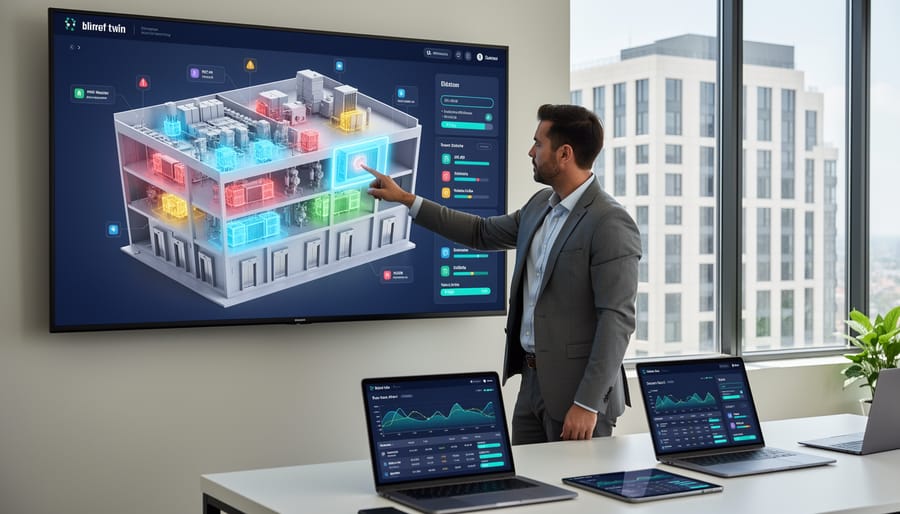
Imagine knowing your HVAC system will fail three weeks before it actually does. That’s the power of predictive maintenance through digital twins, and it’s transforming how property managers handle operational budgets.
Digital twins continuously monitor equipment performance by collecting real-time data from sensors embedded in building systems. This technology analyzes patterns that humans might miss—subtle temperature fluctuations in a cooling tower, minor vibrations in elevator motors, or gradual pressure drops in plumbing systems. When the digital model detects anomalies that signal impending failure, it alerts facility teams before costly breakdowns occur.
The financial impact is substantial. Traditional reactive maintenance costs property owners an average of $250 per repair call, plus the expense of emergency service rates and tenant disruption. Emergency HVAC repairs can run $5,000 to $15,000, while a planned replacement of the same component might cost half that amount. One commercial property management firm in Chicago reported saving $180,000 annually across their portfolio by catching equipment issues before failures occurred.
Beyond direct repair savings, predictive maintenance reduces insurance premiums. Buildings with documented proactive maintenance programs often qualify for lower property insurance rates since they demonstrate reduced risk of major system failures and resulting damage claims. Some insurers offer discounts of 5-15% for properties utilizing digital twin technology.
The operational budget benefits extend to tenant retention too. Preventing unexpected outages means fewer disruptions, happier tenants, and reduced vacancy rates. When your digital twin flags a potential boiler issue in October rather than discovering it during January’s coldest week, you’ve not only saved on emergency repair costs—you’ve protected your property’s reputation and revenue stream.
Energy Management and Sustainability Tracking
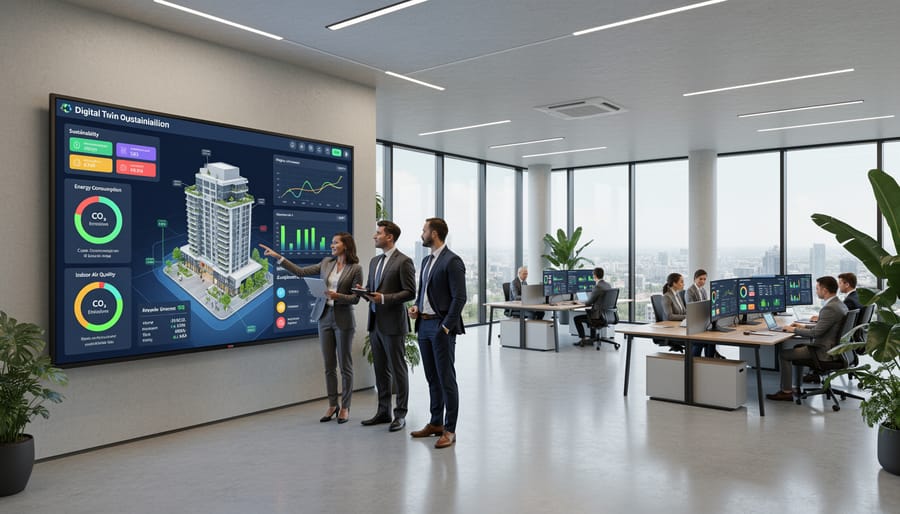
Digital twins are transforming how buildings consume energy, offering real-time monitoring capabilities that traditional management systems simply can’t match. By creating a virtual replica of your property, these systems continuously analyze energy usage patterns, HVAC performance, lighting efficiency, and equipment operation to identify optimization opportunities you might otherwise miss.
Think of it as having a 24/7 energy auditor who never sleeps. The digital twin collects data from IoT sensors throughout the building, tracking everything from occupancy patterns to temperature fluctuations. This granular visibility allows property managers to make data-driven adjustments that can reduce energy consumption by 20-30% on average, translating directly to lower operating costs and improved net operating income.
The sustainability benefits extend beyond cost savings. Digital twins help property owners demonstrate measurable progress toward Environmental, Social, and Governance (ESG) commitments, which increasingly influence investment decisions and tenant preferences. Buildings with verified energy efficiency metrics often command premium rents and higher valuations, as institutional investors prioritize assets aligned with carbon reduction goals.
Here’s where the financial incentives really add up: insurers are beginning to recognize that energy-efficient buildings with advanced monitoring systems present lower risks. Better climate control reduces moisture-related damage risks, while predictive maintenance prevents equipment failures that could trigger claims. Some property insurers now offer reduced premiums for buildings equipped with comprehensive digital twin systems that demonstrate proactive risk management.
Additionally, properties with documented sustainability credentials may qualify for green financing options featuring favorable terms, creating multiple financial advantages that compound over the asset’s lifecycle.
Space Optimization and Tenant Experience
Digital twins transform how property managers understand and optimize their spaces by creating real-time virtual replicas that track occupancy patterns, environmental conditions, and tenant behavior. This technology goes beyond simple floor plans, offering dynamic insights that directly impact your bottom line through improved space utilization and tenant retention.
By analyzing movement patterns and workspace usage, digital twins help identify underutilized areas and overcrowded zones. Property managers can make data-driven decisions about reconfiguring layouts, adjusting lease pricing based on actual demand, or converting unused square footage into revenue-generating amenities. For example, if your digital twin reveals that conference rooms sit empty 60% of the time, you might redesign that space into co-working areas that tenants actually need.
The tenant experience benefits are equally compelling. Digital twins integrate with building systems to monitor air quality, temperature, lighting, and noise levels in real time. When sensors detect suboptimal conditions, facility teams receive instant alerts, often resolving issues before tenants even notice. This proactive approach, powered by PropTech analytics, significantly boosts tenant satisfaction scores and renewal rates.
From a financial perspective, properties leveraging digital twins for space optimization typically see 15-30% improvements in space efficiency, translating to higher occupancy rates and premium lease values. Insurance carriers are also beginning to recognize well-monitored buildings as lower-risk assets, potentially reducing property insurance premiums. When tenants feel heard and their environments consistently meet expectations, they stay longer, reducing costly turnover and vacancy periods that drain property value.
Risk Management and Insurance Implications
Digital twins are revolutionizing how property owners and insurers approach risk management. By creating a continuously updated virtual replica of your building, this technology provides real-time monitoring of structural conditions, environmental factors, and potential hazards that traditional inspections might miss. Think of it as having a 24/7 health monitor for your property that can detect issues like water damage, electrical anomalies, or HVAC inefficiencies before they escalate into costly claims.
Insurance companies are taking notice. Properties equipped with digital twin technology may qualify for reduced premiums because they demonstrate proactive risk mitigation. The detailed data these systems generate—encompassing everything from maintenance records to incident timestamps—creates an irrefutable documentation trail that streamlines the claims process. If disaster strikes, you’ll have comprehensive before-and-after comparisons showing exactly what was affected and its pre-loss condition.
For property managers overseeing multiple buildings, digital twins offer centralized risk dashboards that prioritize interventions based on actual data rather than guesswork. This predictive capability doesn’t just potentially lower insurance costs; it helps you avoid claims altogether by addressing vulnerabilities early. As insurers increasingly embrace technology-driven underwriting, digital twin adoption may soon become a competitive advantage in securing favorable coverage terms.
The Financial Case for Digital Twins
Implementation Costs and Financing Options
Understanding the financial commitment behind digital twin technology helps property professionals make informed investment decisions. Initial setup costs typically range from $10,000 to $100,000 depending on property size and complexity. A small commercial building might start around $15,000, while large mixed-use developments can exceed $250,000 for comprehensive implementations.
The cost breakdown includes hardware sensors and IoT devices (30-40% of initial investment), software platforms and integration (40-50%), and professional installation services (10-20%). Ongoing expenses average $2,000 to $10,000 annually for software subscriptions, data storage, sensor maintenance, and system updates.
Many property owners find these numbers daunting, but specialized financing solutions have emerged alongside PropTech adoption. Several lenders now offer PropTech-specific loans with terms ranging from 3 to 7 years, recognizing digital twins as property improvements that enhance asset value. Some commercial real estate lenders bundle digital twin implementations into refinancing packages, allowing owners to fold costs into existing mortgages at favorable rates.
Alternative financing options include equipment leasing arrangements, where sensor hardware is leased rather than purchased outright, reducing upfront capital requirements by 40-60%. Progressive insurance carriers also offer premium discounts of 5-15% for properties with digital twin monitoring systems, as the technology demonstrably reduces claims through early risk detection. When calculating total cost of ownership, factor in energy savings (typically 15-30% reduction), reduced maintenance emergencies, and improved tenant retention, which often produce ROI within 18-36 months.
ROI Calculations and Break-Even Timeline
Understanding the financial impact of digital twin technology is crucial for making informed investment decisions. The numbers tell a compelling story for property managers and investors willing to embrace this innovation.
For commercial properties, the typical break-even period ranges from 18 to 36 months, depending on building size and complexity. A mid-sized office building investing $75,000 in digital twin implementation can expect annual operational savings of $30,000 to $45,000 through reduced energy consumption, optimized maintenance scheduling, and decreased equipment downtime. This translates to break-even in roughly 20-24 months, with ongoing returns year after year.
Energy efficiency alone drives substantial ROI. Properties using digital twins for HVAC optimization typically see 15-25% reductions in utility costs. For a 100,000-square-foot commercial building spending $200,000 annually on energy, that’s $30,000 to $50,000 in annual savings. Predictive maintenance capabilities prevent costly emergency repairs—one prevented HVAC failure can save $15,000 to $40,000 in replacement costs and business disruption.
Property value appreciation represents another significant benefit. Buildings equipped with digital twin technology command premium valuations, with studies showing 3-5% higher market values compared to comparable properties. Institutional investors increasingly favor tech-enabled properties, recognizing their competitive advantages in tenant retention and operational efficiency.
For residential developers, digital twins facilitate faster sales cycles and justify premium pricing. Projects showcasing virtual twins experience 20-30% shorter time-to-market, reducing carrying costs substantially. When financing costs run $50,000 monthly, shaving three months off your timeline saves $150,000 immediately.
Insurance benefits sweeten the equation further. Properties with comprehensive digital monitoring systems often qualify for 10-15% premium reductions, adding thousands in annual savings while providing superior risk management capabilities that protect your investment long-term.
Who’s Already Using Digital Twins (And What They’re Learning)
Digital twins aren’t just theoretical concepts discussed in industry conferences anymore. Forward-thinking real estate companies are already putting this technology to work and seeing measurable results.
Take The Edge Olympic in Amsterdam, for example. This 40,000-square-meter office building uses a comprehensive digital twin that monitors everything from energy consumption to air quality in real time. The building’s operators can predict maintenance issues before they become costly problems, reducing downtime by approximately 40 percent. Perhaps more importantly, they’ve cut energy costs by 70 percent compared to similar buildings, a saving that translates directly to improved net operating income.
On the residential side, property management companies are discovering digital twins can transform how they maintain apartment complexes. One mid-sized property management firm in California implemented digital twin technology across a portfolio of 2,000 units. By tracking HVAC performance, water systems, and electrical infrastructure digitally, they identified patterns showing which units would likely need repairs within the next 90 days. This predictive capability allowed them to schedule maintenance proactively, reducing emergency service calls by 35 percent and improving tenant satisfaction scores significantly.
Mixed-use developments present particularly compelling use cases. Hudson Yards in New York City employs digital twin technology to manage the complex interplay between retail spaces, offices, and residential towers. The system optimizes everything from elevator traffic patterns during peak hours to coordinating deliveries across different property types. Facility managers report being able to respond to issues 60 percent faster than they could with traditional building management systems.
What are these early adopters learning? First, the technology requires upfront investment in sensors and integration, but the return on investment typically materializes within 18 to 24 months through reduced operating costs. Second, insurance carriers are taking notice. Properties with robust digital twin systems are beginning to qualify for premium discounts of 5 to 15 percent, as insurers recognize the reduced risk profile that comes with predictive maintenance and early problem detection.
The most successful implementations share a common thread: they started small with one building or specific systems before scaling up. This measured approach allowed teams to learn the technology and demonstrate value before making larger capital commitments.
Getting Started: What Property Managers Need to Know
Assessing If Your Portfolio Is Ready
Not every property portfolio will benefit equally from digital twin technology. Before committing to this investment, evaluate three key factors: property complexity, asset value, and management scope.
Start with property complexity. Digital twins deliver the most value for buildings with intricate systems—think commercial towers with advanced HVAC, multi-tenant office buildings, or mixed-use developments. A single-family rental might not justify the cost, while a 50-unit apartment complex with shared utilities could see substantial returns through predictive maintenance and energy optimization.
Next, consider asset value. Properties worth several million dollars or more typically make better candidates, as the technology costs become proportionally smaller relative to potential savings. The investment threshold has dropped significantly, but you’ll want projected annual savings to exceed 20-30% of implementation costs to achieve reasonable payback periods.
Finally, assess your management structure. If you’re managing multiple properties or planning long-term holds, digital twins can streamline operations across your portfolio. They’re particularly valuable when you’re seeking financing for renovations or acquisitions, as lenders increasingly favor tech-enabled properties with documented performance data. Similarly, insurance providers may offer premium reductions for buildings with continuous monitoring systems that reduce risk exposure.
Choosing the Right Digital Twin Platform
Selecting the right digital twin platform requires careful evaluation of both technical capabilities and business alignment. Start by asking vendors about integration capabilities—the platform should connect seamlessly with your existing property management software, building automation systems, and financial tools. Look for platforms offering real-time data processing, scalable cloud infrastructure, and intuitive dashboards that don’t require a computer science degree to navigate.
Key questions to ask include: What’s the total cost of ownership beyond initial setup? How long until we see measurable ROI? What training and support do you provide? Can the platform handle our portfolio size and planned growth? Request case studies from similar real estate organizations and insist on a trial period or demo using your actual property data.
Watch for red flags like vendors who overpromise instant results, lack transparent pricing models, or can’t explain their data security protocols. Platforms requiring excessive customization or lacking API documentation often signal future headaches. Be wary of solutions that lock you into proprietary hardware or long-term contracts without clear exit strategies. The right partner should understand real estate operations, not just push technology for its own sake.

Implementation Roadmap and Common Pitfalls
Rolling out digital twin technology requires strategic planning and realistic timelines. Start with a pilot project on a single property or building, typically taking 3-6 months from initial data collection to operational deployment. This proof-of-concept phase helps you understand integration challenges with existing property management systems before scaling to your entire portfolio.
The biggest pitfall early adopters face is underestimating data preparation time. Poor quality or incomplete building information wastes resources and delays ROI. Begin by auditing your current documentation, IoT sensor coverage, and BIM files before engaging vendors. Another common mistake is selecting technology partners without verifying their real estate expertise—general industrial digital twin platforms often lack property-specific features like tenant experience modules or lease lifecycle integration.
Budget conservatively for the first year. While sensor installation and software licensing are upfront costs, ongoing expenses for data storage, platform maintenance, and staff training frequently catch organizations off guard. These operational costs typically run 20-30% of initial implementation expenses annually.
Avoid rushing implementation without stakeholder buy-in. Successful deployments involve property managers, maintenance teams, and even tenants early in the process. Their input ensures the digital twin addresses real operational pain points rather than becoming an underutilized novelty. Plan for a 12-18 month journey from pilot to full deployment, with measurable milestones quarterly to maintain momentum and justify continued investment to leadership.
The Future of PropTech and Digital Twin Integration
The digital twin revolution in real estate is just beginning, and the next 3-5 years promise transformative changes that will fundamentally reshape how we manage, value, and interact with properties.
Artificial intelligence integration stands at the forefront of this evolution. Soon, AI-powered digital twins won’t just mirror buildings—they’ll predict maintenance needs before failures occur, optimize energy consumption in real-time, and even suggest renovation strategies that maximize property value. Machine learning algorithms will analyze years of building data to identify patterns invisible to human observers, potentially saving property managers thousands in preventative maintenance costs.
The marriage of blockchain for asset tracking with digital twins represents another game-changing development. Imagine every component of a building—from HVAC systems to elevators—having an immutable digital record of maintenance, warranties, and performance history stored on blockchain. This transparency will streamline property transactions, reduce insurance premiums through verified building histories, and create new financing opportunities as lenders gain unprecedented insight into asset conditions.
We’re also witnessing the convergence of digital twins with augmented reality, allowing property managers to visualize hidden infrastructure simply by pointing their smartphones at walls. This capability will revolutionize everything from inspections to tenant communications.
For insurance providers, these advancements mean more accurate risk assessments and potentially lower premiums for properties with comprehensive digital twin monitoring. Lenders will similarly benefit from enhanced due diligence capabilities, making property-backed loans less risky.
Industry experts predict that within five years, digital twins will become standard rather than exceptional for commercial properties over 50,000 square feet. These PropTech innovations will democratize access to sophisticated building intelligence, making enterprise-level insights available to smaller property owners through cloud-based platforms. The question isn’t whether to adopt digital twin technology—it’s how quickly you can position yourself to leverage these emerging capabilities.
Digital twin technology represents more than just another PropTech trend—it’s rapidly becoming a competitive differentiator in the real estate market. As we’ve explored throughout this guide, the benefits span from predictive maintenance and operational efficiency to enhanced property valuations and improved insurance outcomes. For early adopters, the advantages are clear: reduced operating costs, better tenant experiences, and data-driven decision-making that transforms how properties are managed and valued.
The financial case for digital twins continues to strengthen as implementation costs decrease and proven ROI metrics emerge. Properties equipped with digital twin technology are already seeing 20-30% reductions in maintenance costs and attracting premium tenants who value smart building features. Additionally, insurers are beginning to recognize these systems as risk-mitigation tools, potentially leading to more favorable coverage terms and premiums for forward-thinking property owners.
If you’re considering implementing digital twin technology for your properties, start with these actionable steps. First, assess your current property data infrastructure and identify what information you’re already collecting. Second, research vendors who specialize in real estate applications rather than generic industrial solutions. Third, begin with a pilot project on a single property or building system to prove the concept before scaling. Finally, engage with your insurance provider and financial advisors early in the process to understand how this investment might impact your coverage options and financing opportunities.
The question isn’t whether digital twins will transform real estate—they already are. The real question is whether you’ll be among the early adopters who gain competitive advantage, or play catch-up as the industry standard evolves. The technology is ready, the business case is proven, and the time to explore is now.